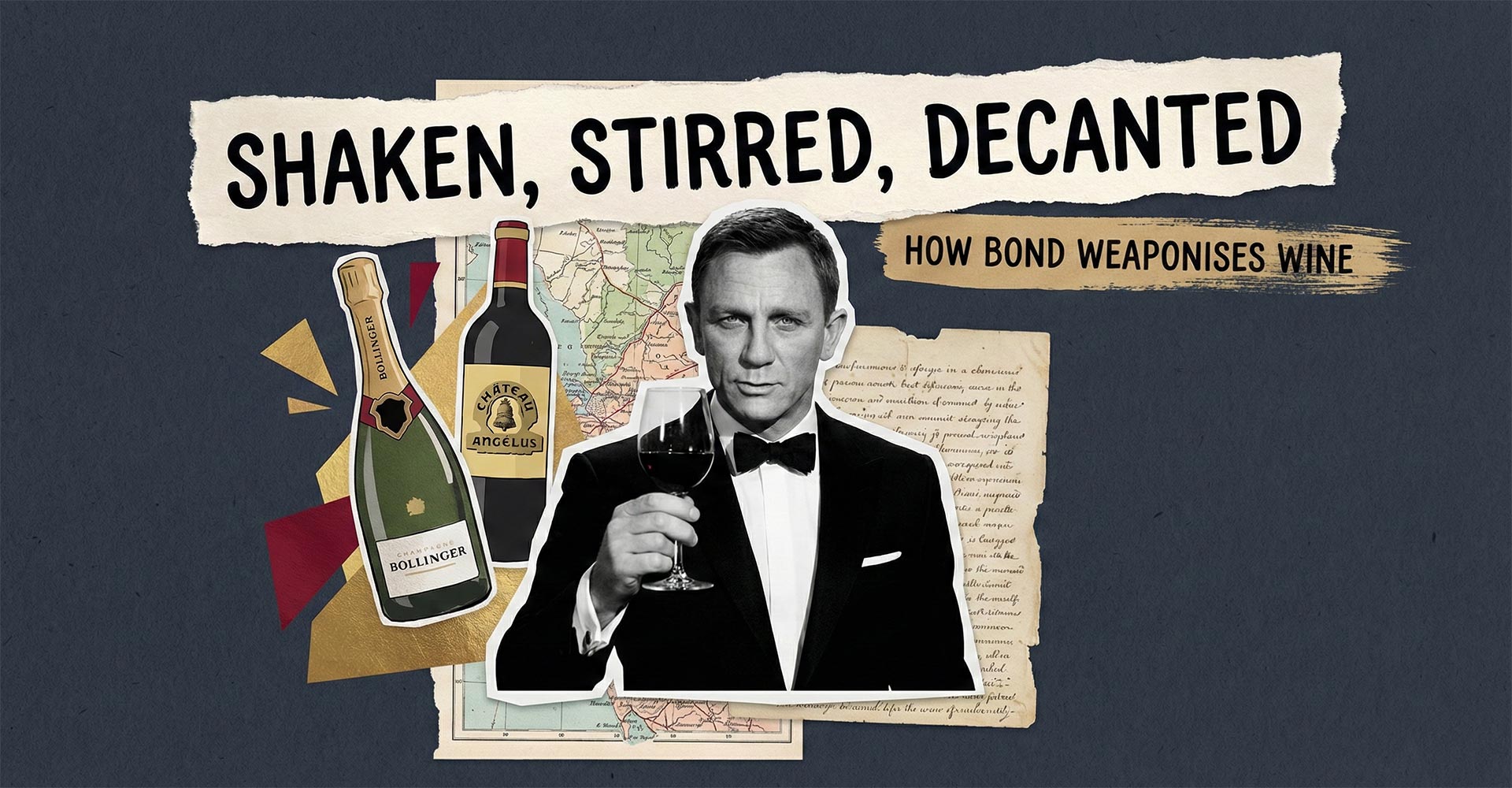
If James Bond ordered wine like the rest of us, he’d probably ask for “the good one” and hope for the best.
Instead, he names the vintage, questions the temperature, spots a fake waiter by his claret knowledge, and quietly judges you for pairing red wine with fish.
Bond doesn’t just drink wine.
He weaponises it.
Across 25 official Eon films, 007 has become cinema’s most influential wine curator. Not through flashy labels or drunken excess, but through precision, restraint, and narrative intent. Champagne and Bordeaux aren’t props. They’re character signals. And for wine brands paying attention, they’re also a masterclass in how brand partnerships should really work.
Wine as Character, Not Product Placement
Bond’s drinks are never accidental. They tell you who he is before he says a word.
From Ian Fleming’s wartime Taittinger obsession to Daniel Craig’s quiet devotion to Château Angélus, Bond’s cellar mirrors shifts in luxury culture, masculinity, and taste. This is why the franchise has outlasted trends, actors, and even the Cold War.
Where most product placement screams for attention, Bond’s wine choices whisper confidence.
And whispering, as it turns out, is far more persuasive.
The Literary Roots: Taittinger, Taste and Tastefulness
Bond’s palate was set long before the cameras rolled. In Casino Royale (1953), Fleming has Bond declare Taittinger Blanc de Blancs Brut 1943 “probably the finest Champagne in the world”.
That choice mattered.
This wasn’t about wealth. It was about discernment. A Chardonnay-led Champagne from a producer known for elegance, chosen during wartime scarcity. It positioned Bond as a man who noticed detail, not labels.
Then Fleming does something clever. By Moonraker (1955), Bond calls Taittinger “a fad” and switches to Dom Pérignon. That single line opens the door for evolution. Bond is allowed to change his mind. Brands are allowed to age in and out. The character stays credible because taste isn’t fixed. It’s learned.
Brand lesson:
Bond doesn’t endorse loyalty. He endorses judgement.
Connery’s Bond: Wine as Social Lie Detector
Sean Connery’s Bond uses wine the way others use guns. Calmly. Precisely. With intent.
In Dr. No (1962), Bond casually corrects the villain on Dom Pérignon vintages. In From Russia with Love (1963), he exposes Red Grant with one immortal line:
“Red wine with fish. That should have told me something.”
That moment isn’t snobbery. It’s a competence test. Bond doesn’t spot villains by violence. He spots them by mistakes.
By Diamonds Are Forever (1971), he’s identifying assassins via Château Mouton Rothschild 1955, a Pauillac masterpiece scoring well into the mid-90s. Bond doesn’t just know the wine. He knows how it should be served. And when it isn’t, someone dies shortly after.
Brand lesson:
Wine works best on screen when it signals intelligence, not indulgence.
The Bollinger Shift: How a Handshake Beat a Contract
The most important wine partnership in cinema history wasn’t signed in a boardroom. It was agreed over dinner.
In 1978, producer Cubby Broccoli and Bollinger’s Christian Bizot shook hands. No hard sell. No garish logo shots. Just shared values.
From Roger Moore onwards, Bollinger became Bond’s Champagne. Not because it paid the most, but because it fit the character.
Bollinger is Pinot Noir-led. Oxidative. Serious. Complex. A Champagne for people who know, not people who shout.
Bond often drinks Bollinger R.D., a wine aged far longer than most Champagnes, released only when ready. It’s a quiet flex. Exactly like Bond.
Brand lesson:
The strongest partnerships feel inevitable, not bought.
When Bond Jokes, Wine Still Tells the Truth
Even in Moore’s more playful era, wine remains a truth teller.
The fictional Thai sparkling “Phuyuck” in The Man with the Golden Gun is a joke, but it lands because Bond immediately returns to Dom Pérignon. Tradition matters. Standards matter.
Then comes For Your Eyes Only (1981), where Bond orders Theotoky Aspro from Corfu. A real wine. A real estate. A real nod to place.
No glamour shot. No explanation. Just quiet authenticity.
The Theotoky estate still proudly plays that clip today.
Brand lesson:
Authenticity ages better than exposure.
Brosnan to Craig: From Prestige to Personal Taste
By the Brosnan era, Bond is fully a luxury signal. Bollinger La Grande Année appears repeatedly, especially the legendary 1990 vintage. This is Bond at peak confidence.
But Daniel Craig changes the tone.
In Casino Royale (2006), Bond shares Château Angélus with Vesper Lynd. A Right Bank wine. Modern. Fashion-forward. Slightly controversial. The 1982 vintage chosen wasn’t even at its best.
That’s the point.
Craig’s Bond is still forming. Less polished. More emotional. By Spectre, he’s drinking the flawless 2005 Angélus, a 100-point wine. The arc is complete.
Wine becomes personal, not performative.
Brand lesson:
Long-term partnerships work when they evolve with the story, not freeze in time.
What Wine Brands Should Learn From Bond
This is where Bond stops being trivia and starts being strategy.
1. Integration Beats Interruption
Bond never “shows” the wine. He interacts with it. He comments on it. He judges people by it. That’s why it sticks.
2. Expertise Is Sexier Than Excess
No one remembers how many bottles Bond drinks. They remember which ones and why.
3. Let the Audience Feel Clever
Bond doesn’t explain the wine. He assumes you’ll either know or want to learn. That aspiration is gold.
4. Partnerships Should Feel Earned
Bollinger didn’t buy Bond. Bollinger became Bond.
Why This Matters Now
Modern wine marketing often shouts when it should whisper. It chases influencers instead of aligning with narratives that last decades.
Bond proves that taste travels further than hype.
For wine brands, the opportunity isn’t copying 007. It’s understanding him. Build partnerships where your wine doesn’t interrupt the story. Let it be the story.
Because if James Bond teaches us anything, it’s this:
The most powerful person in the room doesn’t need to say much.
He just needs to order well.
Wines Featured in the James Bond Films
|
Bond Actor |
Film |
Year |
Wine |
|---|---|---|---|
|
Sean Connery |
Dr. No |
1962 |
Dom Pérignon 1955 (Bond states preference for 1953) |
|
Sean Connery |
From Russia with Love |
1963 |
Taittinger Blanc de Blancs (implied 1943) |
|
Sean Connery |
From Russia with Love |
1963 |
Brolio Chianti Classico (ordered incorrectly with fish) |
|
Sean Connery |
Goldfinger |
1964 |
Dom Pérignon 1953 |
|
Sean Connery |
Thunderball |
1965 |
Dom Pérignon 1955 |
|
Sean Connery |
You Only Live Twice |
1967 |
Dom Pérignon 1959 |
|
George Lazenby |
On Her Majesty’s Secret Service |
1969 |
Dom Pérignon 1957 |
|
George Lazenby |
On Her Majesty’s Secret Service |
1969 |
Taittinger Blanc de Blancs |
|
Sean Connery |
Diamonds Are Forever |
1971 |
Château Mouton Rothschild 1955 |
|
Roger Moore |
Live and Let Die |
1973 |
Bollinger (vintage unspecified) |
|
Roger Moore |
Live and Let Die |
1973 |
Dom Pérignon 1955 |
|
Roger Moore |
The Man with the Golden Gun |
1974 |
Dom Pérignon 1964 |
|
Roger Moore |
The Man with the Golden Gun |
1974 |
“Phuyuck” (fictional Thai sparkling wine) |
|
Roger Moore |
The Spy Who Loved Me |
1977 |
Dom Pérignon 1952 |
|
Roger Moore |
Moonraker |
1979 |
Bollinger R.D. 1969 |
|
Roger Moore |
For Your Eyes Only |
1981 |
Theotoky Aspro (Corfu, Greece) |
|
Roger Moore |
Octopussy |
1983 |
Bollinger R.D. (vintage unspecified) |
|
Roger Moore |
A View to a Kill |
1985 |
Bollinger 1975 |
|
Timothy Dalton |
The Living Daylights |
1987 |
Bollinger R.D. 1975 |
|
Timothy Dalton |
Licence to Kill |
1989 |
Bollinger R.D. (vintage unspecified) |
|
Pierce Brosnan |
GoldenEye |
1995 |
Bollinger La Grande Année 1988 |
|
Pierce Brosnan |
Tomorrow Never Dies |
1997 |
Bollinger La Grande Année 1989 |
|
Pierce Brosnan |
The World Is Not Enough |
1999 |
Bollinger La Grande Année 1990 |
|
Pierce Brosnan |
Die Another Day |
2002 |
Bollinger La Grande Année 1995 |
|
Pierce Brosnan |
Die Another Day |
2002 |
Bollinger 1961 (requested) |
|
Daniel Craig |
Casino Royale |
2006 |
Château Angélus 1982 |
|
Daniel Craig |
Casino Royale |
2006 |
Bollinger La Grande Année 1990 |
|
Daniel Craig |
Quantum of Solace |
2008 |
Bollinger La Grande Année 1999 |
|
Daniel Craig |
Skyfall |
2012 |
Bollinger R.D. 1997 |
|
Daniel Craig |
Spectre |
2015 |
Château Angélus 2005 |
|
Daniel Craig |
Spectre |
2015 |
Bollinger R.D. 2002 |
|
Daniel Craig |
No Time to Die |
2021 |
Bollinger Special Cuvée |
|
Daniel Craig |
No Time to Die |
2021 |
Bollinger Millésimé 2011 (007 Limited Edition) |
|
Daniel Craig |
No Time to Die |
2021 |
Château Angélus (vintage unspecified) |