For centuries, wine has been a love story between nature and human patience. Sun, soil, rain, luck, and a bit of stubbornness. But today, that romance is under pressure.
I’ll be honest. When I first heard about CRISPR being used in vineyards, I wasn’t horrified. I was fascinated. It seemed logical. We live in a world where AI can write code, analyse genomes and accelerate drug discovery. Why wouldn’t that same precision thinking find its way into viticulture? If anything, I expect AI to speed up and refine these processes dramatically in the near future.
Climate change is speeding up ripening. Fungal diseases are thriving. Growers are spraying more than they’d like. And consumers want wines that are both premium and planet-friendly.
So here’s the question no one expected to ask over a glass of Barolo.
Can gene editing help save traditional wine?
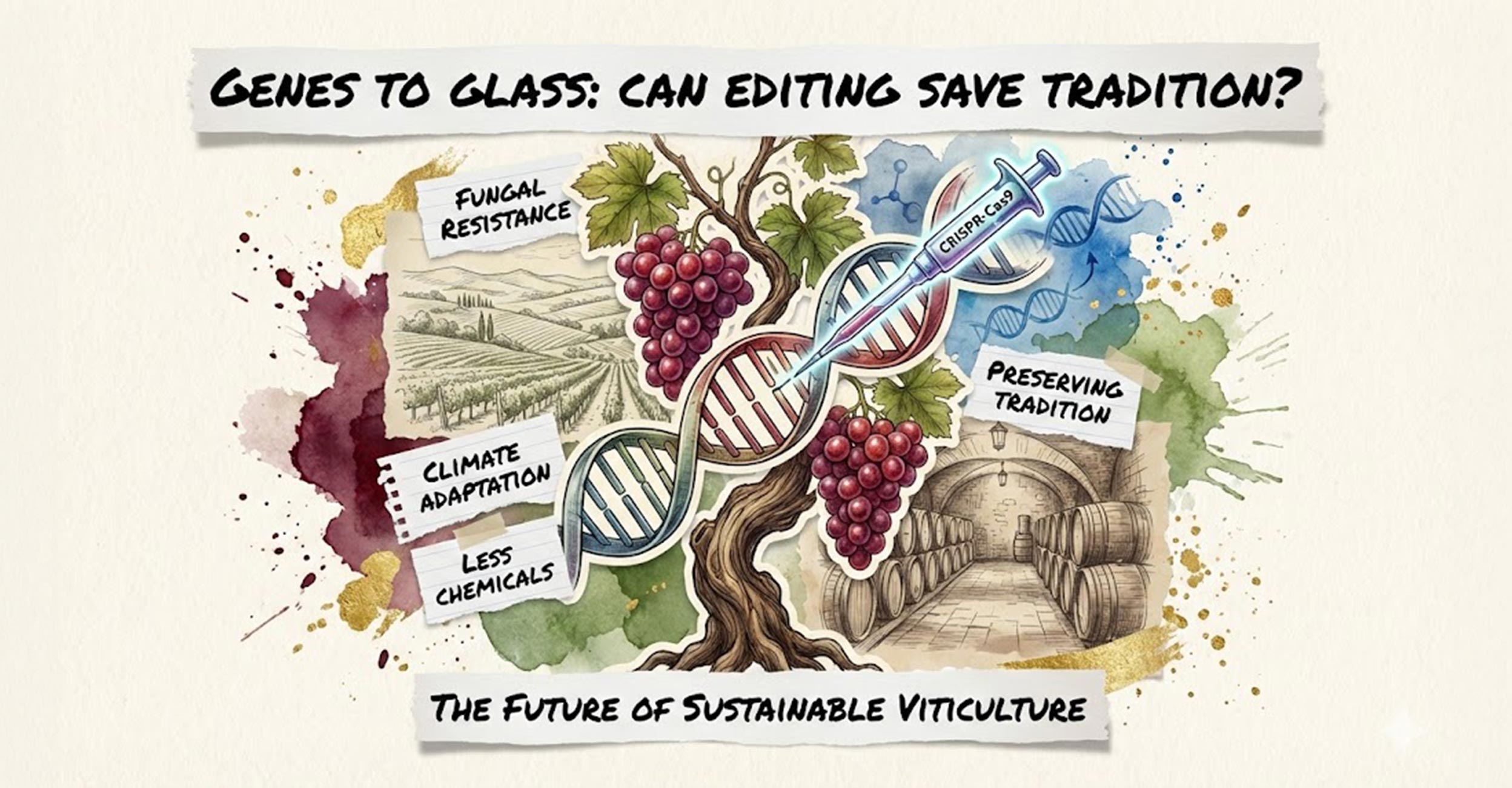
Welcome to the world of “Genes to Glass”.
Before we go further, a quick translation. CRISPR stands for Clustered Regularly Interspaced Short Palindromic Repeats. It refers to a natural defence system found in bacteria, now paired with the Cas9 enzyme, which acts like molecular scissors. Together, they allow scientists to make precise edits to specific genes without reshuffling the entire genome. That’s the geeky science part out of the way.
The Problem in the Vineyard
Vitis vinifera, the species behind the world’s most revered wines, is surprisingly fragile. Powdery mildew, downy mildew, and grey mould love grapevines almost as much as we do.
For decades, the main defence has been chemical fungicides. They work. But they come at a cost.
• Environmental impact
• Resistant pathogen strains
• Rising labour and fuel costs
• Growing consumer demand for cleaner, greener production
In some regions, vineyards can see 12 to 20 spray treatments a season. That’s a lot of tractor passes and a lot of chemistry.
Now imagine reducing that by 70 to 80 percent without changing the grape variety itself.
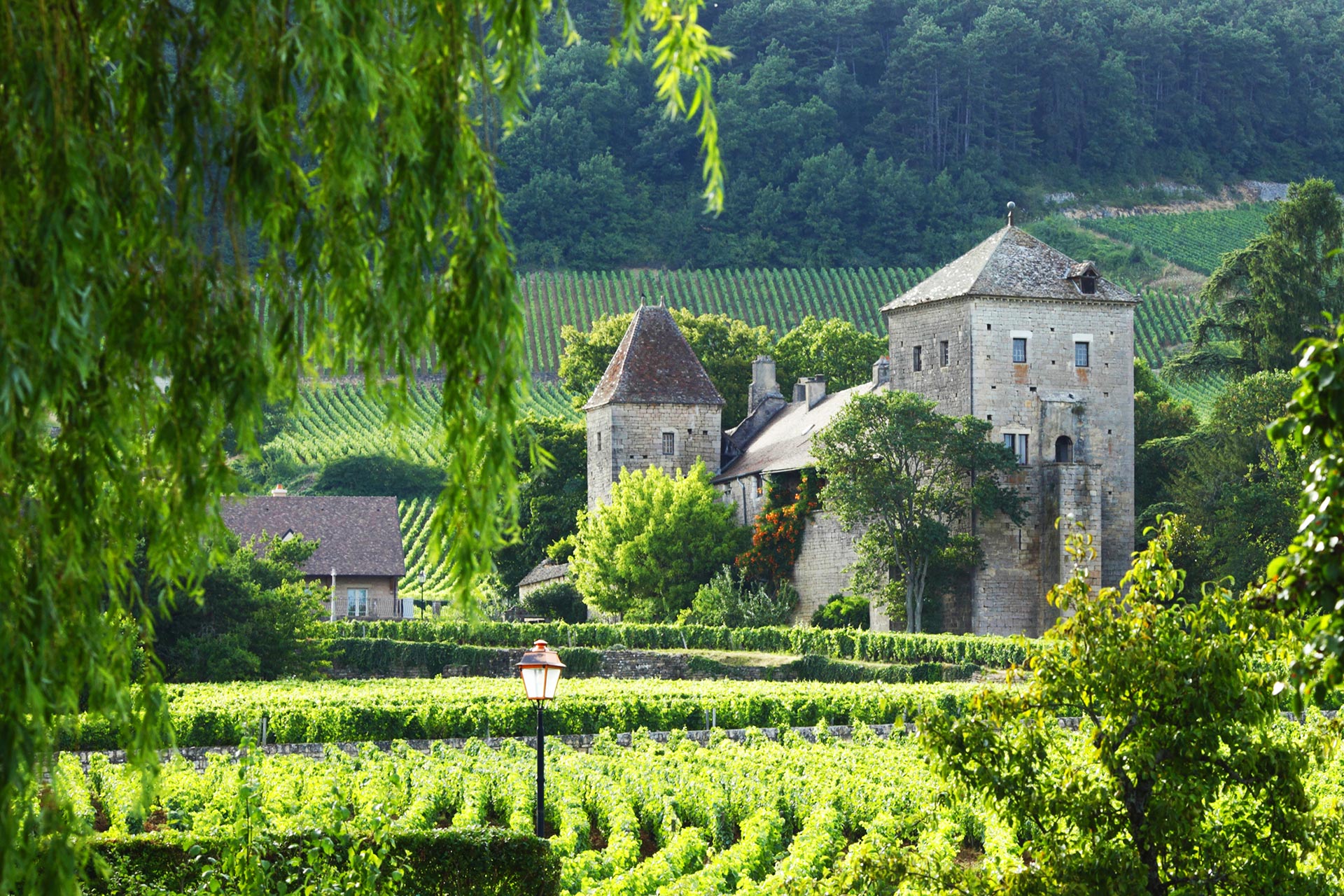
I remember standing on a rolling hill in Montalcino, looking across rows of beautiful Sangiovese vines. It should have been one of those perfect postcard moments. Instead, the conversation turned to how wet the season had been and how much more they’d needed to spray. More passes. More cost. More pressure. The romance of the landscape doesn’t always reveal what’s happening beneath the leaves.
That’s where CRISPR enters the conversation.
What CRISPR Actually Does
Let’s clear something up.
CRISPR is not about creating Frankenstein Merlot.
Unlike traditional breeding, which mixes entire genomes and can take 20 years or more, CRISPR allows scientists to make highly targeted edits to specific genes that already exist within the vine.
Think of it less like crossbreeding two dogs and more like quietly removing a faulty switch from the electrical system.
In grapevines, researchers are targeting what are known as susceptibility genes. These are the genetic “doorways” that pathogens use to infect the plant. Close the doorway, and the fungus struggles to get in.
One of the main targets is the MLO gene family, which plays a key role in powdery mildew infection. Knock out that pathway, and the vine becomes dramatically more resistant.
And crucially, the wine remains Chardonnay. Or Merlot. Or Nebbiolo.
Same identity. Fewer sprays.
Powdery Mildew: The First Big Win
Powdery mildew is the most economically damaging fungal disease in viticulture.
CRISPR editing of MLO genes has already shown strong resistance in controlled trials. Field trials are underway in Italy, France and the United States.
In some edited lines, resistance was linked to natural plant defence responses such as cell wall strengthening and localised oxidative bursts. In simple terms, the vine fights back faster and more effectively.
Researchers have successfully edited varieties like Chardonnay and Glera, the grape behind Prosecco. Even Merlot, which is chemically complex and notoriously tricky in tissue culture, has now been edited using more refined delivery systems.
That’s significant. Because premium black varieties are the ones no one wants to compromise.
Downy Mildew and Grey Mould: More Complex, Still Promising
Downy mildew and Botrytis are trickier opponents. They involve multiple genetic pathways and different infection strategies.
Researchers are exploring edits to immune signalling regulators and transcription factors that help the vine mount broader defence responses. Some edits improve resilience to both powdery and downy mildew simultaneously.
Botrytis presents an interesting twist. It is both villain and hero. Harmful grey rot ruins crops. Noble rot creates Sauternes.
Any editing strategy has to be subtle. The goal is resilience, not the elimination of complexity.
This is precision work, not a genetic sledgehammer.
Climate Change: The Bigger Threat
Disease pressure is only half the story.
Rising temperatures are accelerating ripening. Grapes are reaching high sugar levels before phenolic maturity. Alcohol rises. Acidity drops. Balance suffers.
In some projections, parts of Southern Europe could become unsuitable for classic Vitis vinifera production if temperatures rise beyond 2 degrees.
CRISPR is now being explored as a way to fine-tune ripening dynamics.
By adjusting sugar transport or stress response pathways, scientists aim to slow sugar accumulation while preserving aromatic and phenolic development.
Imagine maintaining freshness in a warming climate without abandoning traditional varieties.
That’s not science fiction. It’s active research.
The Economic Case Is Hard to Ignore
Fungus-resistant cultivars already show dramatic reductions in spray treatments.
Instead of 12 to 20 treatments per season, resistant lines may require only 2 to 4.
That means:
• Lower labour costs
• Fewer tractor passes
• Reduced copper and sulphur input
• Smaller carbon footprint
• Healthier soils and biodiversity
For growers under pressure from both regulation and climate volatility, that stability is not just attractive. It’s survival.
But What About the Wine?
This is the question that matters most.
Will it still taste like Barolo? Like Chianti? Like Left Bank Bordeaux?
For me, Bordeaux is the emotional benchmark. Weather patterns there have been increasingly volatile, and I’d hate to think there isn’t a viable solution to protect those wines. If careful gene editing means I can still open a beautifully structured Left Bank claret in 30 years’ time, with balance intact and alcohol in check, that’s a conversation worth having.
The core argument for CRISPR in viticulture is that it preserves clonal identity. There is no wholesale genomic reshuffling as with traditional hybridisation.
The bouquet, tannin structure, and regional expression remain intact.
Researchers are also monitoring phenolic compounds (natural compounds that influence colour, flavour, structure and ageing) carefully, especially in black varieties where resveratrol and tannins define structure and ageing potential.
The goal is not to redesign wine. It is to protect it.
And if I’m forced to choose? I’d rather drink an edited wine that requires far fewer chemical interventions than one that clings to tradition while being sprayed 18 times a season. For me, that feels like less external interference, not more.
Regulation and Reality
The legal landscape is shifting.
The European Union is moving towards a framework that distinguishes between traditional GMOs and New Genomic Techniques. If an edit mirrors what could occur naturally or through conventional breeding, it may be regulated more lightly.
The United States already takes a relatively permissive approach if no foreign DNA is present.
The bigger hurdle may not be science or law.
It may be perception.
Will Consumers Accept It?
Recent surveys suggest attitudes are softening. When consumers understand that gene editing can reduce fungicide use and protect environmental sustainability, acceptance rises significantly.
Trust matters. Public research institutions carry more weight than corporate narratives.
Framing matters too.
If CRISPR is presented as a tool to preserve heritage and terroir rather than industrialise wine, resistance drops.
In other words, the story we tell will matter almost as much as the science itself.
Genes to Glass, Not Lab to Factory
Wine has always evolved.
We moved from amphora to oak barrels. From wild fermentation to selected yeasts. From horse ploughs to GPS-guided tractors.
CRISPR may simply be the next tool in that long arc of adaptation.
Not to replace tradition.
But to give it a fighting chance in a rapidly changing world.
If the choice is between losing classic regions to climate stress or carefully editing susceptibility genes to reduce chemicals and preserve identity, the conversation deserves nuance.
Because ultimately, what’s at stake is not just vineyard efficiency.
It’s whether future generations will still recognise the glass in their hand.
And that, for anyone who loves wine, is worth discussing.