How Artificial Intelligence Is Rewriting the Rules of Wine
For thousands of years, wine has been about soil, sun, skill and a bit of luck.
Then along came artificial intelligence.
The global wine industry, steeped in tradition and fiercely protective of its terroir, is now navigating a quiet technological revolution. And it’s not just about shiny gadgets in cellars. AI has moved from being a geeky side project to sitting right at the heart of serious winery strategy.
Let’s talk numbers for a moment.
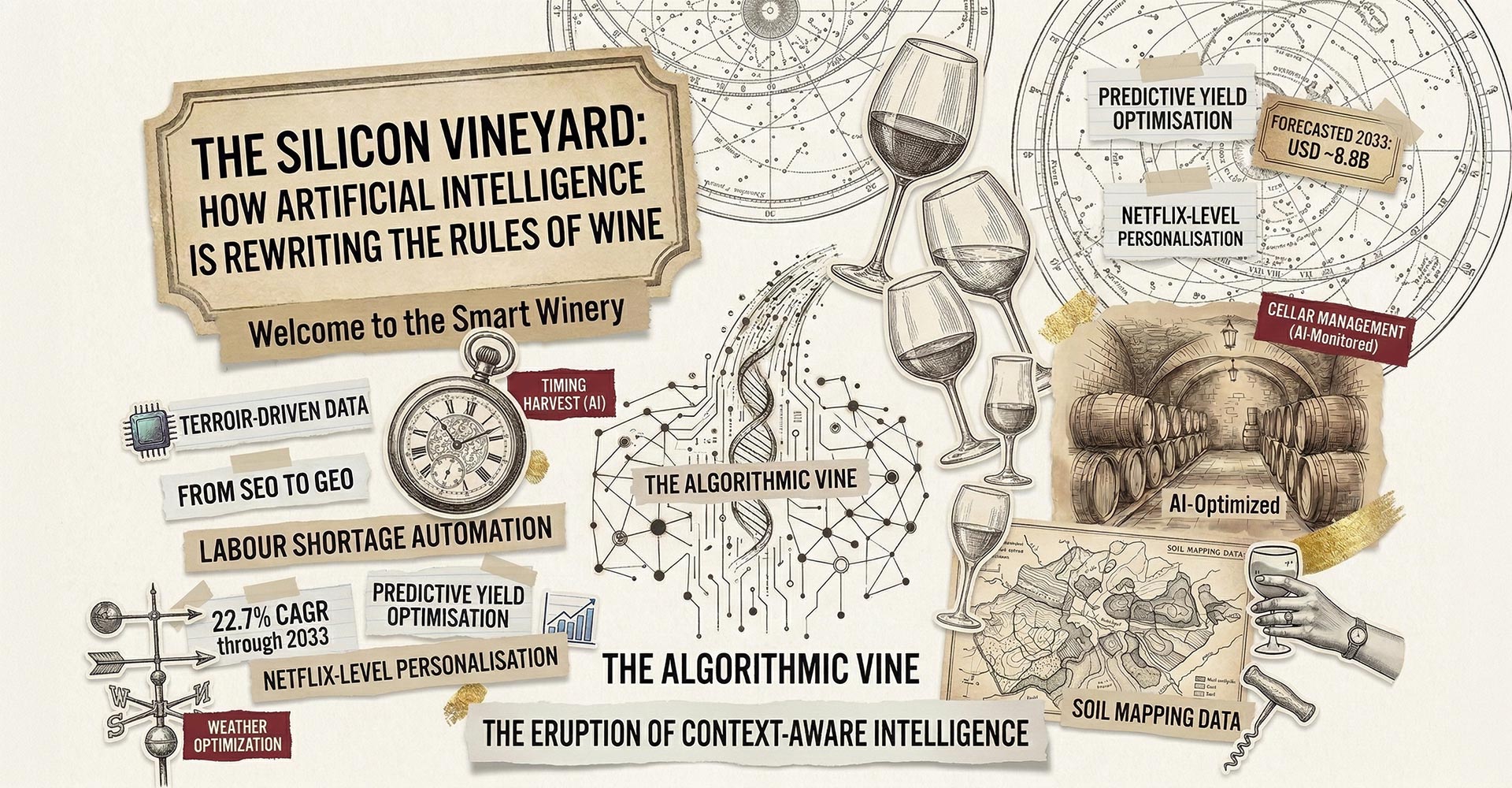
As of 2024, the global market for AI-driven wine recommendations reached USD 1.14 billion. It’s forecast to grow at a compound annual growth rate of 22.7% through to 2033. By then, the market is expected to reach around USD 8.8 billion.
That’s not a rounding error. That’s a structural shift.
This isn’t simply more investment flowing into technology. It’s the industry responding to some very real pressures: climate volatility, labour shortages, rising production costs, and a generation of consumers who expect Netflix-level personalisation when choosing a bottle of Rioja.
Welcome to the Smart Winery.
From Gut Feel to Data Streams
Wine has always had an intuitive side. Walk the vineyard. Taste the berries. Read the sky.
Now add satellite imagery, predictive weather modelling, soil sensors and AI analysing fermentation in real time.
The shift is profound.
Instead of reacting to problems, wineries are beginning to predict them. Instead of relying purely on experience, they’re combining it with data. Digital twins of fermentation tanks can simulate outcomes before a grape is even crushed. Robotic vineyard tools help manage precision tasks. AI-powered sensory analysis is increasingly used to help maintain consistency across vintages.
It’s not about replacing the winemaker.
It’s about giving them better tools.
And frankly, in an era of unpredictable weather and tighter margins, that’s not a luxury. It’s becoming essential.
Climate, Costs and Complexity
Why is this happening now?
Because the industry is facing a perfect storm of challenges.
Climate-induced weather extremes are no longer theoretical. Recent vintages tell the story clearly. Bordeaux suffered devastating spring frosts in 2017 and again in 2021, wiping out significant portions of the crop. Meanwhile, regions in Spain and California have faced repeated heatwaves that accelerate ripening and compress harvest windows.
Frosts where there weren’t frosts. Heat spikes at harvest. Rain at exactly the wrong moment.
AI models can’t control the weather, but they can help vineyards anticipate these risks and respond with far greater precision.
Labour shortages are also biting hard across agricultural sectors. Robotics and automated vineyard tools are beginning to fill some of these gaps without compromising quality.
Production costs continue to rise as well. Smarter forecasting, yield optimisation and waste reduction can make a real difference to winery margins.
And then there’s the consumer.
Today’s wine buyer doesn’t simply walk into a shop and browse. They scroll. They search. They compare. And increasingly, they expect recommendations tailored to their palate, price range and preferences.
That’s where AI-powered recommendation engines come in.
Platforms such as Vivino, Wine-Searcher, Amazon and specialist wine AI companies like Preferabli analyse vast datasets to suggest bottles that match individual taste profiles. They examine purchase histories, flavour profiles, ratings and behavioural data to deliver surprisingly accurate suggestions.
I have to admit I’m a big fan of Vivino myself and use it regularly to track wines and discover new bottles.
The result is wine discovery that can feel almost psychic.
Creepy? Maybe slightly.
Effective? Absolutely.
Market Dynamics: Where It’s Taking Off
North America and Europe are currently leading the charge.
According to industry analysis from organisations such as the International Organisation of Vine and Wine (OIV), along with consulting insights from firms like McKinsey on digital transformation in agriculture, mature wine markets with strong e-commerce infrastructure tend to adopt data-driven tools faster than most regions.
This trend is also highlighted in the WineGuide101 2026 Trends Report, which points to the growing influence of AI-driven discovery and digital wine commerce across established wine markets.
But keep an eye on Asia-Pacific.
Rising disposable incomes and a growing interest in premium wines are fuelling serious momentum. Combine that with a highly tech-savvy population and you have a region that may well leapfrog others in AI-driven wine retail and discovery.
In short, this isn’t a Western-only story.
It’s global.
Tradition vs Technology
Now here’s the question that makes some winemakers shift uncomfortably in their chairs.
Does AI dilute the romance of wine?
As someone who has spent more than two decades exploring wines and sharing discoveries through WineGuide101, I see technology as another tool in the winemaker’s kit rather than a threat to tradition.
In fact, I’d argue the opposite.
Wine has always been a blend of art and science. We romanticise the art and quietly rely on the science. AI is simply the next step in that scientific evolution.
Terroir still matters. Craft still matters. Human judgement still matters.
But ignoring technology in the face of climate change and shifting consumer behaviour isn’t romantic. It’s risky.
The future vineyard isn’t a cold, robotic factory. It’s a connected ecosystem where data and human intuition work together.
The Silicon Vineyard doesn’t replace the soul of wine.
If anything, it may help protect it.
And if it also helps you discover your next favourite bottle with uncanny accuracy, well, I’m not complaining.
Cheers to that. 🍷