AI IN WINE MARKET DECISION-MAKING
The integration of artificial intelligence in the wine industry to enhance decision-making, market analysis, and consumer confidence without replacing human expertise.
- Supports data-driven pricing, demand forecasting, and inventory management.
- Enhances consumer confidence by reducing uncertainty in wine selection.
- Facilitates global market analysis and identification of pricing opportunities.
- Transforms wine collecting into strategic portfolio management while preserving the drinking experience.
I recently had the privilege of joining Cult Wines on their podcast, which gave me a rare opportunity to bring together two worlds I’ve spent years immersed in. Wine and AI. On the face of it, they shouldn’t really work together, but that’s exactly why they do. One is built on tradition, heritage, and stories that stretch back centuries. The other moves at a pace that makes last week feel like history. And yet, the more time you spend with both, the more obvious it becomes that they’re not in conflict at all. In fact, they complement each other rather well.
A Market Reset and a Shift in Behaviour
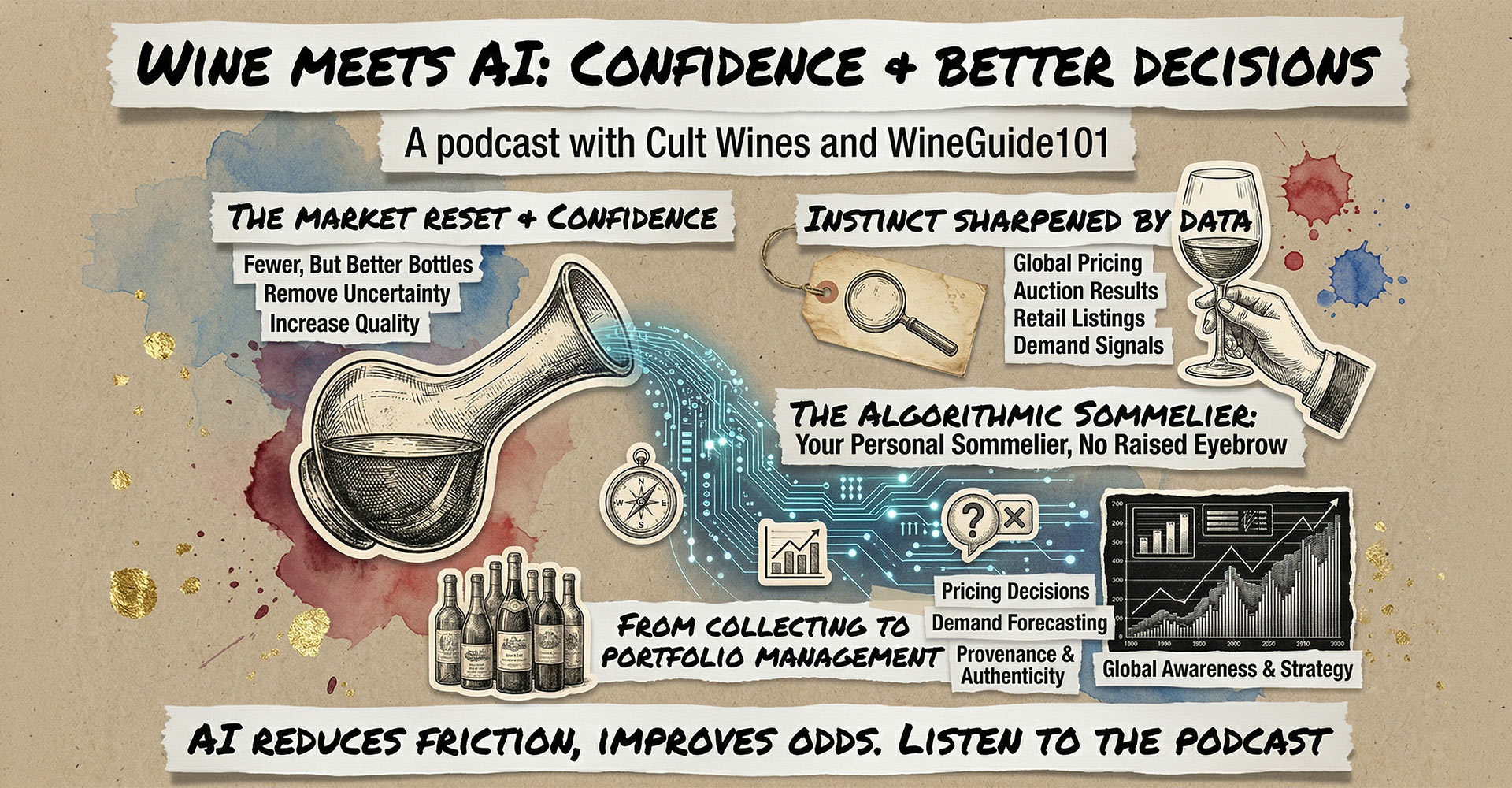
One of the key themes we explored was the state of the wine market. There’s a temptation to talk about recovery, but that’s not quite right. What we’re actually seeing is a reset. After a period of overproduction and softer demand, the market is becoming more disciplined and, importantly, more rational. The premium end is holding up far better than the entry level, and there’s a growing sense that decisions are being made with more thought and better information. That shift towards a more data-aware market is exactly where AI starts to play a meaningful role.
At the same time, consumer behaviour is changing. People are drinking less, but they want each bottle to matter more. That “fewer but better” mindset is reshaping buying decisions, and when someone feels sure they’re making a good choice, they’re far more comfortable spending a bit more. Remove the uncertainty, and you often increase the quality of what ends up in the glass. This is where AI quietly earns its place. People are drinking less, but they want each bottle to matter more. That “fewer but better” mindset is reshaping buying decisions, and when someone feels sure they’re making a good choice, they’re far more comfortable spending a bit more. Remove the uncertainty, and you often increase the quality of what ends up in the glass. This is where AI quietly earns its place. People are drinking less, but they want each bottle to matter more. That “fewer but better” mindset is reshaping buying decisions. Confidence has become the key driver. When someone feels sure they’re making a good choice, they’re far more comfortable spending a bit more. Remove the uncertainty, and you often increase the quality of what ends up in the glass. This is where AI quietly earns its place.
One of the lines I used on the podcast was that AI is essentially your personal sommelier in your pocket, without the raised eyebrow or the bill at the end. Not in a way that replaces expertise or experience, but in a way that removes the friction before the purchase. It helps you navigate choice. It can analyse preferences, compare prices globally, surface wines you might never have discovered, and even highlight where demand is starting to build before it becomes obvious. It gives you a far better starting point, but the final decision remains entirely human.
For me personally, instinct is still at the core of how I approach wine, and that hasn’t changed. Having spent over two decades exploring fine wine and building WineGuide101 into a community of engaged enthusiasts, that instinct has been shaped by experience as much as curiosity. That hasn’t changed. What has changed is the quality of information supporting that instinct. Data now sharpens judgement and, at times, challenges it. I can look across global pricing, auction results, retail listings, and demand signals in a matter of moments. What used to take time, effort, and a fair bit of guesswork is now far more immediate and far more reliable. It doesn’t remove the art of decision-making, but it certainly improves the odds of getting it right.
From Collecting Bottles to Managing Portfolios
There’s also a broader shift taking place in how people think about wine. We’re moving, slowly but noticeably, from collecting bottles to managing portfolios. That might sound a little clinical, but it doesn’t strip away the enjoyment. If anything, it enhances it. AI handles the complexity in the background, leaving the experience of wine untouched. Collectors are becoming more informed, more globally aware, and more strategic, not because they have to be, but because the tools now allow them to be.
Where AI is having the biggest impact, particularly for businesses, is often behind the scenes. It’s in pricing decisions, demand forecasting, inventory management, and customer targeting. These aren’t the glamorous parts of the industry, but they are the parts that determine profitability and long-term sustainability. AI is also playing a growing role in trust, helping with provenance, identifying anomalies, and reducing risk in fine wine markets where authenticity matters enormously.
A question that often comes up is whether AI risks removing the romance from wine. The answer, quite simply, is no. AI doesn’t touch the experience of drinking wine. It doesn’t replace the story, the occasion, or the emotion. What it does is improve the journey leading up to that moment. It helps people make better choices with greater confidence, and that tends to result in better bottles being opened.
If there’s one key takeaway from the conversation, it’s this. The biggest shift isn’t the technology itself. It’s what happens when people feel more confident in their decisions. That change in confidence alters behaviour, and when behaviour changes at scale, markets follow. That’s exactly what we’re starting to see in wine.
A Practical AI Prompt Example (For Wine Businesses)
If you’re wondering what this actually looks like in practice, here’s a simple example of how AI can be used to support better decision-making in a wine business.
Prompt:
“Using available market data such as Liv-ex indices, auction results, retail listings, and search demand signals, analyse fine wine pricing trends across Bordeaux, Burgundy, Tuscany, and Napa. Identify undervalued wines, overvalued wines, and short-term opportunities over the next 3–6 months. Highlight key drivers influencing price movement.”
Typical outcome: a clear view of where pricing is misaligned, which regions are gaining momentum, and where short-term opportunities are emerging.
What comes back is not guesswork. It’s a structured market view that helps you spot patterns, pricing gaps, and opportunities much faster than traditional methods.
This is where AI becomes commercially useful. Not theoretical, but practical.
Listen to the Podcast
If you’d like to hear the full conversation with Cult Wines, it’s well worth a listen, especially if you want a clearer view of where the wine market is heading and how AI is already shaping buying and investment decisions. We go deeper into the market dynamics, the role of AI in collecting and investing, and where this is all heading next.
And if you’re in the wine trade, this isn’t something to watch from the sidelines. AI isn’t a gimmick or a passing trend. It’s a practical tool that can help you make better decisions, improve margins, and create stronger customer experiences. I’d be very happy to talk to any wine businesses looking to understand how this fits into their world.
Because the future isn’t AI versus wine. It’s the two working together. And when that balance is right, it’s incredibly powerful.