Let’s be honest. For centuries, winemaking has been a mix of instinct, tradition, and the occasional glance at the sky followed by a hopeful shrug.
Now? The vines are talking back. And they’ve brought data.
The global wine industry is going through its biggest shift since mechanical harvesters arrived and quietly offended half of Bordeaux. This time, it’s not about replacing hands with machines. It’s about turning the entire vineyard into a living, breathing data system.
Welcome to the age of intelligent viticulture.
I’ve spent over 30 years working in digital and marketing, and more recently helping businesses apply AI in practical ways. Watching it move into wine is one of the most interesting shifts I’ve seen, because it’s not replacing tradition. It’s sharpening it.
From Gut Feel to Gigabytes
At the heart of this shift is a simple idea. Stop treating vineyards as one big field and start treating every vine as an individual.
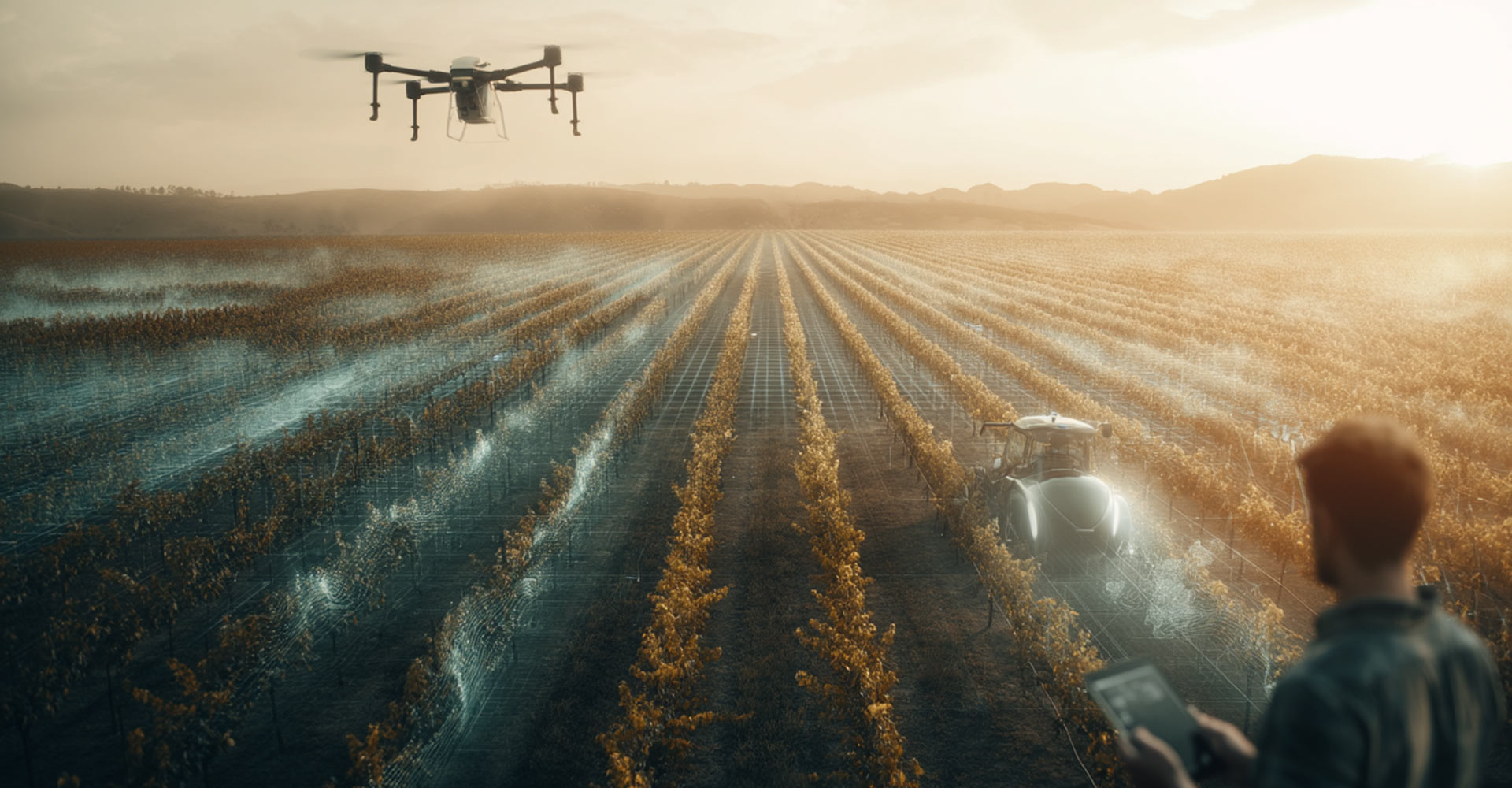
AI, satellites, drones, and sensors now work together to create what’s essentially a “digital twin” of the vineyard. Think of it as a constantly updated map of what’s happening in every row, every metre, every leaf.
Where growers once relied on experience and educated guesswork, they now have real-time insight into vine health, soil moisture, and even early signs of disease.
And yes, it’s as powerful as it sounds.
Eyes in the Sky, Boots on the Ground
(And yes, there are real players behind all this.)
On the satellite side, platforms like Deep Planet (VineSignal), OneSoil, and Farmonaut are leading the charge. Drones and aerial imaging are typically handled by specialists such as VineView and UAV-IQ. On the ground, sensor systems from Arable, Tule (now part of CropX), and Lumo provide the real-time vineyard data that feeds everything else.
AI-driven scouting and analytics platforms, including AgScout, Atlas Vineyard Management, and UC Davis’ Leaf Monitor, bring it all together into something a grower can actually use.
Eyes in the Sky, Boots on the Ground
Satellite imagery gives growers the big picture. It tracks vine vigour, soil moisture, and stress levels across entire estates.
But the real magic happens when you zoom in.
Drones can spot issues invisible to the human eye. Subtle changes in light reflectance can reveal nitrogen deficiencies or early disease, long before leaves start looking sorry for themselves.
On the ground, sensors measure everything from microclimate to water loss. Not estimates. Actual numbers. In real time.
It’s like giving the vineyard a nervous system.
AI: The Brain Behind the Bottle
All this data would be useless without something to make sense of it. That’s where AI steps in.
Modern systems can now identify vine diseases with accuracy that rivals, and sometimes beats, experienced agronomists. They don’t get tired. They don’t miss things. And they don’t need a coffee break.
More importantly, they predict.
Instead of reacting to problems, growers can act before they happen. Disease outbreaks, water stress, uneven ripening. All flagged early, often before any visible sign appears.
Which is exactly where the value lies.
The Digital Twin Vineyard: From Observation to Simulation
This is where things move from clever to genuinely transformative.
A “digital twin vineyard” isn’t a buzzword. It’s a working model of your vineyard that updates constantly, combining satellite data, drone imagery, soil sensors, and AI into a single, living system.
In practical terms, it means every vine, or at least every micro-block, has a digital counterpart that reflects its current condition. Not last week. Not yesterday. Now.
But the real value isn’t just seeing what’s happening. It’s testing what could happen next.
With a well-built digital twin, growers can:
- Predict yield based on cluster development and historical patterns
- Model irrigation strategies before turning on a single valve
- Anticipate water stress days in advance
- Identify underperforming zones early in the season
- Forecast disease risk windows based on microclimate behaviour
In other words, it shifts vineyard management from reaction to simulation.
Instead of asking, “What’s wrong here?” you start asking, “What happens if we change this?”
Platforms like AgScout are already pushing in this direction, capturing millions of plant-level data points throughout the season. Others, like Deep Planet, are building block-level intelligence that, while not always labelled as a digital twin, behaves very much like one.
That said, we’re not quite at the fully seamless version yet.
Most vineyards today are running partial twins. Data is still fragmented across platforms, and integration can be clunky. One system tracks water, another tracks vigour, another handles operations.
The direction of travel is clear though. Everything is moving towards a unified model where data flows together and decisions become faster, sharper, and far less reliant on guesswork.
And here’s the important bit.
This doesn’t replace the winemaker. It sharpens them.
A digital twin won’t tell you what style of wine to make. It won’t decide when something feels right. But it will give you a level of clarity that used to take years, sometimes decades, to build.
It turns instinct into informed instinct.
A Real-World Snapshot: The Digital Twin in Action
Take a mid-sized Napa Valley estate, not unlike those already experimenting with platforms like AgScout and Deep Planet.
Early in the season, satellite data flags a slight variation in vigour across one block. Nothing dramatic. The sort of thing that, historically, might have been put down to “just one of those patches.”
The digital twin tells a different story.
Drone imagery zooms in and reveals subtle chlorophyll variation. Ground sensors confirm slightly lower soil moisture at depth. The AI model connects the dots and predicts that, left alone, this section will ripen faster but with lower phenolic balance.
Now the grower has options.
They simulate two irrigation strategies inside the system. One increases water slightly to stabilise growth. The other introduces controlled stress to concentrate flavour, but with a risk of uneven ripening.
Instead of guessing, they choose deliberately.
They adjust irrigation only in that micro-zone. No blanket changes. No overcorrection.
A few weeks later, the same system flags that part of the block has reached optimal ripeness ahead of the rest. Rather than harvesting the entire area in one go, they split-pick.
The result?
Better balance. More consistent fruit. And a wine that reflects precision rather than compromise.
Nothing about this replaces the winemaker’s judgement. It simply gives them a clearer view of what’s actually happening, and what’s likely to happen next.
Which, in a world of unpredictable weather and rising costs, is a very useful edge to have.
Water, Chemicals, and the End of Guesswork
If there’s one area where AI is quietly changing everything, it’s resource management.
Water use can drop by as much as 30 percent when irrigation is guided by real-time plant stress rather than habit. Fertiliser use becomes targeted instead of blanket. Chemical spraying becomes precise instead of generous.
Some vineyards are cutting chemical use by up to 90 percent using “see and spray” systems that only treat affected vines.
Better for the environment. Better for the wine. And, not insignificantly, better for the bottom line.
The Rise of the Robot Vineyard
Labour shortages have nudged another shift. Automation.
Autonomous tractors, robotic weeders, and AI-driven sprayers are moving from novelty to necessity.
They’re not perfect. Some struggle on steep terrain, and not every vineyard looks like a Californian postcard. But where conditions allow, they’re already proving their worth.
Long shifts, consistent performance, and a steady stream of data back to the grower.
No complaints. No sick days. No arguments about playlist choices.
Quality: Where It Really Gets Interesting
Here’s the part that tends to get overlooked.
AI isn’t just about saving money. It’s about making better wine.
By identifying exactly when and where grapes reach peak ripeness, growers can harvest more precisely. No more averaging across a block. No more compromising quality for convenience.
Some estates are even using AI to redesign vineyards, adjusting row orientation to protect grapes from excessive heat.
That’s not optimisation. That’s evolution.
The Catch: It’s Not Plug and Play
Of course, it’s not all smooth sailing.
The biggest challenge isn’t the technology. It’s the data.
In practice, the biggest challenge I see isn’t collecting information. It’s turning that volume into something a vineyard team can actually act on without slowing everything down.
Too much of it, in fact.
A single drone flight can produce tens of gigabytes of information. Without the right systems, that’s less insight and more headache.
Connectivity can also be an issue. Not every vineyard has perfect signal, which makes edge computing, processing data locally, increasingly important.
And then there’s the human factor.
Because despite all this clever technology, the winemaker still matters. A lot.
AI can tell you what’s happening. It can even suggest what to do next. But it can’t taste the wine. It can’t define style. And it definitely can’t replace intuition built over decades.
So, What Does the Future Look Like?
By 2032, the most successful vineyards won’t be choosing between tradition and technology.
From what I’m seeing, the vineyards that will thrive over the next decade won’t be the ones choosing between tradition and technology.
They’ll be blending both.
Satellites for the overview. Drones for the detail. Sensors for precision. AI for prediction. And humans for judgement.
Because at the end of the day, wine is still about balance.
Now we just have better tools to achieve it.
And if that means your next bottle was helped along by a satellite, a robot, and an algorithm… well, as long as it tastes good, who’s complaining?
Who’s Leading This Space
If you’re wondering who’s actually building all this, here are a few of the key players shaping modern, AI-driven viticulture:
- Deep Planet (VineSignal) – https://www.deepplanet.ai
- AgScout (Scout) – https://www.agscout.ai
- Arable – https://www.arable.com
- CropX (inc. Tule) – https://www.cropx.com
- VineView – https://www.vineview.com
- Vintrace – https://www.vintrace.com
- UC Davis (Leaf Monitor) – https://wineserver.ucdavis.edu
This isn’t a complete list, and the space is evolving quickly. But these are the names consistently pushing things forward.
Damon Segal is a digital strategist and founder of Emotio, with over 30 years of experience in marketing and AI. He shares his wine journey at WineGuide101, where technology meets taste.