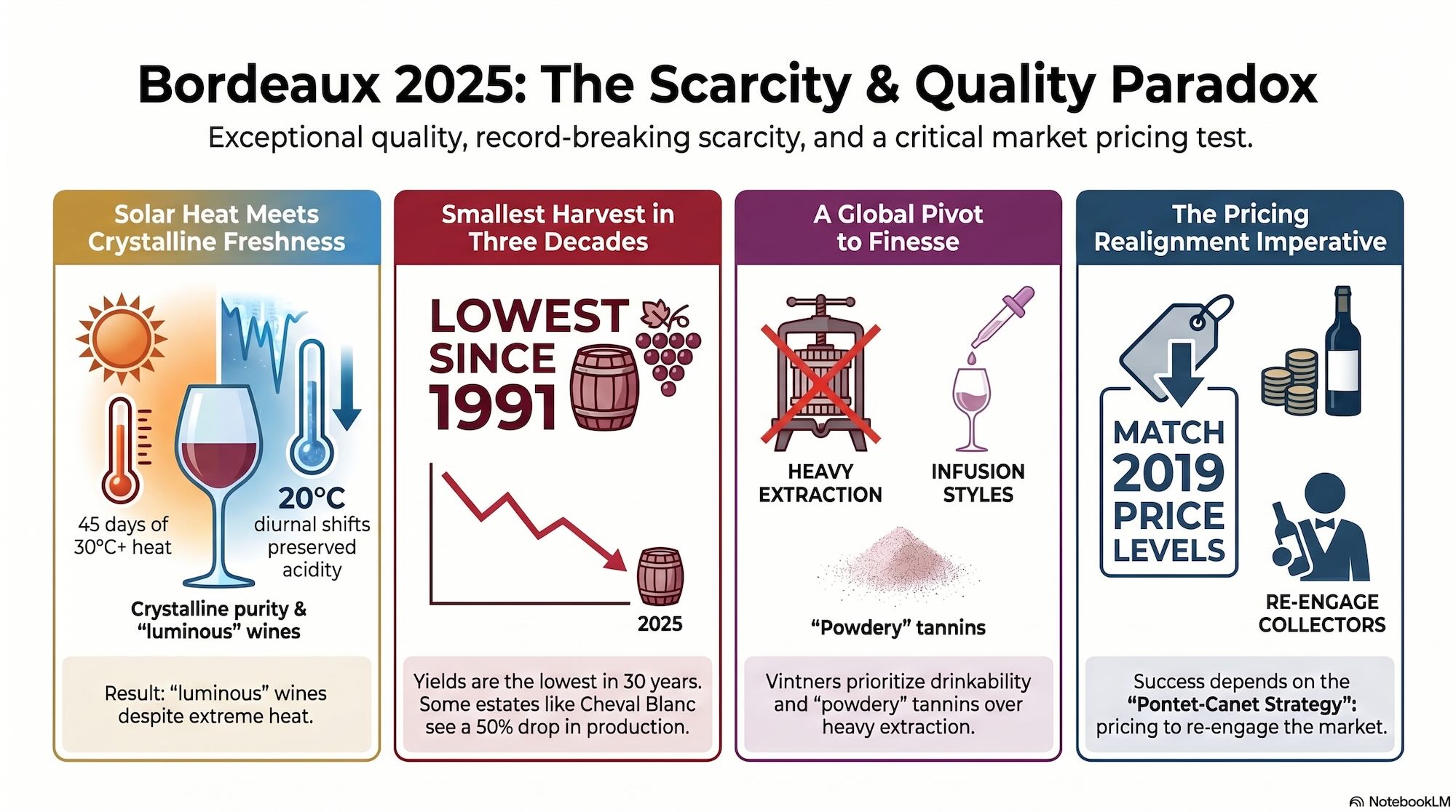
Bordeaux 2025 is a high-quality but high-stakes En Primeur vintage. Based on En Primeur tastings, producer reports, market data, and recent conversations with winemakers in Bordeaux, the wines show freshness, balance, and precision despite extreme heat and drought, driven by cool nights and a perfectly timed August rain. However, with historically low yields and a cautious global market, the success of the campaign depends less on what’s in the glass and more on pricing discipline. In short: outstanding wines, but buyers are no longer playing along unless the numbers make sense.
A Vintage That Shouldn’t Work… But Does
On paper, Bordeaux 2025 sounds like trouble, with record heat, relentless drought, and vines pushed to the brink.
Yet somehow, the wines are… elegant.
Not jammy. Not heavy. Not the usual “sunburn in a glass” you’d expect from a year like this. Instead, we’re seeing freshness, clarity, and balance. Almost annoyingly so.
The secret? Cool nights. Lots of them.
Having followed Bordeaux vintages for over two decades, this is one of the few years where the narrative and the glass completely diverge.
That diurnal shift kept acidity intact and alcohol in check, giving us wines that feel more like a well-composed symphony than a heavy metal concert.
The Moment That Saved the Vintage
Late August. The vines are struggling. Winemakers are sweating (possibly more than the vines).
Then it rains.
Not too much. Not too late. Just enough.
That rainfall effectively hit the reset button, allowing tannins to ripen properly while dialling alcohol back to sensible levels. Think 13.5% instead of “good luck standing up after this.”
Without that rain, we’d be telling a very different story.
Scarcity Is Real. Not Marketing Fluff
Compared to recent vintages like 2019 and 2022, where yields were closer to historical norms, 2025 stands out for its significantly reduced volumes, reinforcing just how structurally tight this vintage really is.
Let’s be clear. This isn’t “limited allocation” in the usual Bordeaux sense.
2025 is genuinely tiny.
- Some estates are down nearly 30%
- Cheval Blanc reportedly at just 15 hl/ha
- Berry sizes the smallest in decades
- Around 20,000 hectares of vineyard gone in recent years
Translation: less wine, more concentration, higher stakes.
But here’s the twist… scarcity alone doesn’t guarantee demand anymore.
A Shift in Style (Finally)
Winemakers clearly got the memo.
Instead of chasing power, 2025 leans into finesse:
- Gentler extraction
- More infusion-style winemaking
- Focus on texture over brute force
The result?
Tannins that feel polished rather than punishing.
It’s Bordeaux… but slightly less intimidating.
Right Bank: Quietly Showing Off
If you’re looking for where 2025 really sings, head right.
Saint-Émilion
Limestone soils delivered wines with precision, freshness, and a lovely mineral edge. From a tasting perspective, the limestone sites in Saint-Émilion stand out for their tension and clarity, something that’s increasingly rare in warmer vintages. There’s a calm confidence here. No drama. Just quality.
Pomerol
Richer, rounder, but still balanced.
Clay soils did their job beautifully, holding onto water when it mattered most.
Left Bank: Precision Over Power
The Left Bank didn’t try to out-muscle the vintage. Smart move.
- Saint-Julien: quietly brilliant and consistent
- Pauillac & Saint-Estèphe: rain arrived just in time
- Margaux & Pessac: required more finesse, but the best wines shine
This collective restraint reinforces the broader shift in 2025 toward elegance and drinkability over sheer power.
Overall, it’s a thinking person’s vintage, not a flex.
The Left Bank didn’t try to out-muscle the vintage. Smart move.
- Saint-Julien: quietly brilliant and consistent
- Pauillac & Saint-Estèphe: rain arrived just in time
- Margaux & Pessac: required more finesse, but the best wines shine
Overall, it’s a thinking person’s vintage, not a flex.
And Then There Are the Whites…
Plot twist. The whites are exceptional.
Picked early, before the rains, they combine:
- Intensity
- Freshness
- Structure
There’s also a growing trend worth noting:
Médoc Blanc is on the rise, with top estates planting white varieties. Not something you’d have predicted ten years ago.
Sauternes: The Comeback Nobody Talks About Enough
Quietly, Sauternes is building a streak.
2025 makes it a trilogy of strong vintages, thanks to excellent botrytis development. These wines are:
- Rich
- Balanced
- Built to age
And still criminally overlooked.
The Real Story: Pricing (Yes, Again)
Here’s where it gets awkward.
The wines are good. Very good.
But the market? Still cautious.
Collectors are no longer buying En Primeur out of habit. They’re comparing:
- Release prices
- Back vintages
- Actual value
When you can buy a ready-to-drink 2019 cheaper than a 2025 futures release… you’ve got a problem.
Pontet-Canet Just Set the Tone
Dropping prices back to 2019 levels wasn’t just generous. It was necessary.
It’s effectively said:
“Let’s reset this before the whole thing falls apart.”
Now everyone’s watching to see who follows.
What Actually Makes Sense to Buy?
For collectors, the goal is simple: identify wines where quality, scarcity, and pricing discipline align to create both drinking pleasure and long-term value.
The following view reflects both market data and long-term observing of Bordeaux pricing cycles.
This isn’t a vintage for blanket buying. It’s a vintage for thinking.
Worth Watching
- Cheval Blanc, Vieux Château Certan: tiny yields, serious pedigree
- Pontet-Canet: pricing done properly
- Carmes Haut-Brion, Troplong Mondot: overperformers
I’ve already seen some encouraging pricing from Haut-Batailley and Pontet-Canet, both of which are not only well-positioned but genuinely lovely wines.
Safe Bets
- Léoville Las Cases
- Ducru-Beaucaillou
- Léoville Barton
Smart Value
- Branaire-Ducru
- Laroque
- Batailley
The theme?
Quality is widespread. Value is not.
Final Thought: A Brilliant Vintage at a Breaking Point
Bordeaux 2025 proves something important.
Even under extreme conditions, great winemaking still delivers.
The wines are elegant, precise, and genuinely exciting.
But the market has changed.
Buyers are sharper. Less sentimental. More selective.
Personally, this is a vintage I will be buying. Not for quick returns, but because it aligns with how I now think about Bordeaux – wines that will drink beautifully into my late 60s and 70s, assuming I’m still opening bottles with the same enthusiasm.
So this vintage won’t be defined by quality alone.
It will be defined by whether Bordeaux finally listens.
Because if pricing doesn’t adjust…
2025 might not just be a great vintage.
It might be a turning point.
Having seen multiple En Primeur cycles rise and reset, this feels less like a vintage launch and more like a structural inflection point.