Invited to Pétrus by Gordon Ramsay in Belgravia for a wine pairing dinner, I expected polish, precision and a serious cellar. I got all of that, plus a reminder that fine dining works best when the room runs like a machine, but never feels like one.
Is Pétrus by Gordon Ramsay worth visiting for wine lovers?
Yes. Pétrus is not just a Michelin-starred restaurant with a serious wine list. It is a wine-led dining room where the pairing feels properly considered, the sommelier team is genuinely engaging, and the food gives the bottles something meaningful to do. Go for the pairing if offered, accept the blind-tasting humiliation, and leave your ego somewhere near the cloakroom.
Disclosure: I was invited to experience the wine pairing dinner at Pétrus. The opinions, observations and mild blind-tasting embarrassment are entirely my own
 A Restaurant Rich in Heritage and Charm

 A Restaurant Rich in Heritage and Charm
Pétrus is one of those restaurant names that arrives at the table before you do.
It carries the weight of Pétrus itself — Bordeaux-inspired prestige, Gordon Ramsay’s culinary reputation, Michelin-star expectations and a rich legacy within London’s dining scene. Today, under Executive Head Chef Orson Vergnaud, the restaurant feels less like a monument to its past and more like a dining room still very much in motion.
That matters, because Pétrus could easily lean on reputation alone. Instead, the evening felt precise, generous and alive, with Head Sommelier Milena De Waele giving the wine pairing much of its personality from the very beginning.
Milena was recently ranked No. 28 in the Taylor’s Port Top 100 Sommeliers list, and sitting through the dinner, that recognition made complete sense. Her strength was not just knowledge. It was translation. She made the wines interesting without turning the table into a lecture, gave us clues when the bottles were served blind, and then let us enjoy being confidently wrong.
The evening did not feel like a museum piece. Nor did it feel like a restaurant desperately trying to prove it is still relevant, which is a particular danger in fine dining. Some dining rooms mature with grace and depth, while others simply become dated and overindulgent. Pétrus, thankfully, belongs firmly in the former category.
The room is elegant, polished and calm. The central wine cellar gives the space its quiet drama, reflecting glass, bottle shapes and warm light back into the room. It is not vintage. It is not especially modern. It has that slightly early-2000s, claret-and-polished-metal confidence, but tailored, softened and made Belgravia-appropriate.
In other words, not retro. More like a very expensive suit that has been expertly tailored to fit the present.
The Service: Effortless Precision with Warm, Polished Formality
Fine dining service is often described as a perfectly tuned machine, usually by people who have run out of metaphors after the amuse-bouche.
But here, the phrase fits.
The team moved with remarkable timing. Everyone seemed to be in the right place at the right moment, but without the hovering, table-stalking awkwardness that can make luxury feel like surveillance with better glassware.
Kane and Filippo deserve a mention for bringing warmth and ease to the room. The whole team was professional but not stiff. That matters. There is a version of fine dining where everyone is so technically correct that you start to miss the human touch. Pétrus avoided that trap.
The result was a dining room that felt quietly yours. Courses arrived, glasses changed, sauces appeared, explanations landed, and then everyone slipped away again. Smooth, calm, controlled. The sort of service that looks effortless precisely because it is not.
The Wine Pairing: Where the Evening Really Found Its Voice
The wines were served blind, which is enormous fun if you have abandoned all professional pride.
The evening opened with Champagne Gimonnet Gonet Famille de Vignerons L’Étonnant Blanc de Noirs, a slightly unexpected Blanc de Noirs from a village better known for Chardonnay. It set the tone immediately: bright, structured and just unconventional enough to signal that this would not be a predictable pairing.
The opening bites followed: beef tartare with lemon gel, black garlic crisp, taramasalata and osetra caviar. Small, neat, flavourful, and exactly the sort of thing that makes you realise you should probably slow down and behave like someone who has eaten in public before.
My first course, the lobster raviolo with finger lime, fennel and bisque, was one of the standout dishes of the evening, paired, if my notes and memory are behaving, with Pieropan Calvarino Soave 2023. The wine brought citrus, white flowers, pear, almond and wet-stone brightness, cutting beautifully through the richness of the bisque and giving the dish real lift.
Alison’s first course, Wye Valley asparagus tart with smoked duck, hazelnut and wild garlic, went in a different direction with Schloss Gobelsburg Ried Lamm 1ÖTW Kamptal Grüner Veltliner 2021 from magnum. It was creamy, polished and almost Burgundian in feel, with enough weight for the smoked duck and enough freshness for the asparagus and wild garlic. It was easy to see why people might drift towards Chardonnay in a blind tasting. This was Grüner in a rather good coat.
The next pairing brought one of the evening’s most difficult white wine moments: Tarelo 2019 from Pico in the Azores. This was the table’s glorious curveball. Honey, beeswax, dried herbs, elderflower, flint and something saline, almost sea-carried. It smelled familiar, then refused to give its address. Wines from volcanic island sites have a habit of doing that.
That sense of sea air and wildness made sense alongside Alison’s Devon monkfish with celeriac, Iberico chorizo and dulse. The dish had depth and savoury warmth from the chorizo, but the wine kept pulling it back towards freshness, salt and lift.
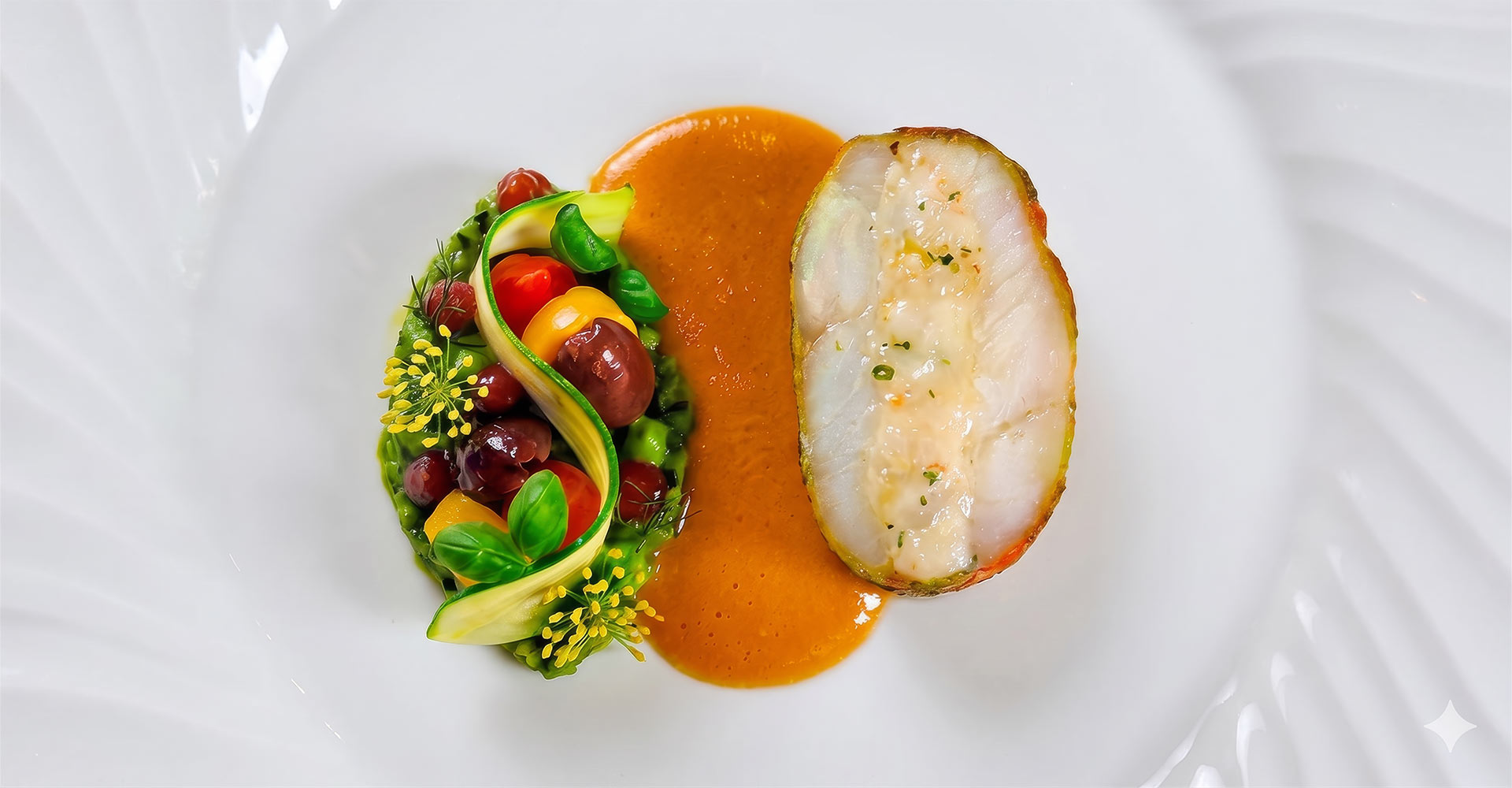
My confit turbot arrived with Paradella Patrimonio 2022, a pairing that leaned into restraint rather than power. The wine’s herbal, saline edge echoed the Mediterranean notes of the dish, while its quiet structure allowed the fish to remain the focal point. This was less about contrast and more about alignment.
Then came the reds. My 100 Days Aged Blue Grey, with violet artichoke, pomme soufflé and girolles, was paired with By Farr Sangreal Pinot Noir 2022. A confident choice. The Pinot had enough depth and savoury nuance to meet the beef, but crucially avoided overwhelming it. Red fruit, fine structure and that Geelong elegance made it feel like a conversation rather than a contest.
Alison’s Herdwick rack of lamb with young peas, mint and Roves des Garrigues was paired with Craggy Range Gimblett Gravels Syrah 2021. This showed a deeper, darker, more peppered expression: black fruit, spice and structure, but still with freshness. It was exactly the sort of Syrah that makes sense with lamb, especially when mint and herbs are part of the dish rather than an afterthought.
The sorbet course was a lovely reset. Mine leaned towards rose and champagne, while Alison’s basil and strawberry sorbet had that brilliant sweet-herbal snap that can either be gimmicky or completely refreshing. Here, it worked.
Dessert moved into proper indulgence with my Plaisir sucré, chocolate crémeux, hazelnut and milk. Alison finished with Rum Baba, fraise des bois, yoghurt and verbena, which sounded lighter on paper but still had enough sweetness and aromatic lift to feel like a proper finale.
My final wine had me wandering confidently towards Vin Santo and other fortified possibilities from Australia, which was, naturally, wrong. It was, however, a Madeira — label regrettably missed — and it worked exactly as Madeira should: sweetness balanced by acidity, richness cut with lift, and enough complexity to complement and elevate the chocolate’s depth.
Alison’s was a Loire Chenin Blanc, bringing quince, baked apple, honeyed fruit and bright acidity. It worked particularly well with her rum baba, cutting through the syrup and yoghurt while picking up the fruit and verbena.
There is something wonderfully humbling about blind tasting. You can know a fair amount about wine and still find yourself saying, with total confidence, something that is almost impressively wrong. Wine does that. It waits until you feel clever, then pulls the chair away, and I was perfectly fine with that, as I am always learning.
Why the Pairing Worked
The best comment of the evening came from Milena when she explained how she works with the kitchen. The chef prepares the dish, she brings the wines, they taste together, and they collaborate completely to get the perfect match.
That is the magic.
Proper pairing is not “white with fish, red with meat” dressed up in nicer shoes. It is a conversation between plate and glass. Sometimes the wine solves the dish. Sometimes the dish sharpens the wine. Sometimes both need to move slightly towards each other.
At Pétrus, the pairing did not feel bolted on. It felt built in.
The lobster needed lift and texture. The turbot needed saline precision. The beef needed structure without aggression. Dessert needed sweetness, but also enough complexity to avoid becoming syrup.
That is where a good sommelier earns the badge.
Bottom Line for Wine Lovers
Take the pairing. Let them pour blind if they offer. You may get several things wrong, but you will enjoy the wines more because you had to meet them properly.
The Commercial Lesson
For anyone watching the premium restaurant market, Pétrus is an interesting case.
The brand has history. The Ramsay name brings recognition. The Michelin star brings expectation. The wine cellar brings authority. But none of that guarantees affection.
What made this dinner memorable was not the brand equity. It was the human delivery of it.
Milena’s pairing gave the evening personality. Kane and the floor team gave it ease. Executive Head Chef Orson Vergnaud gave the wines something precise to work with. Together, the experience felt expensive, but not emotionally distant.
Pétrus did.
Pétrus is still a strong choice for:
- Wine lovers who want a serious pairing experience.
- Special occasions where service matters as much as food.
- Diners who enjoy classic French foundations with modern detail.
- Anyone who wants a polished London restaurant that does not feel desperate to be fashionable.
- With lunch listed at £59 per person, Pétrus also looks surprisingly accessible for a Michelin-starred dining room.
It may be less ideal if you want casual, buzzy, noisy dining. This is not that room. Pétrus is more composed than spontaneous. But within that composure, there is warmth.
Final Pour
I went to Pétrus expecting a technically excellent dinner. I left remembering the wine.
That is not a criticism of the food. The cooking was Michelin all the way: precise, elegant, beautiful and genuinely delicious, with flavours that tasted as good as they looked. But the pairing gave the evening its narrative. It turned the meal from a sequence of polished plates into a conversation.
Would I go back?
Absolutely.
And next time I will still guess confidently and incorrectly, because apparently that is now part of my process.