Set against the historic backdrop of Fishmongers’ Hall at London Bridge, the Goedhuis Waddesdon Collection Tasting 2026 brought together an extraordinary global portfolio. But beyond the scale and setting, a handful of wines stood out for the right reasons—clarity, restraint and drinkability. These are the bottles that genuinely stayed with me after the room, the crowd and the noise fell away.
A setting that raises expectations
The Waddesdon Rothschild Collection Picpoul has quietly become my go-to when I’m throwing parties. It does exactly what you need it to—fresh, reliable, easy to drink, and it keeps people happy without needing an explanation. So coming into this tasting, I was curious to see what the rest of the range—and the wider portfolio around it—looked like in context.
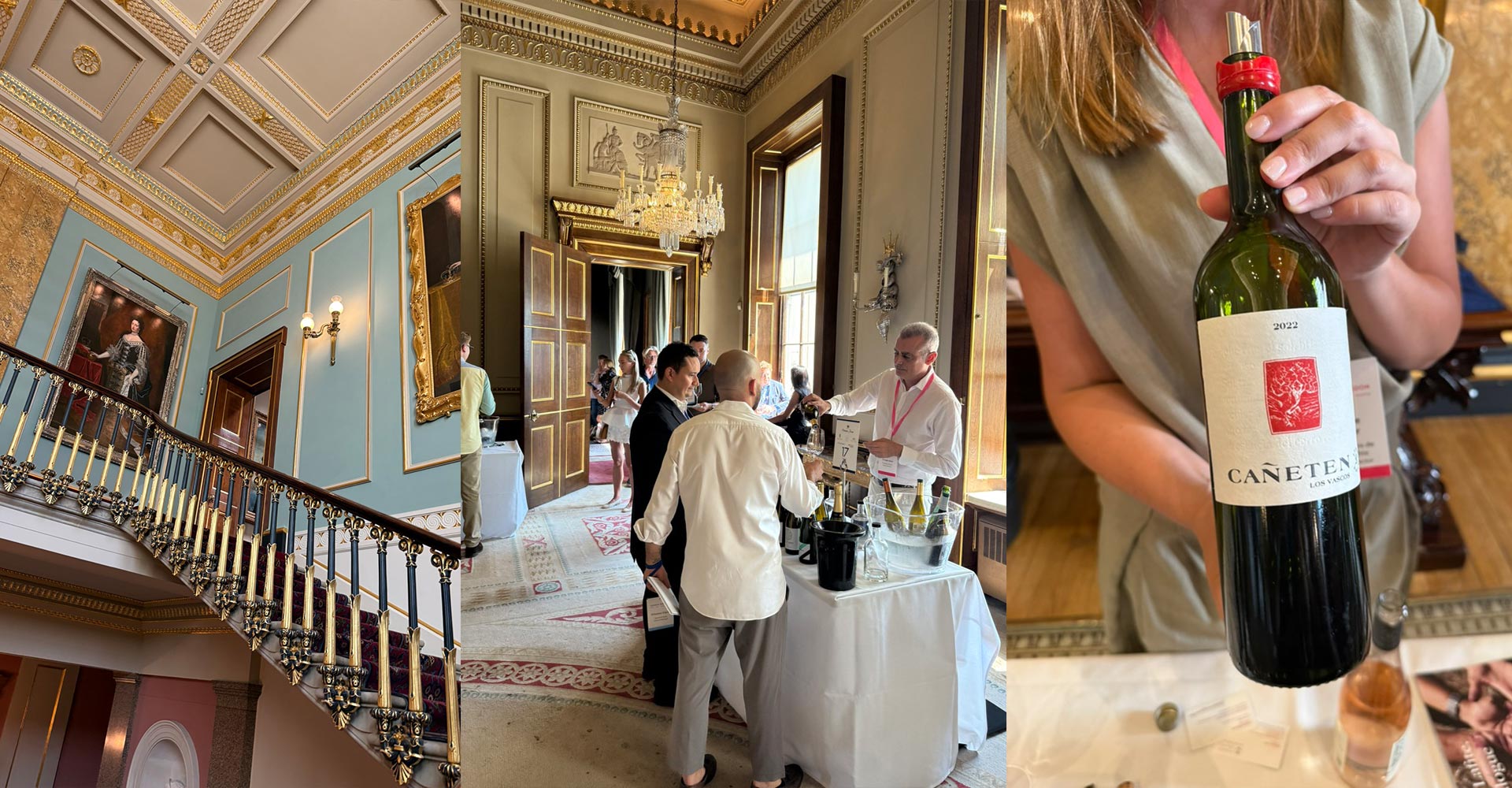
The Goedhuis Waddesdon Collection Tasting 2026 took place at Fishmongers’ Hall, overlooking London Bridge and the Thames. It is a suitably grand setting for a portfolio of this scale, with historic interiors, ornate ceilings and rooms that make even a quick tasting lap feel faintly ceremonial.
That matters more than it sounds.
Because when you’re surrounded by scale, heritage and serious names, it becomes harder—not easier—to judge the wine. Everything starts to feel important. Everything feels like it should be good.
And most of it is.
The portfolio spanned Domaines Barons de Rothschild Lafite, Edmond de Rothschild Heritage, Penfolds, Beaulieu Vineyard, Champagne Barons de Rothschild, Château d’Estoublon and a long tail of serious global producers.
Trying everything would have been a mistake.
So I didn’t.
Instead, I focused on the wines that made me stop, go back, or simply remember them later without needing to check my notes.
What was the most interesting discovery?
Caneten 2022 – Viña Los Vascos
This was the standout “what is that?” wine of the tasting.
Caneten is a new release from Los Vascos (Domaines Barons de Rothschild Lafite, Chile), but what makes it interesting is not just that it’s new—it’s how it came about.
Rather than building a wine top-down, the team identified a small pocket of vineyard—around one square kilometre—where conditions were noticeably different. More humidity. Slower drying. A slightly altered rhythm to the day that set it apart from the rest of the estate.
Fifteen plots were isolated.
Then something telling happened.
Across three vintages—2020, 2021 and 2022—the same blend kept emerging consistently, before the wine was formally defined or released.
That’s the moment where you stop “making” a wine and start recognising one.
The final composition is 54% Syrah, 43% Cabernet Sauvignon and 3% Cabernet Franc—a far more nuanced blend than it first appears, and still an unusual direction for the estate.
The élevage is equally considered: 16 months in total, with 60% in 4,000L foudres, 14% in barrel and 26% in concrete. That mix matters, because it explains the balance in the glass—structure without heaviness, polish without dominance from oak.
And it shows.
On the nose, the wine opens in layers rather than in one hit—blackberry and raspberry first, then more lifted red fruit, followed by floral notes of violet and hibiscus, and a subtle spice line running underneath.
On the palate, it’s the balance that stands out most. There’s a smooth entry, then a line of acidity that brings energy and tension, supported by a fine, well-defined tannic structure. The finish carries through with gentle spice and cedar, without ever tipping into excess.
It still doesn’t feel pushed. No excess weight. No obvious winemaking trying too hard to impress you—just a wine that knows exactly what it is.
It feels… confident.
Which is rare for a new wine.
Bottom Line: Caneten 2022 is one of those early-stage wines you want to follow. Distinctive, restrained, and clearly driven by place rather than formula.
Which Beaulieu Vineyard wine would I actually buy?
Rutherford Reserve vs Georges de Latour Private Reserve
This was one of the clearest contrasts of the tastings, and a very useful one.
The 2019 Rutherford Reserve came across as the more serious, composed wine on the table.
- More together
- More structured
- More settled
It felt like a wine already moving into its next phase, rather than trying to show everything at once. The kind of bottle where the shape is already there, and you’re really just deciding how long you want to follow it.
Then comes the 2018 Georges de Latour Private Reserve.
Different proposition entirely.
- More immediate
- More expressive
- More “on the table”
This was the wine the server naturally leaned into, more open, more giving in the glass, and easier to engage with in a tasting environment, and it will be finding its way into my cellar.
So the split becomes slightly different to the usual expectation:
- Rutherford Reserve = the more composed, evolving wine
- Georges de Latour = the more immediately expressive glass on the day
Which is interesting, because it runs slightly against the hierarchy you might expect.
Bottom Line: Rutherford feels like the wine already settling into itself, while Georges de Latour was the one showing more openly in the room.
Is rosé finally being taken seriously?
Roseblood d’Estoublon
Short answer: yes.
Longer answer: it depends who’s making it, and why.
Roseblood sits in an interesting place. The packaging is beautiful, very lifestyle-led, but the wine behind it has more intent than that first impression suggests.
What came through clearly:
- Focus on freshness and acidity
- More structure than typical Provence rosé
- Clear positioning as a food wine
This wasn’t just a “pool rosé.” although would fit the occasion.
It’s the sort of wine that works with proper dishes, vegetables, grilled meats, Mediterranean flavours, without disappearing.
There was also a clever extension into olive oils, which actually reinforced the positioning rather than distracting from it.
It felt coherent.
Which is harder to achieve than it sounds.
Are the Waddesdon Rothschild Collection wines good, or just safe?
The Waddesdon Rothschild Collection Piquepoul is my go-to when I’m throwing parties, it’s fresh, reliable and always lands well. So I was curious to see how the rest of their wines stacked up.
Viognier & Sauvignon Blanc
These are easy to overlook.
They’re not trying to be icons. They’re not trying to tell a complicated story.
But they are commercially very smart wines.
The Viognier stood out more:
- Ripe stone fruit
- Floral but controlled
- No heaviness
Which is key—Viognier often tips into over-perfumed and tiring.
This didn’t.
The Sauvignon Blanc was softer than expected, more textural, less aggressively sharp than many high-volume examples.
And that’s probably the point.
These wines are built for:
- Hospitality
- Events
- Easy repeat purchase
They don’t need to overperform. They need to deliver consistently.
And they do.
What did the tasting actually tell us about the market?
Three things stood out.
1. Restraint is back
The most interesting wines weren’t the biggest.
They were the ones that felt deliberate.
Less oak. More balance. Clearer identity.
2. Rosé is growing up
Producers are talking about terroir, altitude, structure, not just colour.
Consumers are slowly following.
3. Drinkability matters again
Even at the premium end.
There’s a clear shift away from wines that impress once towards wines you actually want to finish.
Which, quietly, is a big change.
Final thoughts
The scale of the Goedhuis Waddesdon tasting is impressive.
But scale doesn’t create memory.
Clarity does.
Caneten stood out because it felt new but grounded.
Rutherford Reserve because it was immediately enjoyable, and it was great to catch up with Landon there from Hundred Acre and Fortunate Son.
Roseblood because it balanced brand and substance.
And the Waddesdon wines because they understood their role perfectly.
Walking back across London Bridge afterwards, those were the bottles still occupying my thoughts.
That’s usually the most honest tasting note you’ll get.
Practical Takeaway
- Collectors: Look at Georges de Latour & Hundred Acre
- Drinkers: Buy Rutherford Reserve
- Explorers: Try Caneten early
- Hospitality: Waddesdon Collection is a safe, smart bet