California is ripping out tens of thousands of acres of healthy vineyards just as the 2026 harvest races ahead of schedule. It sounds like a wine disaster movie. It isn’t. This is primarily a commercial correction, not a collapse in Californian wine quality. And having recently tasted Hundred Acre over dinner, I’d argue the gulf between the headlines and what’s actually in the glass has rarely been more striking.
What struck me at the Hundred Acre dinner wasn’t simply power or concentration, traits California hardly needs help advertising. It was the balance, precision and freshness in the wines. As someone currently studying WSET Level 3 and tasting increasingly broadly, that’s the part of premium California wine I think gets missed. The old stereotype of enormous fruit, enormous alcohol and an equally enormous price tag doesn’t tell the whole story anymore.
California is ripping out vineyards, but this isn’t a quality crisis
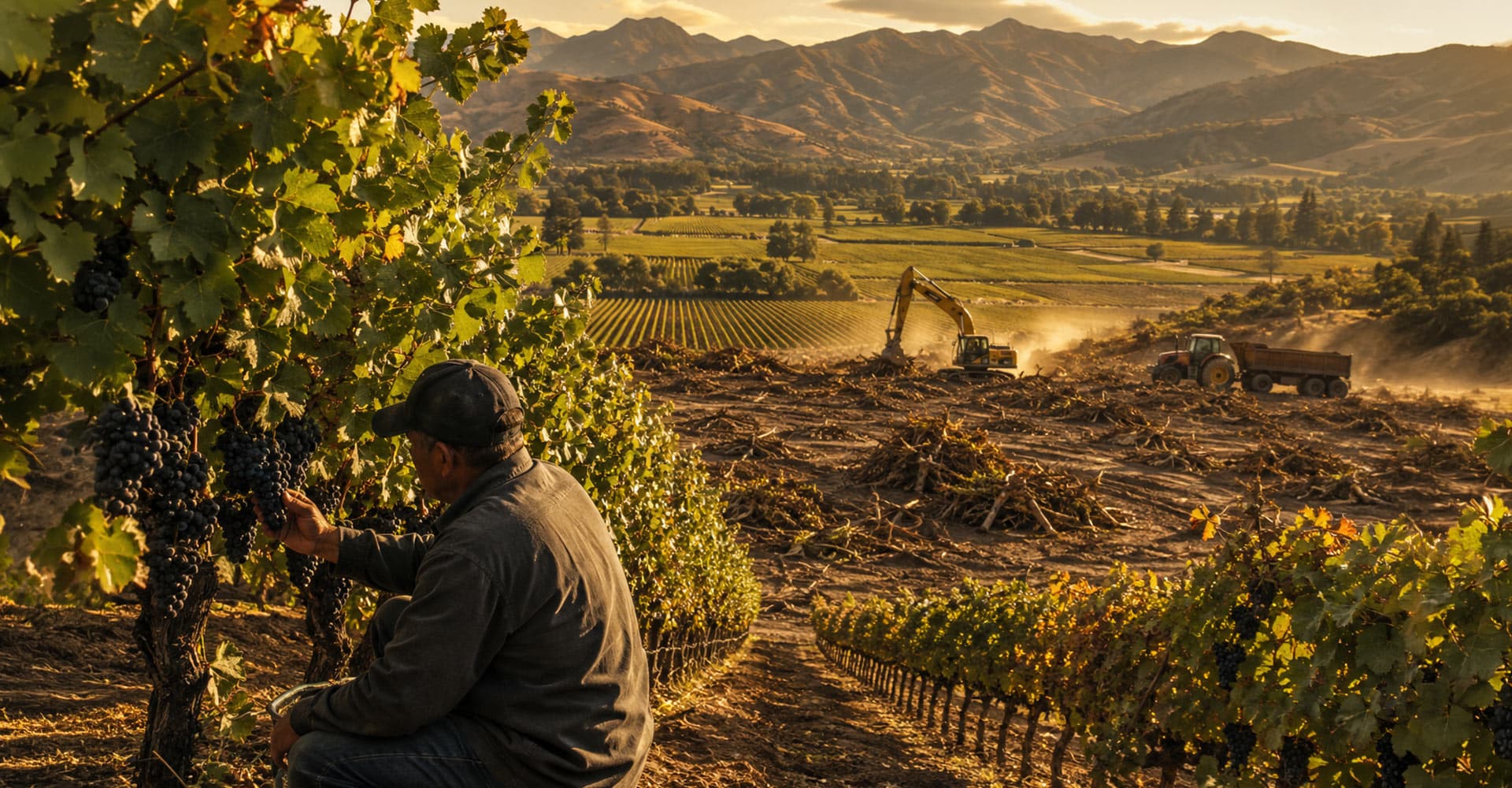
There are few sights more alarming to a wine lover than a bulldozer heading towards a perfectly healthy vineyard.
California currently has rather a lot of them.
Across the state, growers are pulling out tens of thousands of acres of vines, some still capable of producing perfectly good fruit. At the same time, the 2026 vintage is developing remarkably early, with harvest activity in some areas weeks ahead of traditional timings.
You could reasonably conclude that something has gone horribly wrong.
Something has gone wrong, but it’s largely happening in spreadsheets rather than wine glasses.
California has more wine, grapes and vineyard capacity than its current market wants to buy. After years of expansion, changing drinking habits, swollen inventories and weaker exports have created a painful mismatch between supply and demand.
And wine, inconveniently, refuses to behave like software. You can’t simply switch off a vineyard subscription for six months and restart it when customers return.
That distinction matters because California’s current troubles can easily become tangled up with perceptions of Californian wine itself.
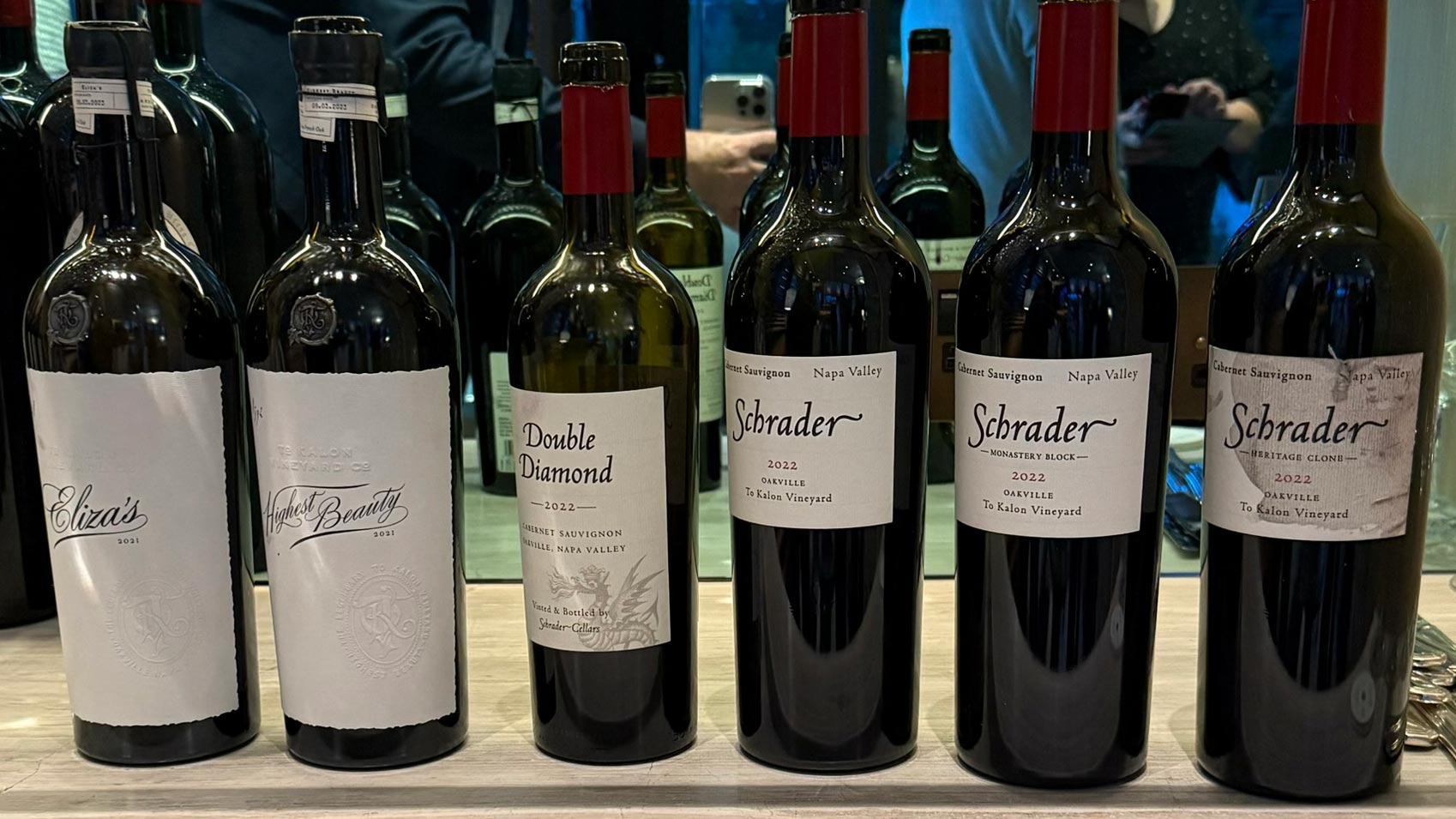
Having recently attended a Hundred Acre wine dinner, I was reminded rather emphatically why that would be a mistake.
The wines were superb: concentrated without simply being enormous, beautifully constructed and showing the sort of precision, depth and confidence that California can achieve at its best. It was also another reminder that writing off California as a land of oversized Cabernet and excessive alcohol is becoming a rather lazy European parlour game.
There is some truly great wine being made in California.
The awkward bit is that California is also making too much wine overall.
Those two things can be true simultaneously.
Why are California vineyards being ripped out?
The simple answer is oversupply.
California’s wine market has been hit by falling consumption, high inventories and increasingly cautious buying from wineries and distributors.
The research paints a fairly uncomfortable picture. Combined on-trade and off-trade wine sales have fallen by around 2% in value year on year, while volumes are down approximately 5%. Direct-to-consumer sales, normally a valuable cushion for wineries, have also contracted across most California regions.
Then there’s the generational problem wine has been discussing for years, usually while pouring itself another glass and hoping the problem will disappear.
Older drinkers remain extremely important to the category, but younger consumers aren’t replacing their consumption at the same rate. Millennials and Gen Z have considerably more choice: cocktails, spirits, RTDs, craft beer, alcohol-free drinks and the increasingly radical option of simply not drinking.
Wine is no longer entitled to their attention.
For an industry capable of describing the geological difference between two neighbouring rows of vines, it has occasionally been remarkably optimistic about assuming consumers will simply keep turning up.
The result is inventory.
When wineries already have too much wine sitting in tanks and warehouses, they don’t rush enthusiastically into vineyards asking growers whether there happens to be another few thousand tonnes available.
They stop buying.
What happened to California’s 2025 grape crop?
The 2025 vintage showed just how severe that imbalance had become.
Research cited in the industry suggests around 30% of California wine grapes may have struggled to find buyers, with estimates suggesting 15% to 23% of the crop was ultimately left unharvested.
That could equate to roughly 500,000 tonnes of fruit left hanging on vines.
For a grower, this is brutal economics.
The vineyard has already been pruned, sprayed, irrigated and managed. Staff have been paid. Fuel has been burned. Equipment has been maintained.
Then harvest arrives and nobody wants the grapes.
A bunch of Cabernet hanging romantically beneath the Californian sunshine is lovely when it’s destined for a winery. When nobody has bought it, it’s essentially an unpaid invoice with seeds.
Bottom Line
California’s vineyard removals aren’t primarily about bad vineyards. They’re about vineyards whose grapes no longer have a commercially viable route to market.
That’s why perfectly healthy vines are disappearing.
How much California vineyard is being removed?
The scale is considerable.
Total estimated California winegrape acreage in the supplied research falls from around 610,000 acres in 2023 to 580,000 in 2024 and approximately 540,000 in 2025.
Bearing acreage also fell, while new vineyard investment has slowed sharply.
Allied Grape Growers has argued that removals of roughly 50,000 acres per year across multiple years may be necessary to bring supply back into line with wine shipments.
Approximately 37,000 acres were reportedly removed following the 2023 harvest, followed by around 40,000 acres after 2024, with further substantial removals expected.
The complication is that vineyards planted during the happier demand years are still coming into production.
Wine has always had an entertaining relationship with timing. By the time you’ve identified a boom, bought the land, planted the vines and waited for them to produce useful fruit, everyone may have decided they prefer tequila.
That lag makes correcting oversupply painfully slow.
Why doesn’t California simply leave the vineyards alone?
Because vines are expensive even when nobody wants their grapes.
Annual farming costs run into thousands of dollars per acre. Labour, water, canopy management, pest control, machinery and fuel continue whether Cabernet is fashionable or not.
California growers also face substantial regulatory and compliance costs. The research cites estimates of around $1,100 per acre for smaller growers and $1,700 for larger operations in regulatory overhead associated with areas including water management, labour and environmental reporting.
Oddly, stopping farming isn’t cheap either.
Vine removal itself can now cost around $2,000 to $3,000 per acre, according to the research, following changes to agricultural burning practices and increased reliance on mechanical removal.
So growers can find themselves in the enviable position of losing money if they keep their vines and requiring more money to remove them.
Wine is romantic right up until somebody opens the agricultural accounts.
Is the 2026 California wine harvest early?
Very.
Warm conditions during late winter and early spring pushed budbreak forward, although colder and wetter weather during flowering subsequently caused uneven fruit set and some shatter.
The result appears to be an unusually advanced but potentially lighter crop.
The research records sparkling wine grapes being harvested in Santa Barbara County from 30 June, Napa sparkling Chardonnay beginning around 21 July, and Sonoma harvest activity starting in late July.
In Paso Robles, Syrah was already showing veraison by 9 July.
That creates an intriguing contrast. California may have fewer grapes because vineyards are being removed, and fewer grapes on individual vines because of the growing season.
The 2025 crush was already only 2.626 million tonnes, reportedly the smallest statewide crush since 1999. Early expectations suggest 2026 processing could fall below 2.5 million tonnes.
The critical word is processing.
Some grapes may physically exist but never reach a winery because nobody buys them.
Does this mean Californian wine will become more expensive?
Possibly, but not evenly.
And this is where the Californian wine market becomes particularly interesting.
The strongest wineries aren’t experiencing the same market as everybody else. The supplied research cites Silicon Valley Bank data suggesting the top quartile of wineries has continued growing sales by around 8%, while the bottom quartile has been contracting at roughly 10%.
That is a huge divergence.
It suggests California isn’t simply shrinking. It’s splitting.
Premium producers with strong brands, recognised vineyards, loyal customers and successful direct-to-consumer businesses can remain resilient. Commodity growers and weaker mid-market brands are far more exposed.
Which brings me back to that Hundred Acre dinner.
Sitting with wines of that calibre, California’s problem certainly didn’t feel like an inability to produce desirable wine. If anything, the evening reinforced how compelling the best Californian Cabernet can be when fruit quality, place, ambition and winemaking align.
This isn’t to suggest every bottle needs to cost three figures, nor that Napa icons are representative of the whole state.
They aren’t.
But they demonstrate something commercially important: distinctive wine still creates desire.
And desire matters enormously when the category itself is shrinking.
What happens to California wine next?
I suspect the most plausible future is a more polarised California.
At one end will be premium estates and distinctive regional producers selling wines with a clear story, recognisable provenance and enough quality to justify their price.
At the other will be highly efficient large producers capable of competing aggressively on volume and cost.
It’s the middle that looks vulnerable. Brands without compelling identity, scale or a meaningful relationship with their drinkers may find themselves squeezed hardest.
My day job is branding and marketing, which makes this part of the California story particularly interesting to me. Great products don’t automatically create demand. A winery can make technically excellent wine and still struggle if consumers don’t understand why it matters, who it’s for or why they should spend £40 on it rather than £20 on something else.
Brands without compelling identity, scale or a meaningful relationship with their drinkers may find themselves squeezed hardest. A label, a vaguely picturesque château illustration and the words “handcrafted” are not quite the marketing strategy they once were.
Bottom Line
California probably doesn’t need more wine. It needs more wine that people actively want.
That means quality matters, but so do storytelling, hospitality, direct relationships, packaging, experience and giving younger consumers a reason to choose wine over everything else competing for their glass.
Is California still producing great wine?
Absolutely.
The sight of vineyards being removed is troubling, particularly for growers whose livelihoods are caught in this enormous correction. There will almost certainly be winery closures, consolidation and painful decisions ahead.
But we shouldn’t confuse economic oversupply with declining winemaking ability.
California remains capable of producing extraordinary Cabernet Sauvignon, Pinot Noir, Chardonnay, Rhône varieties and plenty more besides.
My recent Hundred Acre dinner was a very enjoyable reminder of that. These weren’t wines asking for sympathy because the Californian market is difficult. They were wines demanding attention because they were excellent.
Perhaps that’s ultimately where the correction leads.
Fewer acres. Fewer anonymous wines. Greater pressure to be distinctive. More emphasis on quality, experience and genuine connection with the customer.
California wine is going through something significant, and not everyone will emerge comfortably from it.
But if the best wines are any indication, don’t mistake the sound of vineyards being pulled up for the sound of California wine dying.
There’s still an enormous amount worth drinking.
And, purely in the interests of ongoing research, I’m prepared to keep checking.