Château Mouton Rothschild Artistic Wine Labels
A unique tradition where Château Mouton Rothschild commissions renowned artists to create original artwork for each vintage's wine label.
- Started in 1945 with a 'V for Victory' label by Philippe Jullian.
- Features works by artists like Picasso, Dalí, Warhol, and Kapoor.
- Each label reflects the vintage's story and artistic trends.
- The estate's ram emblem remains constant beneath the changing artwork.
The Convergence of Wine and Art
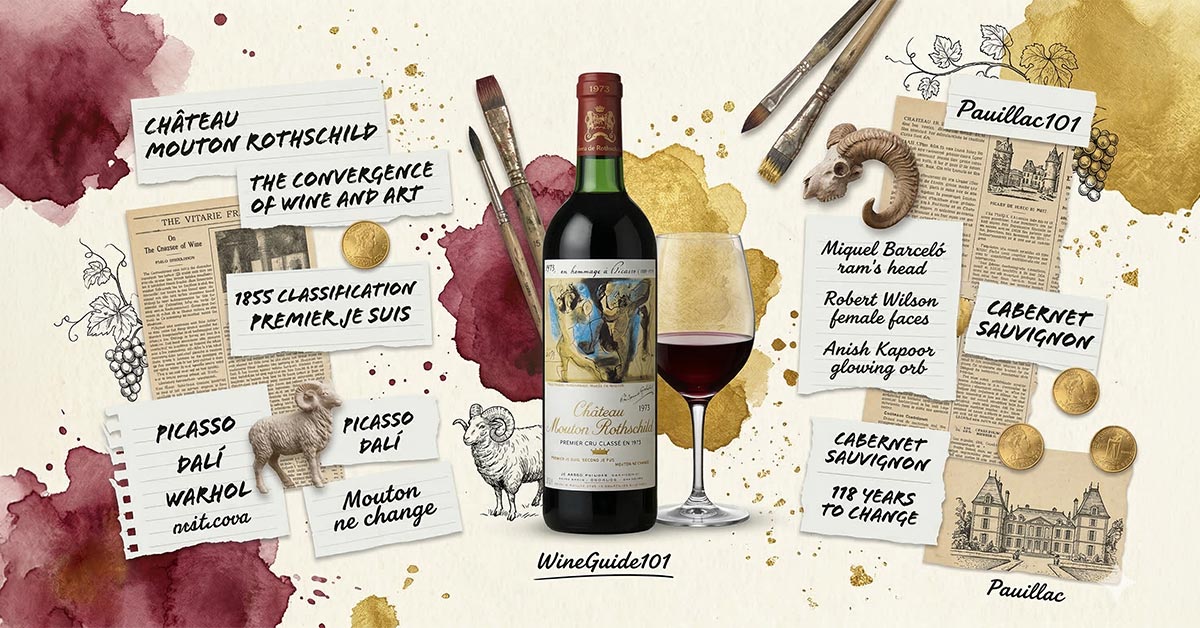
Some wineries make excellent wine. Others build a reputation. Then there’s Château Mouton Rothschild, which somehow managed to do both while turning its labels into a travelling art gallery.
Located in Pauillac in Bordeaux’s Médoc region, Mouton Rothschild isn’t just another prestigious château. It’s a cultural icon. A place where serious winemaking meets Picasso, Dalí and Warhol. Not bad company for a bottle of red.
Over time, the estate has become one of the most recognisable names in wine, blending agricultural excellence with artistic flair in a way no other winery quite has.
Part of the reason this story resonates with me is my own fascination with the intersection of wine and art. Through my Instagram account WineGuide101, I often share digital artworks that I create inspired by wine, vineyards and the visual culture surrounding great estates. It’s a small creative outlet alongside tasting and exploring wines, and Mouton Rothschild feels like the perfect example of how wine can live comfortably in both worlds.
From Frankfurt Financiers to Bordeaux Vintners
The story really begins far from the vineyards of Bordeaux.
In the late 18th century, Mayer Amschel Rothschild built a financial empire from Frankfurt. His five sons spread across Europe, creating a powerful banking network that influenced economics for generations.
One branch eventually led to Baron Nathaniel de Rothschild, who settled in Paris and developed a rather practical idea.
If you’re hosting elite guests in Parisian salons, why rely on someone else’s wine?
Better to make your own.
So in 1853, Nathaniel purchased Château Brane-Mouton at auction for 1,125,000 gold francs. He renamed it Château Mouton Rothschild, and a legend quietly began.
Timing, as they say, is everything.
The 1855 Classification Snub
Just two years after the purchase came one of Bordeaux’s most famous moments.
Napoleon III commissioned a ranking of Médoc wines for the 1855 Universal Exhibition in Paris. The classification created the now-famous hierarchy of First Growths (Premier Cru).
Lafite, Latour, Margaux and Haut-Brion made the top tier.
Mouton Rothschild did not.
Instead, it landed at the top of the Second Growths.
The reason was simple. The estate had recently changed ownership and lacked the long historical price records of the established First Growths.
Technically logical. Emotionally unacceptable.
The Rothschild family didn’t forget. In fact, they spent the next 118 years quietly campaigning to change it.
Persistence paid off.
In 1973, Mouton Rothschild became the only château ever promoted from Second Growth to First Growth, rewriting Bordeaux history.
Their famous motto was updated accordingly:
“Premier je suis, second je fus, Mouton ne change.”
First I am. Second I was. Mouton does not change.
A little swagger in Latin never hurt anyone.
When Wine Labels Became Art
In 1945, Baron Philippe de Rothschild had an idea that was either brilliant or slightly mad.
He asked an artist to design the wine label.
Today that sounds perfectly normal. Back then it was radical. Bordeaux labels were formal and traditional. Baron Philippe wanted something that celebrated the end of World War II.
The result was the famous 1945 “V for Victory” label by Philippe Jullian.
That single decision started what is now one of the longest running artistic collaborations in the wine world. Every vintage of Château Mouton Rothschild features a unique piece of artwork created by a leading artist.
Some of the Legendary Artists
Over the decades the label has become as collectible as the wine itself. The artists who have contributed read like the guest list at a modern art museum.
Among them:
- Salvador Dalí (1958)
- Joan Miró (1969)
- Marc Chagall (1970)
- Pablo Picasso (1973)
- Andy Warhol (1975)
- Henry Moore (1977)
- David Hockney (1971)
- Francis Bacon (1990)
- Balthus (1993)
- Keith Haring (1988)
- Lucian Freud (2006)
- Anish Kapoor (2009)
- Jeff Koons (2010)
- Gerhard Richter (2015)
Today there are more than seventy artists in the collection.
In effect the château has created its own visual timeline of modern art, one vintage at a time.
The Picasso Label and Perfect Timing
The 1973 Picasso label is particularly significant.
That year marked the moment Mouton Rothschild was finally promoted to First Growth, correcting the perceived injustice of the 1855 classification.
The pairing of Picasso and the historic promotion almost feels symbolic, as if the estate had finally secured its place among the great wines of Bordeaux.
The Label That Caused a Scandal
Not every label was universally admired.
The 1993 vintage, created by the artist Balthus, caused a minor scandal in the United States.
The artwork depicted a young nude figure. American importers panicked, fearing regulatory trouble and public backlash. Bottles shipped to the United States had the artwork removed.
Collectors now hunt for the original European bottles with the full artwork intact.
Sometimes controversy adds value.
My Favourite Mouton Rothschild Labels
One of the joys of following Mouton Rothschild over the years is that the label becomes part of the story of the vintage. As someone who has spent more than two decades exploring wines and sharing discoveries through WineGuide101, I find myself drawn to certain labels not only for the wine in the bottle but for the artistic vision behind them. A few stand out as personal favourites.
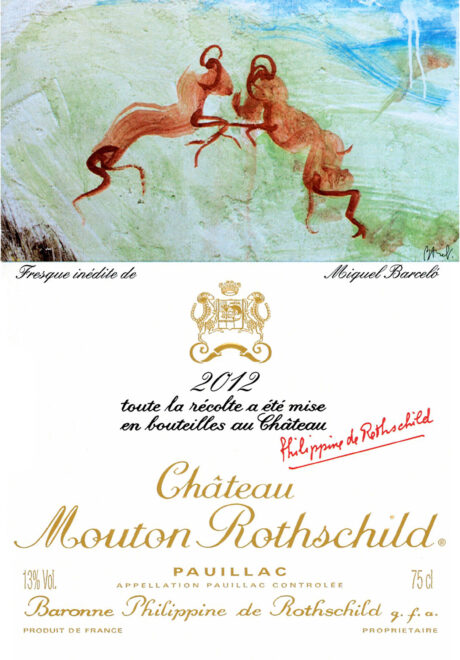 2012 – Miquel Barceló
The 2012 label was created by Spanish artist Miquel Barceló, known for his textured, almost sculptural approach to painting. His artwork for Mouton features a textured, almost sculpted ram’s head emerging from earthy layers of pigment. Barceló is known for working with thick, tactile surfaces, and the ram appears almost carved out of soil and stone, linking the symbol of Mouton directly to the land the wine comes from.
What I love about this label is how it feels connected to the vineyard itself. Barceló often works with natural pigments and earthy textures, and that tactile quality mirrors the idea that great wine is ultimately born from soil and place. It captures the physicality of winemaking in a way few labels do.
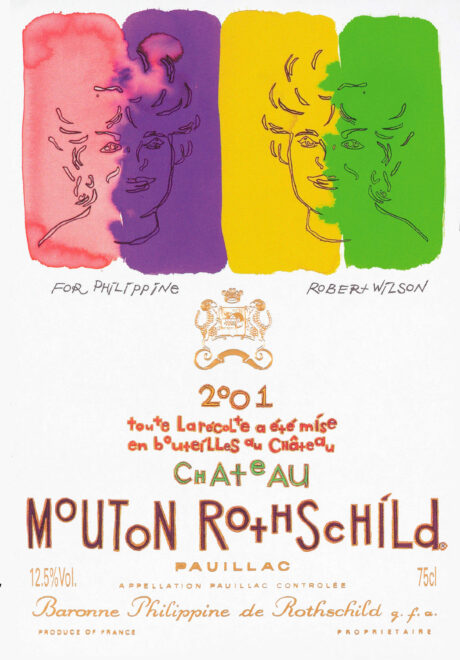 2001 – Robert Wilson
The 2001 label by Robert Wilson, the avant‑garde theatre director and visual artist, is one of the more intriguing designs in the Mouton series. Wilson’s work is minimalist and theatrical, and that influence is immediately visible in the composition.
Rather than depicting wine, vineyards, or even the traditional ram motif, the artwork presents two stylised female facesset against bold colour panels. The figures feel almost like performers on a stage, which makes perfect sense given Wilson’s long career directing opera and experimental theatre.
At the top of the label appears the dedication “For Philippine”, referring to Baroness Philippine de Rothschild, who led the estate from 1988. The paired faces are widely interpreted as a symbolic tribute rather than a literal portrait, reflecting themes of duality, reflection and performance that Wilson often explores in his work.
What appeals to me about this label is its quiet drama. The symmetry and colour blocks almost resemble stage lighting, creating a sense of stillness and contemplation. It doesn’t shout for attention. Instead it invites you to look more closely, much like the wine itself, which rewards patience and time in the glass.
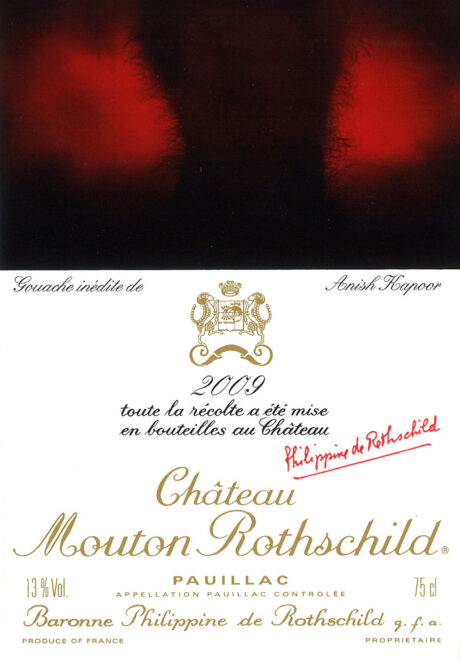 2009 – Anish Kapoor
The 2009 label by Anish Kapoor is one of the most visually striking in the entire series. Kapoor is famous for exploring depth, void and reflection in his sculptures, and his label reflects that fascination.
The artwork resembles a glowing orb or portal with deep red tones. It almost feels as if you are looking into the heart of the wine itself. For me, this label perfectly matches the vintage. 2009 was a powerful, celebrated year in Bordeaux, and Kapoor’s work captures that sense of intensity and depth.
These labels remind me that Mouton Rothschild isn’t just about collecting bottles. It’s about collecting stories, moments in art and wine that intersect in a single vintage.
The Ram Symbol
Look closely at most Mouton Rothschild labels and you will see the château’s coat of arms beneath the artwork, which includes the distinctive ram emblem.
This is no coincidence.
The word “Mouton” translates from French as “sheep”. Historically the hill where the vineyard sits was pastureland where sheep once grazed. The ram therefore became a visual symbol of the estate.
Baron Philippe embraced this symbolism. The ram represents strength, determination and leadership. Over time it became the unmistakable emblem of Mouton Rothschild.
Even though the central artwork changes every vintage, the ram emblem in the château crest remains constant, acting as the visual signature of the estate.
Think of them as the signature of the house.
The Wine Behind the Fame
Of course none of this would matter if the wine itself were not exceptional.
Mouton Rothschild sits in the heart of Pauillac, where deep gravel soils create perfect conditions for Cabernet Sauvignon.
Typical blends include:
- Cabernet Sauvignon
- Merlot
- Cabernet Franc
- Petit Verdot
The wines are powerful yet elegant, showing blackcurrant, cedar and graphite notes with the structure to age for decades.
These bottles are not just wines. They are time capsules.
Where Wine and Culture Collide
What makes Mouton Rothschild unique is not just the quality of the wine.
It is the philosophy behind it.
The estate transformed the idea of a wine brand into something far broader, a meeting point between agriculture, culture and art.
Few producers have managed to turn a wine label into a global artistic collaboration for nearly eighty years.
Final Thoughts
Château Mouton Rothschild is more than a First Growth.
It is proof that wine can sit comfortably alongside art, history and a little family stubbornness.
From a disputed ranking in 1855 to becoming the only château ever promoted in the classification, its story reads more like a novel than a winery profile.
Add Picasso to the label and Cabernet Sauvignon in the glass and you have something truly special.
Now the only real question is this.
Do you frame the label first, or drink the wine?
You can explore all the labels here