CLIMATE SQUEEZE IN WINE PRODUCTION
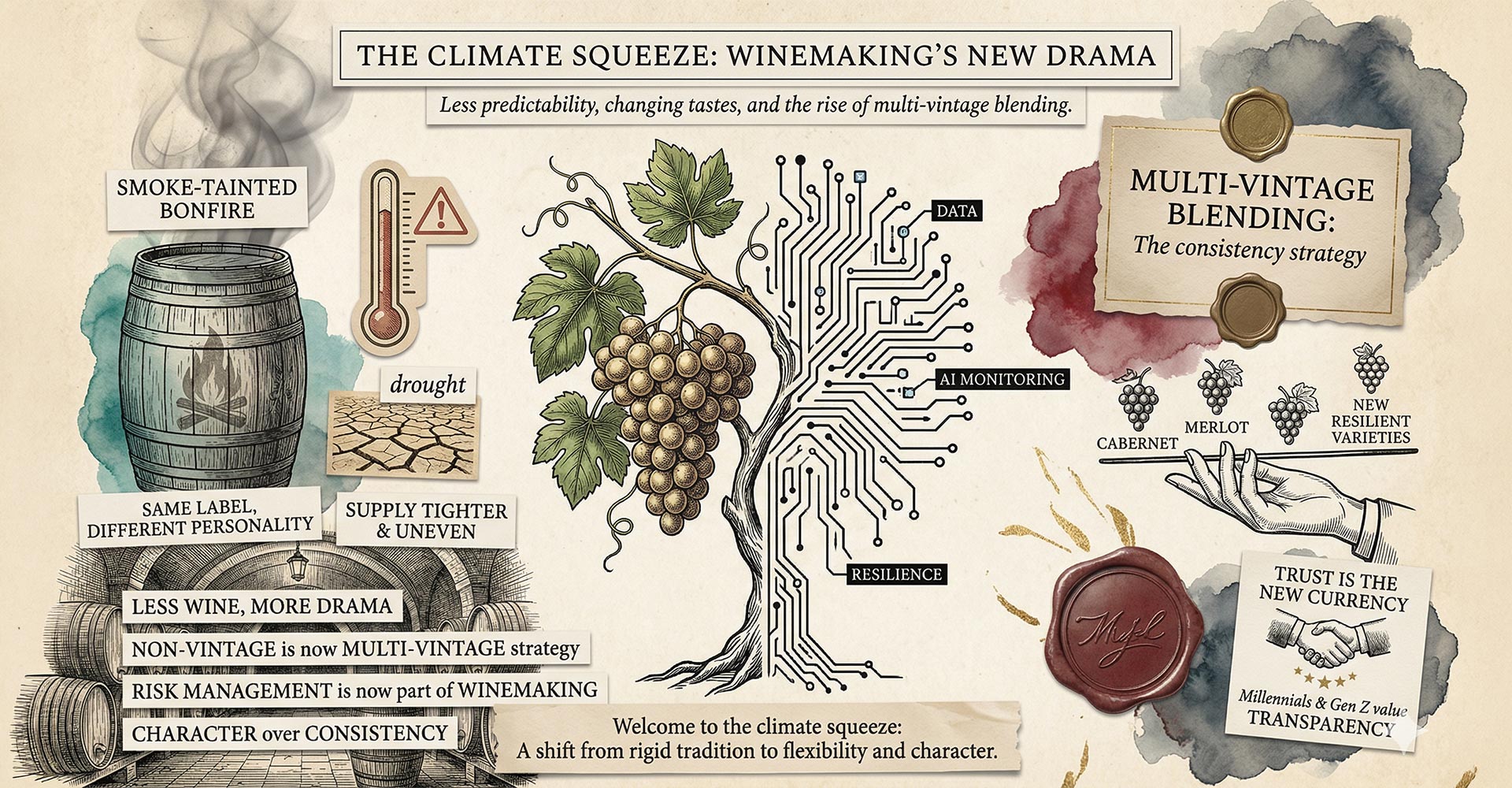
The climate squeeze refers to the impact of changing climate conditions on wine production, affecting quantity, quality, and consistency.
- Global wine supply is reduced, uneven, and less predictable due to weather extremes.
- Warmer temperatures alter grape ripening, changing wine taste profiles and prompting new grape varieties.
- Producers adopt risk management strategies like multi-region sourcing and multi-vintage blending for stability.
- Transparency and trust with consumers are increasingly important as vintage variability grows.
If you’ve opened a bottle recently and thought, “Hang on, this tastes a bit different,” you’re not imagining things. Wine isn’t just evolving. It’s being pushed around by the weather like a picnic table in a British summer storm.
Welcome to the climate squeeze. A polite way of saying the wine world has lost its comfort blanket of predictability.
Less Wine, More Drama
The latest figures from the International Organisation of Vine and Wine suggest global production is still well below where it used to be. Even with a small recovery, we’re not back to “normal”. In fact, normal has quietly left the building.
Italy’s having a decent run. France and Spain, not so much. And the US is doing that classic thing where one region thrives while another quietly panics.
The result? Supply is tighter, more uneven, and a lot less reliable than it used to be.
For drinkers, that means two things:
- Your favourite wine might not always be there
- And when it is, it might not taste quite the same
Same Label, Different Personality
Climate isn’t just affecting how much wine gets made. It’s changing what’s inside the bottle.
Warmer temperatures speed up ripening. Sugars rise. Acidity drops. You end up with wines that are bigger, bolder, sometimes a bit less fresh than the classic style you remember.
In places like Bordeaux, producers are already introducing new grape varieties just to keep things balanced. That’s not experimentation for fun. That’s survival.
Then there’s frost, drought, hail, and the increasingly unwelcome guest… wildfire smoke.
Smoke taint is exactly what it sounds like. A wine that carries a faint memory of a bonfire that no one invited. Sometimes you don’t notice it until the aftertaste, which is even less charming.
When Winemakers Start Thinking Like Traders
Traditionally, wine was about place. One vineyard, one region, one story.
Now it’s also about risk management.
Producers are spreading their bets. Sourcing grapes from multiple regions. Blending across wider areas. Quietly building flexibility into what used to be rigid systems.
Some are even leaning more on bulk wine markets, effectively using the global supply as a safety net. Not glamorous, but very practical.
And contracts? They’re getting sharper. Especially around quality issues like smoke taint. No one wants a legal debate over whether a wine tastes like a campfire.
The Rise of Multi-Vintage (And Why It Matters)
Here’s where it gets interesting.
We’re seeing a shift away from the obsession with a single vintage. Instead, more producers are blending across multiple years.
Think of it less as cutting corners and more as composing a consistent style.
Champagne has done this for decades. Now still wines are catching on.
The upside is simple:
- More consistency for the drinker
- Less waste for the producer
- A bit more control in an uncontrollable world
It’s also a quiet rebrand. “Non-vintage” used to sound like a compromise. “Multi-vintage” sounds like a strategy. Because it is.
Scarcity Isn’t Always Bad News
Here’s the slightly contrarian bit.
Less supply doesn’t always mean trouble. Sometimes it builds desirability.
If a producer makes less wine but keeps quality high, that scarcity can drive demand. Prices rise. Prestige follows. Collectors pay attention.
It’s the same psychology as limited editions, just with corks instead of trainers.
Trust Is the New Currency
What’s really changing is how brands talk to us.
Consumers, especially younger ones, don’t expect perfection anymore. They expect honesty.
Tell people a vintage was tough. Show them what happened in the vineyard. Explain why the wine tastes a little different this year.
That kind of transparency builds trust far quicker than pretending everything is exactly the same as it was ten years ago.
And in a market full of choice, trust wins.
So Where Does This Leave Us?
The era of predictable wine is over. That’s the blunt truth.
But it’s not all doom and gloom.
What we’re seeing is a shift from rigid tradition to something more flexible, more honest, and arguably more interesting.
Wine has always been a product of its environment. Now that environment is just a bit more… lively.
And perhaps that’s the real story.
Every bottle is becoming less about consistency, and more about character. Less about perfection, and more about survival.
Which, when you think about it, makes opening a bottle feel a bit more like an adventure.
Cheers to that.