I’ve always believed the shape of a wine glass matters.
Not in a snobbish, “look at my twelve different stems” sort of way. More in a practical, sensory, slightly nerdy way. Wine isn’t just something you taste. It’s something you smell, feel, and experience, preferably with a bit of theatre and good company.
Last week at Caledonian House in Knightsbridge, I finally had the sort of proof that makes you stop mid-sip and think, right, this is properly interesting.
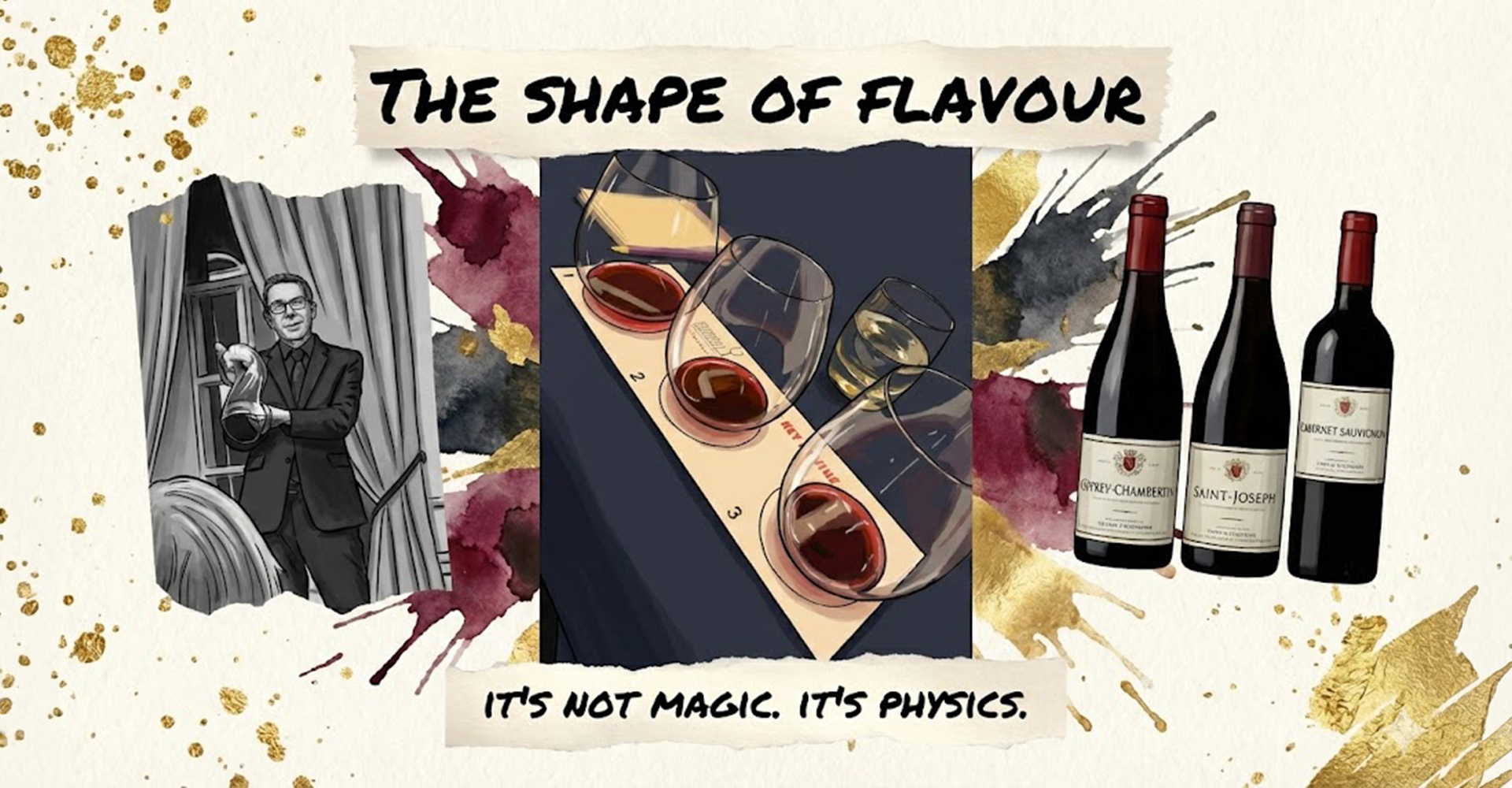
This wasn’t theory and it certainly wasn’t marketing fluff. It was three excellent wines, three different glasses per wine, and a room full of grown adults quietly recalibrating their opinions.
The Setting
Caledonian House was the perfect backdrop. Wood panelling, heavy curtains, polished surroundings. The kind of place where you feel you should sit up slightly straighter and pretend you always drink Gevrey-Chambertin on a Tuesday.
On the table were:
- Gevrey-Chambertin 2019, Les Evocelles, Les Parcellaires de Saulx
- E. Guigal Saint-Joseph 2021
- Finca Ambrosía “Precioso” Cabernet Sauvignon 2020, Gualtallary, Argentina
In other words, serious wines with structure, pedigree and something to say.
Next to them sat the real stars of the evening. Three Riedel stemless glasses per person. Same capacity. Same crystal. Different shapes. Slight differences in curvature that, at first glance, look almost trivial.
They are not trivial.
It’s About Aroma As Much As Taste
We talk about “tasting” wine as if it all happens on the tongue.
In reality, your palate is working with a very limited toolkit. Sweet, sour, bitter, salt and umami. That’s your lot. Everything else, the cherry, the violet, the graphite, the cedar box and the whisper of something that reminds you of your grandfather’s study, comes from aroma.
Flavour is simply taste plus smell working together.
So if you change how aroma is collected and delivered to your nose, you change the experience of the wine. Not by magic. Not by suggestion. By physics and physiology.
That’s what this evening demonstrated so clearly.
The Burgundy Lesson
The Gevrey-Chambertin was first up.
In the first glass it felt a touch tighter, slightly more angular. The acidity stepped forward, the fruit seemed leaner, and the structure a little more pronounced.
Move the same wine into a larger bowl and it was as if someone had quietly turned up the charm. The aromatics lifted. Floral notes emerged. The fruit deepened from tart red cherry into something darker and more generous. The tannins, which had felt assertive, softened and settled into place.
Same wine. Same pour. Same temperature.
Different shape.
It wasn’t dramatic in a fireworks sense. It was more sophisticated than that. A shift in balance. A smoothing of edges. The kind of refinement that makes you think, perhaps I’ve been underestimating this.
The Rhône Reality Check
The Saint-Joseph from Guigal made the point even clearer.
In one glass the tannins marched straight to the front. You could almost chew them. The structure felt firmer, more muscular, slightly more demanding.
In another, the wine relaxed. The fruit had space. The mid-palate broadened. The finish lengthened in a way that felt harmonious rather than forceful.
This wasn’t simply about aeration, although oxygen always plays a part. It was about delivery. About where the wine first touched the tongue and how the bowl gathered and channelled aroma towards the nose.
You could physically sense the difference in where the wine landed and how it travelled.
The Cabernet Moment
Then came the Finca Ambrosía Cabernet Sauvignon from 1,200 metres in Gualtallary.
High altitude, intense UV, deep colour from thick skins and serious concentration. This was not a shy wine.
In the wrong glass, the alcohol felt more obvious and the tannins gripped a little harder than they needed to. It was impressive, but slightly stern.
In the glass designed specifically for Cabernet, everything aligned. The fruit stepped forward with confidence, the tannins felt structured but polished, and the finish carried on far longer than expected. It was the same wine, but now it felt composed rather than assertive.
Nothing had changed in the bottle.
Only the bowl in your hand.
Universal Glass vs Purpose Built
At some point the inevitable question came up. What about universal glasses?
They absolutely have their place. For trade tastings, masterclasses, events and even for those of us with limited cupboard space, a good universal glass is a smart, practical choice.
But if you’re opening something special at home and you genuinely want to see what that wine can do, it’s hard to argue that one shape can optimise every grape variety.
I’ve always believed shape matters. After this tasting, I’m even more convinced. Not because it looks good. Not because it feels premium. But because it changes the balance of fruit, acidity and tannin in a measurable, repeatable way.
Form follows flavour.
What I Took Home
I left Caledonian House with three stemless glasses and, more importantly, a renewed appreciation for something many of us overlook.
We’ll debate terroir, altitude, oak regimes and extraction techniques with great passion. We’ll analyse critic scores and vintages. Then we’ll pour the wine into whatever glass happens to be clean and nearest.
If you care about wine, give it the right stage.
Because sometimes the difference between good and genuinely memorable isn’t in the vineyard or the cellar.
It’s in your hand.
Cheers,