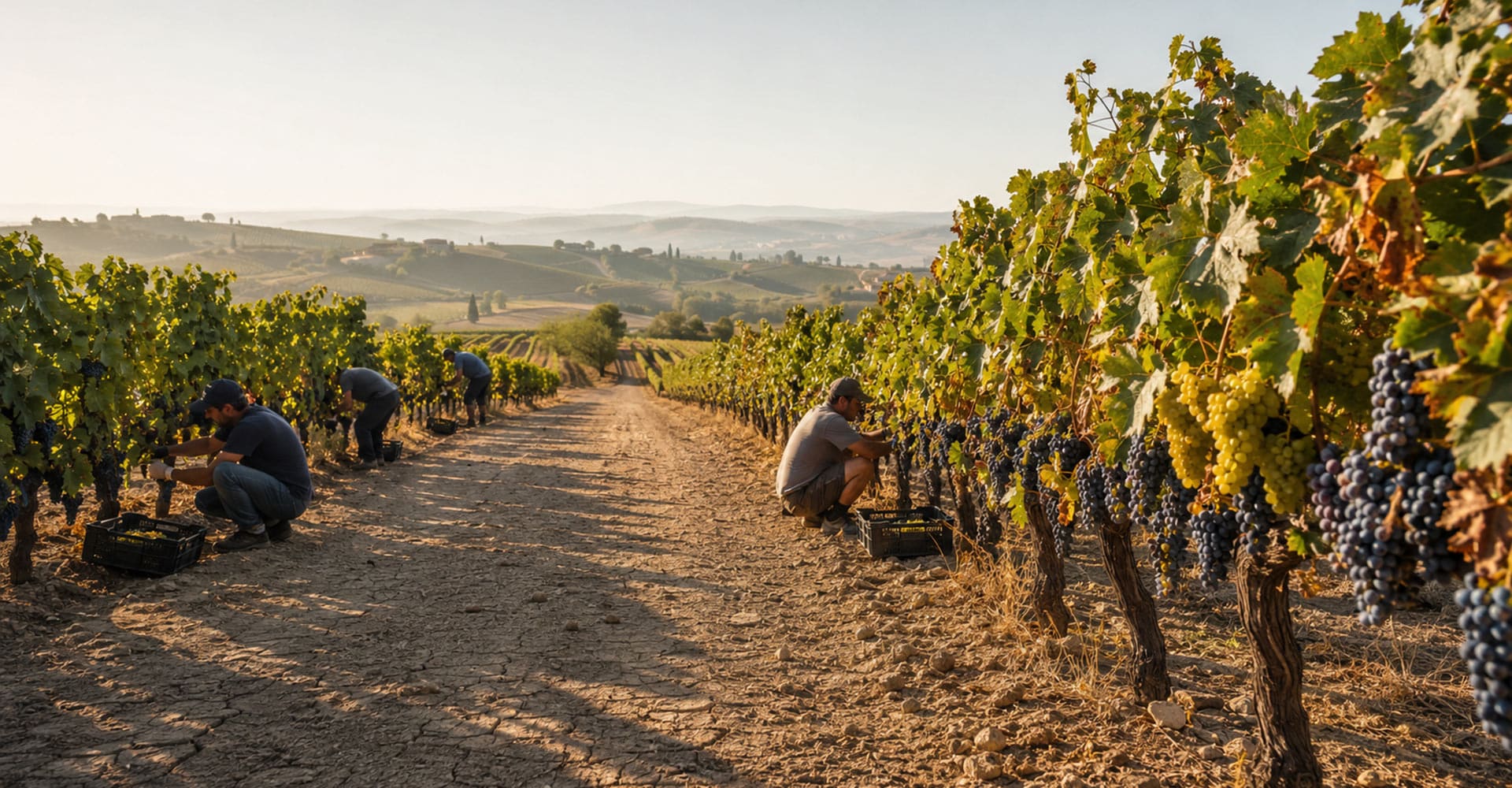
Europe’s 2026 grape harvest has arrived startlingly early. Champagne began official picking on 12 August, Burgundy on 8 August and Franciacorta before July had even finished. Heat and drought have pushed grapes towards ripeness at extraordinary speed, but the important question for wine drinkers isn’t when the grapes were picked. It’s what all that heat, lost acidity and concentrated fruit will eventually taste like.
There was a time when grape harvesting in August sounded faintly ridiculous in some of Europe’s great wine regions. September was early. October was normal. August was when everyone was supposed to be sitting outside drinking the previous vintage.
Not anymore.
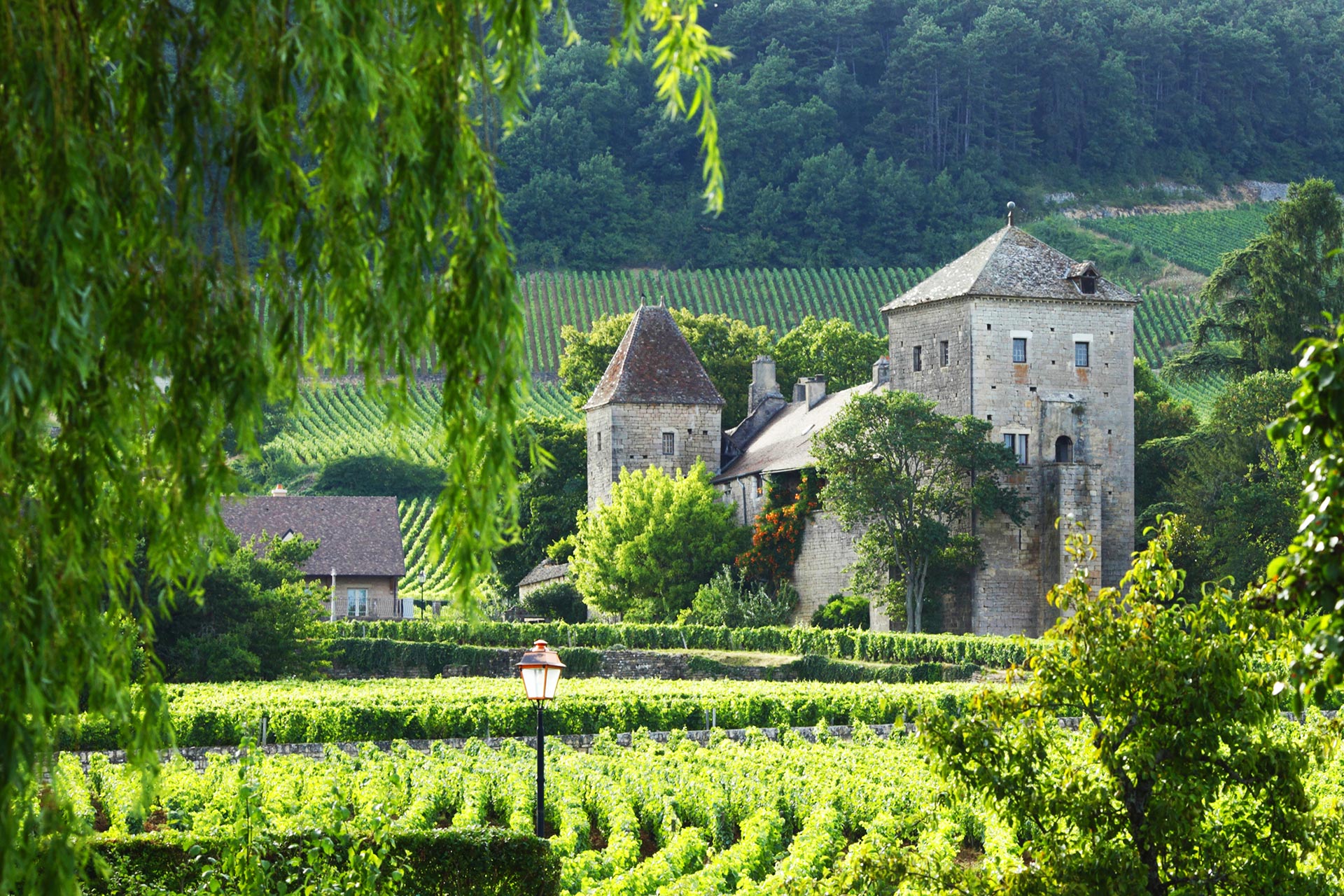
The 2026 European wine harvest has rewritten the calendar across several regions. Champagne officially started picking on 12 August, with special permission allowing some growers around Montgueux to begin on 6 August. Burgundy started around 8 August. Bordeaux growers were picking grapes destined for Crémant on 6 August and dry whites from around 15 August.
Franciacorta went earlier still, beginning on 30 July.
Germany announced on 28 August that its main harvest had begun earlier than ever recorded across all 13 wine-growing regions, while parts of Switzerland were already harvesting during the middle of August.
As someone studying WSET Level 3, I’ve discovered that wine education has an unfortunate ability to make you look at perfectly enjoyable grapes and start worrying about malic acid. In 2026, however, worrying about acidity is entirely justified.
Because the fascinating part of this vintage isn’t simply that Europe harvested early. It’s why, and what those conditions could eventually put into our glasses.
Why was the 2026 European wine harvest so early?
The simple answer is heat.
Mild winter conditions were followed by repeated heatwaves between May and July, accelerating the vines through flowering, véraison and ripening.
In France, average harvest dates have already moved forward by around 21 days during the past five decades. Champagne provides an even more dramatic illustration. The traditional period between flowering and harvest was roughly 100 days two generations ago, then closer to 90. In 2026 it fell towards just 80 days.
That isn’t simply an inconvenient diary problem for vineyard managers.
Grapes are ripening differently.
When temperatures become extreme, particularly above around 35°C, vines reduce photosynthesis to conserve water. Meanwhile berries can continue concentrating sugar through water loss and desiccation.
And here comes the problem.
Sugar ripeness and flavour ripeness don’t necessarily arrive at the party together.
A grower can find themselves looking at grapes containing enough sugar to produce considerable alcohol while the skins, seeds and flavours are still developing. Pick immediately and tannins can remain green. Wait too long and potential alcohol continues upwards while acidity disappears.
Wine has always involved choosing the right moment to pick. In vintages like 2026, that moment can feel less like a window and more like somebody briefly opening the door.
What does extreme heat do to acidity in wine?
This may be the single most important factor when we eventually taste the 2026 vintage.
The main acids in grapes are tartaric and malic acid. Tartaric acid remains comparatively stable as grapes ripen, but malic acid is much more vulnerable to heat.
Warm days, and particularly warm nights, accelerate the vine’s consumption of malic acid. The result is lower total acidity and higher pH.
That matters because acidity provides much of the freshness, tension and structure we associate with great wine.
Studying this in more depth for WSET Level 3 has made me increasingly interested in the relationship between sugar ripeness, physiological ripeness and acidity. It’s one of those subjects that sounds painfully academic until you taste two wines side by side and realise it’s essentially the difference between freshness and alcoholic fruit soup.
It becomes particularly critical somewhere such as Champagne or Franciacorta. Grapes for traditional-method sparkling wine are normally picked with considerably greater acidity than grapes destined for still wine because that freshness needs to survive fermentation, blending and prolonged ageing on the lees.
Suddenly, waiting another few days for additional flavour development can become an expensive game of acidity roulette.
Bottom Line
Heat doesn’t merely make grapes sweeter. It changes the balance between sugar, acidity and physiological ripeness. In 2026, picking at exactly the right moment may prove one of the biggest differences between an exciting wine and a rather alcoholic fruit bomb.
Why drought could actually help some wines
Heat is only half the story. Much of Europe also experienced serious water stress.
Drought restricts berry growth, creating smaller grapes with a higher ratio of skins to juice.
For red wine, that can sometimes be beneficial. More skin relative to juice potentially means greater colour, flavour and phenolic concentration.
But there’s a fairly obvious commercial downside to producing beautifully concentrated grapes containing less juice: you have less wine to sell.
German cellar yields reportedly fell from typical extraction levels around 76 to 78% towards 70%, while frost, drought and berry shrinkage contributed to losses approaching 30% in some European vineyards.
Champagne had an especially complicated year. Spring frost reportedly destroyed around 30% of the initial crop before summer heat and drought reduced berry and bunch weights further in some areas.
This is where vineyard location becomes fascinating.
Older vines with deeper roots can access water reserves unavailable to younger vines. Moisture-retentive soils can outperform shallow, rapidly drying sites. Higher-altitude vineyards, north-facing slopes and cooler microclimates can suddenly become valuable rather than inconvenient.
Wine drinkers have spent decades being told that terroir matters. Climate change appears determined to make absolutely sure we understand the point.
What will 2026 European wines taste like?
It’s far too early to issue a definitive vintage verdict. Anyone confidently scoring the bottled 2026 vintage while some of the grapes are still entering wineries deserves either admiration or confiscation of their crystal ball.
But the conditions give us clues.
Warm-vintage reds can favour darker, riper fruit profiles such as blackberry, black cherry and plum rather than tart redcurrant and sour cherry. Alcohol may be higher, textures broader and tannins softer where grapes achieved good phenolic maturity.
The best reds could be concentrated and impressive, particularly from vineyards where vines had access to sufficient water.
The risk is imbalance. Drought-stressed vines, rapidly accumulating sugar and falling acidity can produce wines that feel heavy or finish dry and alcoholic rather than fresh.
Whites may move from green apple, citrus and floral characters towards ripe orchard fruit, peach and more tropical flavours. Again, acidity will be crucial.
If you prefer leaner, mineral-driven whites, 2026 could become a vintage where vineyard altitude, aspect and producer become particularly useful buying clues.
Can winemakers fix low acidity in the cellar?
To an extent, yes, and this is where the idea that a hot year automatically equals a bad vintage becomes far too simplistic.
Winemakers have options.
They can pick earlier, harvest at night or before dawn, chill incoming fruit and carefully manage pressing. Some producers may suppress malolactic fermentation in whites and sparkling base wines, preserving the malic acid they still have rather than converting it into softer lactic acid.
Acidification is also permitted under certain European regulations, while some winemakers increasingly use specialist yeasts capable of generating acidity naturally during fermentation.
Champagne has another considerable advantage: reserve wines.
Non-vintage Champagne can incorporate wines from previous harvests, allowing producers to blend fresher, higher-acid wines from cooler years with richer base wines from 2026.
Blending has always been one of Champagne’s great strengths. Climate volatility merely gives the cellar master another reason to look smug while standing beside several thousand tanks.
Bottom Line
The 2026 vintage won’t simply reflect the weather. It will reflect how intelligently individual growers and winemakers responded to it. Producer selection could matter more than broad vintage generalisations.
Why the 2026 harvest matters beyond one vintage
There’s also a much bigger commercial story developing.
Earlier harvests mean compressed picking windows, more demand for labour at short notice, greater use of night harvesting, increased refrigeration and higher energy costs.
Combine that with reduced yields and the economics become uncomfortable.
My day job is branding and marketing, including working with premium and hospitality businesses, and this is where the climate story becomes commercially interesting. Producers can absorb changing harvest dates; absorbing lower yields, higher labour costs, more refrigeration and consumers resisting another price increase is rather harder. Wine may begin in the vineyard, but somebody still has to make the numbers work.
Premium producers may be able to pass some additional cost onto consumers. Entry-level producers have far less room to manoeuvre, especially while consumers increasingly show interest in lighter and lower-alcohol drinks.
The vineyard itself is changing too.
Growers are reducing aggressive leaf removal to shade grapes, experimenting with drought-resistant rootstocks, adjusting canopy management and reconsidering irrigation. Regulations developed for a cooler climate are increasingly being tested by a warmer one.
Disease and drought-resistant PIWI varieties are gaining attention in countries including Germany and Switzerland, although persuading Europe’s historic appellations to embrace radically different grapes is unlikely to happen over lunch.
Wine regions are built around tradition. Climate, inconveniently, has never read the rule book.
What I’ll be watching when the 2026 wines arrive
When these wines start reaching the market, I’ll be paying less attention to sweeping vintage scores and more attention to producer, vineyard position, altitude, alcohol and how the wine actually carries its fruit.
Cooler sites and producers who picked at precisely the right moment could be fascinating. A hot vintage isn’t automatically an unbalanced vintage, but it gives the winemaker rather less room to get things wrong.
That, for me, is what makes 2026 particularly interesting. It could be a year where broad regional judgements tell us less than usual, and individual producers tell us much more.
Should wine lovers be excited or worried about the 2026 vintage?
Probably a little of both.
There could be some genuinely exciting wines.
Small berries, healthy fruit and ripe tannins can produce beautifully concentrated reds. Cooler sites may deliver whites combining generous fruit with enough freshness to remain balanced. Champagne producers have sophisticated blending tools available to manage richer base wines.
But 2026 also exposes the growing challenge facing Europe’s traditional wine regions.
The issue is no longer simply whether grapes will ripen. In many places, the challenge is increasingly how to stop them ripening too quickly.
That changes vineyard management, harvesting, winemaking and ultimately the style of wine regions have built their reputations upon.
For wine drinkers, this makes 2026 a vintage worth following rather than prejudging.
When the wines eventually arrive, don’t simply ask whether 2026 was a good year.
Look at the vineyard. Look at the producer. Look at the alcohol level. Consider altitude, aspect and soil.
And then do the only bit of wine analysis that ultimately matters.
Open the bottle.