Wine has a youth problem, but not quite the one everyone keeps dramatically swirling into existence. Younger legal-age drinkers haven’t all abandoned wine for neon cocktails, mushroom coffees and drinks that look like they were designed by a wellness app. They’re still interested. They’re just less willing to play by wine’s old rules.
The next generation doesn’t hate wine. It hates the homework
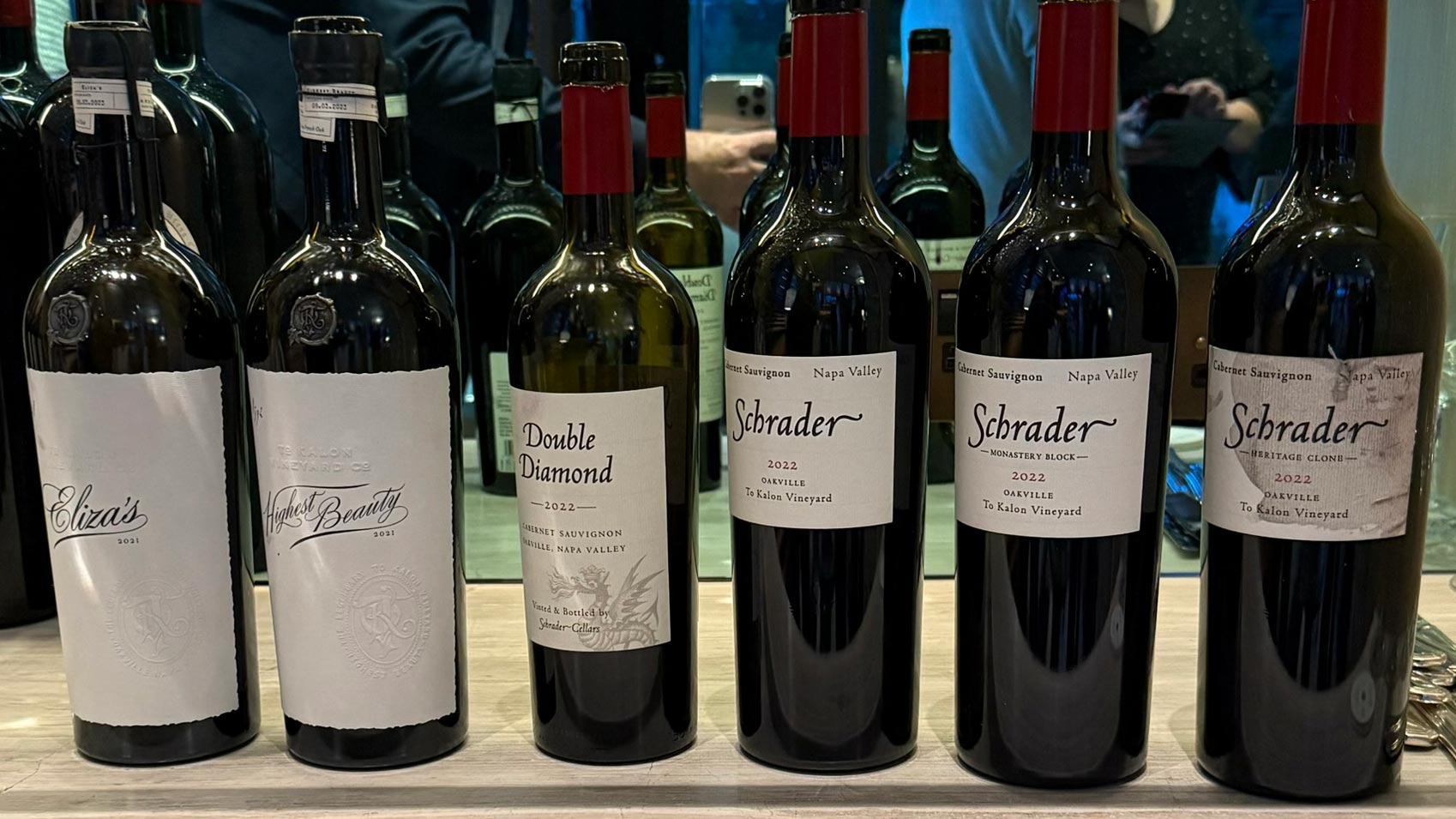
For years, wine has sold itself with a sort of velvet-rope mystique. Regions, appellations, vintages, parcels, producers, classifications and the occasional label that appears to have been designed by a retired bishop. Lovely, if you’re already in the club. Slightly less lovely if you’re 24, standing in a supermarket, wondering whether “Trocken” is a flavour, a place or a mild threat.
As someone who looks at wine through both a glass and a brand strategy lens, I’m less interested in whether younger drinkers “get wine” and more interested in whether wine is making itself easy enough to get.
The research suggests the issue is not total rejection. In the UK, Gen Z and Millennials may represent only 26% of wine volume in the on-trade, but they account for 50% of spend. That is not a generation refusing wine. That is a generation saying, “I’ll have one glass, but make it worth leaving the house for.”
This is the “less but better” generation. They drink less frequently, moderate more naturally and are happier trading up when quality, story and experience align. The old assumption that young drinkers are only hunting for the cheapest bottle is increasingly dusty. Frankly, some parts of the wine trade still treat younger consumers like they’re wandering into the category by accident, clutching a can of something radioactive.
They’re not. They’re selective, visually fluent, socially aware and allergic to being patronised.
Why names matter more than wine wants to admit
Wine has always been obsessed with names, but often the wrong sort. The industry loves place names, producer names, vineyard names and classifications that require either a map, a mentor or a small lie told confidently at dinner.
Younger drinkers respond differently. They’re drawn to names that signal mood, moment and personality. That’s why brands such as Whiny Baby use bottles called “Unwind”, “Obsessed” and “OMG!?!” rather than expecting consumers to decode grape, region and winemaking method before committing to a Tuesday night glass.
South Africa’s New Theory follows a similar path with names like “Growing Pains”, “Love Bite”, “White Lies” and “Pot Luck”. These don’t ask the consumer to perform expertise. They ask a simpler question: what kind of night are we having?
Then there are brands using humour and wordplay to puncture wine’s rather inflated self-image. Young Poets in Germany has used labels such as “Everything Happens for a RSLNG”, “Fifty Shades of GRBGNDR” and “Allday RSÉ”. Is it silly? Absolutely. Is it memorable? Also absolutely. Wine has spent centuries asking to be taken seriously. Occasionally, the most radical thing a bottle can do is lighten up.
This isn’t just label design. It’s conversion strategy. The bottle has to do the job a nervous waiter, a shelf-talker and a TikTok recommendation used to do separately.
The clever bit is that the good examples don’t make the wine worse. They make the buying experience less socially hazardous. The liquid still needs to deliver. A funny label on bad wine is not innovation, it’s just a punchline with acidity.
What kind of bottles are working with younger drinkers?
Younger consumers are being pulled towards wine packaging that feels convenient, eye-catching and suited to real life. Real life, for the avoidance of doubt, is not always a white tablecloth, three glasses per setting and someone whispering “minerality” at a nervous scallop.
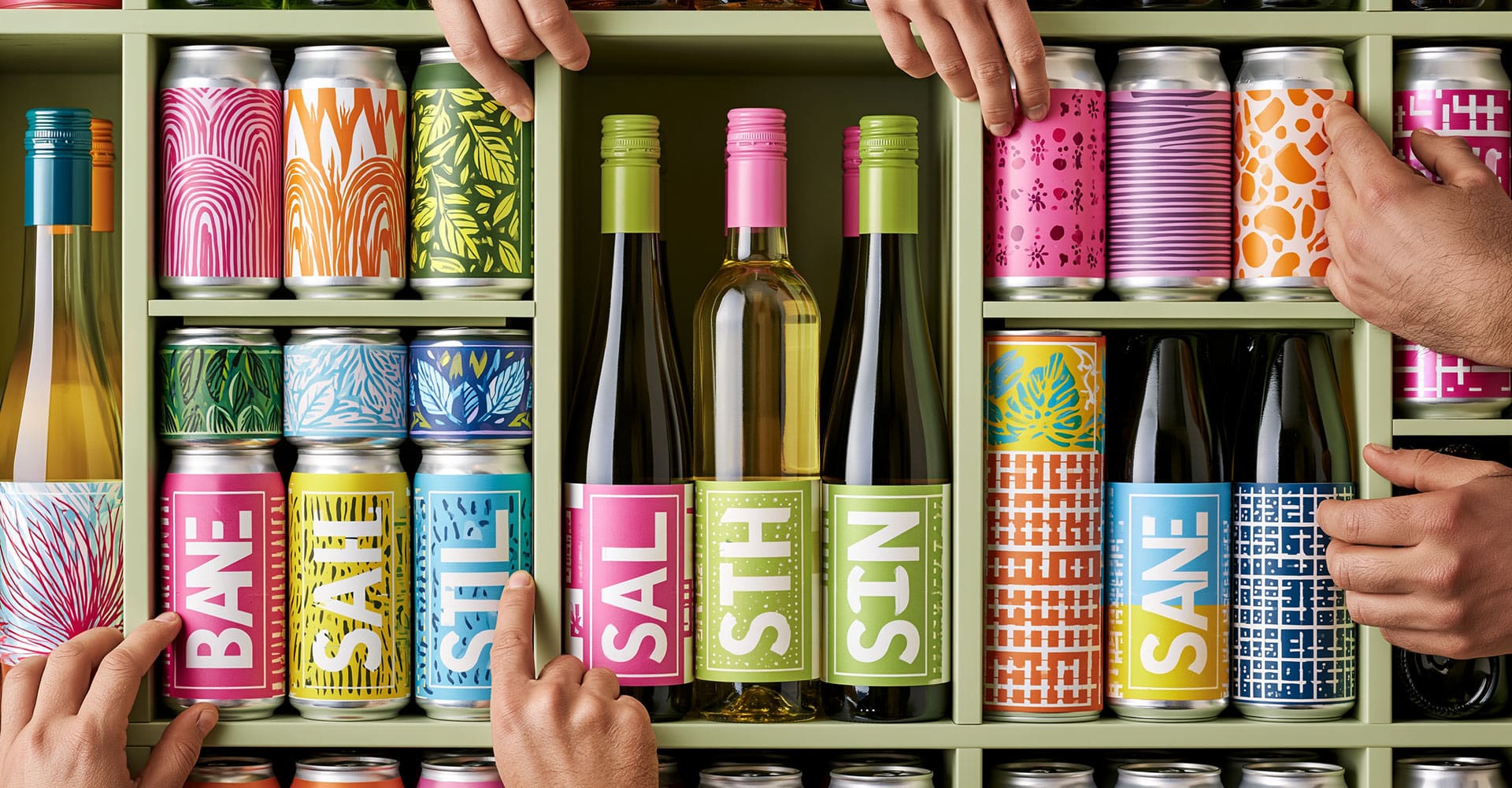
The formats gaining attention are practical: cans, flat recycled PET bottles, lighter glass, premium bag-in-box and resealable alternatives. These formats work because they remove friction. They chill quickly, travel easily, reduce waste and fit occasions where a heavy 750ml glass bottle feels more like luggage than leisure.
Canned wines, for example, make sense for festivals, parks, picnics, trains, barbecues and the sort of house party where nobody owns a corkscrew but everyone has a strong opinion on playlists. Brands such as Vinca Wines and Lovvo are using cans not as a bargain-bin apology, but as part of a modern wine experience.
Flat eco-bottles are also interesting. Packamama’s recycled PET format is dramatically lighter than traditional glass and designed to stack more efficiently. The commercial logic is clear: lower transport weight, more efficient shipping and a sustainability message younger consumers can actually understand without needing a carbon-accounting degree.
Bag-in-box is having its own makeover too. Once treated as the shame cupboard of wine, it is being reimagined by brands such as Gonzo Vino with bolder design, better liquid and a group-friendly format. It stays fresh longer once opened, which suits moderate drinkers. It also has the quiet confidence of saying, “No, we don’t need a punt in the bottle to prove we’re having a good time.”
The label is now a billboard, not a birth certificate
Traditional wine labels often behave like birth certificates: here is where I am from, here is my family name, here is a crest, please respect my lineage. Younger drinkers are more likely to treat the label as a billboard. Does it catch the eye? Does it feel like me? Does it look good on a table, a shelf or, inevitably, Instagram?
That’s why bright colours, clean fonts, graphic design and less formal typography matter. They signal openness. They tell the buyer this bottle is not going to ask them to name three Premier Cru sites before opening.
The strongest youth-facing wine labels are doing three jobs at once. They attract attention, explain the occasion and reduce anxiety. A bottle called “Chill Ya Jolo” from Badia a Coltibuono does this neatly. It plays with the grape Ciliegiolo while telling the drinker exactly what to do: chill it. No ceremony, no lecture, no raised eyebrow from a fictional sommelier hiding in the fridge.
Similarly, Pernod Ricard’s “Greasy Fingers” line leans into food culture, positioning wine with gourmet fast food rather than pretending every bottle is destined for roast lamb and candlelight. This is smart because younger drinkers are not only changing what they drink, they’re changing where wine belongs.
Wine needs to show up next to tacos, burgers, pizza, Korean fried chicken, salads in plastic bowls and whatever happens after someone says, “Let’s just order bits.”
Lower alcohol, lighter styles and the rise of “sessionable” wine
Moderation is not a passing side quest. It’s becoming a central buying behaviour. Younger legal-age drinkers are often more health-conscious, more ingredient-aware and less interested in alcohol as the whole point of the evening.
This is why low-ABV, no-alcohol, organic, vegan, natural and lighter-bodied wines are gaining traction. The language around wine is changing too. Nice’s “Session Wines”, at 3.4% ABV, borrows from beer culture and gives wine a more flexible role. Concha y Toro’s Casillero del Diablo Belight speaks to consumers looking for fewer calories and less alcohol without wanting to be banished to lime and soda exile.
The taste profile is shifting as well. Chilled reds, orange wines, sparkling wines, rosé, Moscato, Pinot Noir and lighter, fresher styles all fit the mood. These wines feel less like a formal decision and more like part of a relaxed social moment.
For producers, this is not about making wine juvenile. It’s about making it legible. A chilled red in a bright bottle with a clear serving cue is not dumbing wine down. It is removing the small invisible barriers that stop people buying it in the first place.
Wine sometimes forgets that confusion is expensive. When people don’t know what a bottle means, they often don’t ask. They buy something else.
Digital storytelling can help, but only when it has a point
Younger drinkers discover products through screens, recommendations, social feeds and visual culture. So yes, QR codes, augmented reality, TikTok, user-generated content and interactive labels can all help.
Treasury Wine Estates’ 19 Crimes is the obvious example, using augmented reality to animate its labels and turn bottles into storytelling devices. La Vieille Ferme leaning into its “Chicken Wine” nickname also shows the power of letting consumers shape the story. Sometimes the audience gives you a better campaign than the boardroom ever could.
But this area needs care. Younger consumers are brutally good at spotting fake relevance. A wine brand cannot simply add a QR code, commission a meme and declare itself culturally fluent. That way lies marketing karaoke.
Babe Wine is a useful warning. It had celebrity backing, viral energy and convenience-led appeal, but initial buzz does not always become lasting brand love. The lesson is not that playful wine branding fails. The lesson is that surface-level youth marketing has a short shelf life, especially when the audience suspects it has been focus-grouped within an inch of its life.
What wine brands should actually learn from this
The best youth-focused wine brands are not trying to make wine “young”. They’re trying to make it easier to choose, easier to carry, easier to understand and easier to enjoy without feeling underqualified.
For producers, the question isn’t “how do we look younger?” It’s “where is the friction in the buying decision, and how do we remove it without making the wine feel fake?”
That means:
- Names should signal mood, occasion or flavour without hiding the wine’s credibility.
- Packaging should match modern occasions, not just cellar traditions.
- Labels should reduce intimidation and increase recognition.
- Lower-alcohol and lighter styles should be treated as positive choices, not compromise products.
- Sustainability claims should be specific, visible and credible.
- Humour should feel natural, not like a committee discovered puns at 4.45pm.
There is a commercial point here too. Younger drinkers may buy less volume, but they can spend more when the proposition feels relevant. That makes brand clarity, occasion targeting and packaging innovation more than design fluff. They are recruitment tools.
The bottom line
Wine doesn’t need to become a soft drink in fancy trousers. It doesn’t need to abandon heritage, terroir or serious winemaking. But it does need to stop assuming that younger drinkers will patiently work their way through a century of category etiquette before buying a bottle.
The brands making progress are the ones translating wine into modern life. They’re using names with personality, bottles with purpose, labels with visual punch and styles that suit how people actually drink today.
The future wine consumer may not want a lecture. They may not want a cork. They may not even want 14.5% ABV on a Wednesday.
But give them a chilled red called something memorable, a can that doesn’t look apologetic, a low-alcohol bottle that still tastes like wine, or a label that says “this is for tonight, not your final exam”, and suddenly wine looks a lot less dusty.
And that, frankly, is good news. Because for all its grandeur, wine’s greatest trick has always been simple: bringing people together around a bottle. Or a can. Or a box. Let’s not be precious. The grapes will cope.