Low-alcohol wine has finally grown up. What was once the vinous equivalent of decaf espresso has become one of the most technically interesting, commercially explosive, and culturally revealing corners of the wine world.
That said, full disclosure. After trying a good number of no and low-alcohol wines over the years, I’m still not convinced most of them drink like proper wine rather than well-made substitutes. Plenty are technically impressive, some are perfectly pleasant, but very few make me want to pour another glass.
Then came an 11% Romanian white. No gimmicks, no dealcoholisation, just a naturally lighter wine that was fresh, balanced, and very easy to drink. It didn’t feel like a compromise. It felt like wine. And that, for me, is where this whole conversation gets interesting.
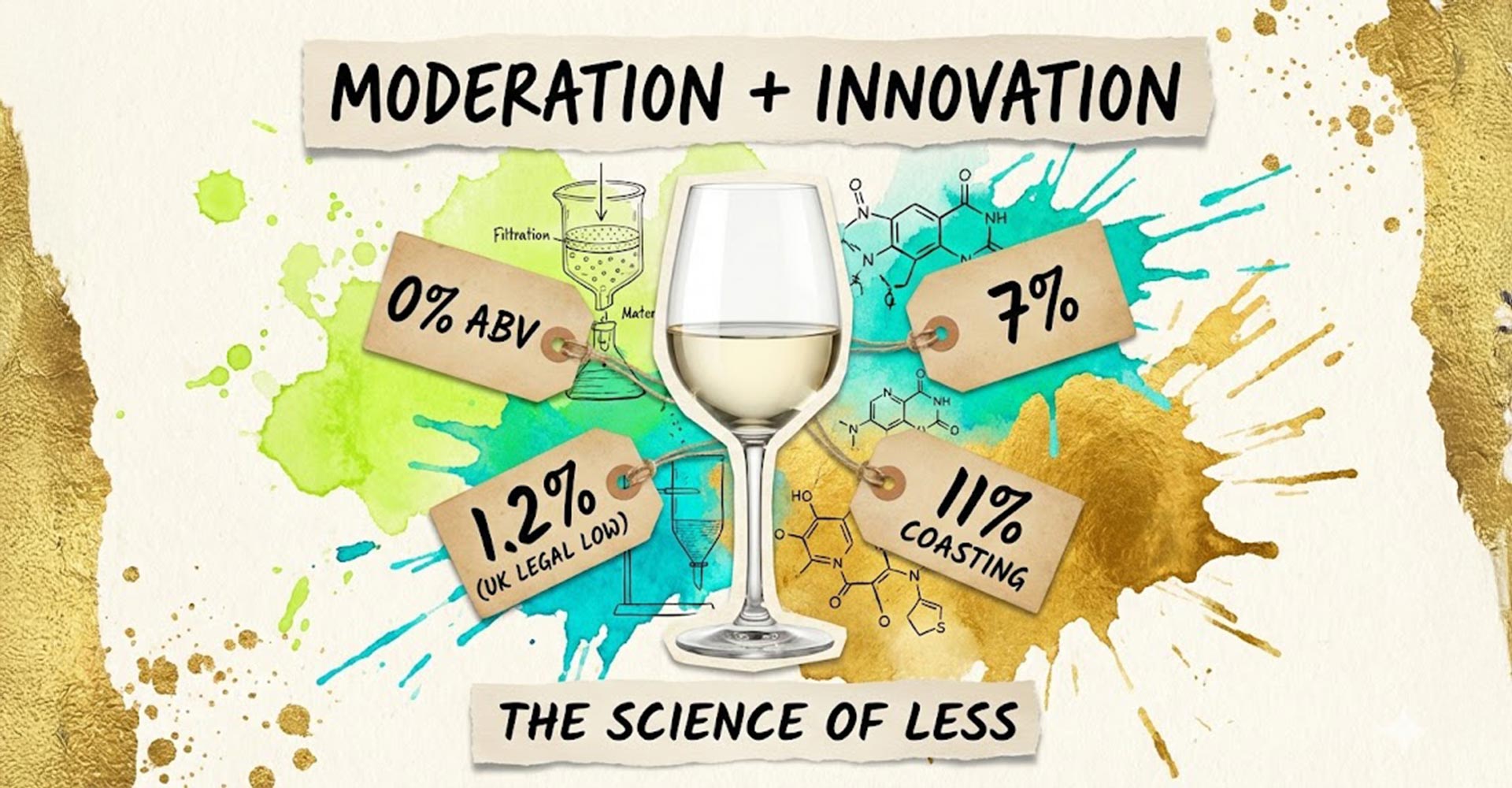
Driven by moderation, mindful drinking, tax pressure, and a collective desire to remember dinner conversations the next day, the category now spans everything from razor-sharp Mosel Rieslings at 7% to award-winning zero-alcohol sparklers that genuinely surprise seasoned drinkers.
Let’s separate fact from fluff, law from lifestyle, and science from marketing spin.
What Does “Low Alcohol” Actually Mean in the UK?
Here’s where things get messy fast.
In the UK, “low alcohol” is not a vibe, a feeling, or something you decide after your second glass. It’s a legal definition.
Under Department of Health and Social Care guidance, “low alcohol” means a maximum of 1.2% ABV. No wiggle room. No poetic licence.
Anything above that may feel light, restrained, or lunchtime-friendly, but it is not legally low alcohol.
That’s why an 11% ABV wine, while dramatically lighter than today’s 14.5% monsters, sits in what winemakers would call medium-low strength. Consumers often see it as a sensible alternative. The law does not.
The key UK definitions, without the legal migraine
- Alcohol-free: up to 0.05% ABV
- De-alcoholised: up to 0.5% ABV
- Low alcohol: up to 1.2% ABV
- Wine: generally must be at least 8% ABV
Drop below that 8% threshold, or remove more than 20% of the alcohol mechanically, and you can’t legally call it wine anymore. You’ve entered wine-based drink territory.
The EU has already softened this stance, allowing terms like de-alcoholised wine and partially de-alcoholised wine. The UK has not caught up yet, much to the frustration of producers and the WSTA.
How Do You Remove Alcohol Without Killing the Wine?
Removing alcohol is not like taking sugar out of tea. Ethanol carries aroma, texture, warmth, and body. Strip it out clumsily and you’re left with something thin, sour, and vaguely disappointed in itself.
Modern producers rely on two main techniques.
Spinning Cone Column (SCC)
This is vacuum distillation done properly.
Wine flows through a vertical column of spinning cones under vacuum, allowing alcohol to evaporate at low temperatures. Aromas are captured first, alcohol removed second, then the aromas are added back.
Pros:
- Excellent phenol retention
- Can even concentrate beneficial compounds
- Strong structure
Cons:
- Often higher perceived acidity
- Can feel lean if not finished carefully
Reverse Osmosis (RO)
This is mechanical filtration rather than heat-based.
Wine is pushed through membranes under pressure. Alcohol and water pass through, flavour compounds stay behind. The alcohol is removed from the liquid and the rest recombined.
Pros:
- Better fruit and floral retention
- More balanced mouthfeel
- Preferred by tasting panels
Cons:
- Can lose minerals
- Risk of feeling thin if badly handled
Most of the best producers now blend techniques or use finishing methods to rebuild texture. This is where quality lives or dies.
Naturally Lower-Alcohol Wines (The Clever Way)
The most convincing lower-alcohol wines aren’t engineered at all. They’re grown that way.
Mosel Riesling, Germany
Kabinett Rieslings regularly sit at 7–9% ABV and feel complete, precise, and quietly brilliant.
High acidity, a touch of residual sugar, and slate-driven minerality give them balance without relying on alcohol. They’re light on their feet but intellectually heavyweight.
Hunter Valley Semillon, Australia
This is the oddball genius of the low-ABV world.
Picked early, bottled around 10–11%, bone dry, and almost austere in youth. Then it ages into something honeyed, nutty, and astonishing over 10–20 years, without ever seeing oak.
Jancis Robinson calls it Australia’s gift to wine. She’s not wrong.
Vinho Verde, Portugal
Fresh, slightly spritzy, 9–11% ABV, and unapologetically joyful.
This is wine designed for immediate pleasure. Lime, green apple, Atlantic freshness. Proof that lower alcohol does not mean less fun.
Txakoli, Basque Country
Saline, high-acid, lightly fizzy, and poured from a height like a local performance art.
At around 10–11%, it’s one of the most food-friendly wines on earth. Anchovies, seafood, pintxos. Job done.
The Rise of Mid-Strength and “Coasting”
Here’s where behaviour really shifts.
UK sales data shows mid-strength wines (5–9% ABV) exploding in popularity, with growth running into the thousands of percent year on year.
This isn’t about abstinence. It’s about pacing.
“Coasting” means choosing two lighter drinks instead of one heavy hitter. You stay present, sociable, and upright. You also remember who you spoke to.
With 74% of UK adults now moderating their alcohol intake, this is not niche behaviour. It’s mainstream.
Tax plays a role too. Duty is now linked directly to alcohol content, pushing producers toward the 9–11% sweet spot where quality and price still align.
Award Winners: Proof This Is No Gimmick
Low and no-alcohol wines are now judged seriously and rewarded accordingly.
Standouts include:
- Kim Crawford Illuminate Sauvignon Blanc (7%): proper varietal character
- Manufaktur Jörg Geiger Visecco: complex, spiced, genuinely adult
- Zeronimo Leonis Blend (0%): arguably the best non-alcoholic red in the world
- McGuigan Zero Shiraz: a red that actually understands tannins
Sparkling styles consistently perform best. CO₂ provides texture where alcohol once lived. Physics, not magic.
What Actually Works Best?
Patterns are clear.
- Aromatic whites thrive
- High acidity is essential
- Sparkling wines outperform still
- Reds need serious structural thinking
The smartest brands stop pretending these wines are identical replacements. They build drinks that stand on their own terms.
Final Thoughts: The Future Is Balanced, Not Boring
Low and no-alcohol wine is no longer about compromise. It’s about control.
For drinkers, 11% remains the safe harbour. For innovators, 5–8% is the next frontier. For winemakers, the challenge is texture, not flavour.
The next decade won’t be defined by how much alcohol is in the glass, but by how intelligently it’s been handled.
And frankly, your head will thank you for it.
Frequently Asked Questions
Q: What is the legal definition of “Low Alcohol” wine in the UK?
In the UK, “low alcohol” is a legally protected term referring to drinks with a maximum of 1.2% ABV. Anything above this threshold, even if significantly lighter than standard wine, cannot be legally marketed as “low alcohol” under Department of Health guidance.
Q: How is alcohol removed from wine during production?
The two primary methods are Spinning Cone Column (SCC), which uses vacuum distillation to evaporate alcohol at low temperatures, and Reverse Osmosis (RO), a mechanical filtration process that separates alcohol and water from the wine’s flavor compounds before recombining them.
Q: Can a drink be called “wine” if it has no alcohol?
Legally, a product must generally be at least 8% ABV to be labeled as “wine” in the UK. Products below this, or those that have undergone significant dealcoholization, must typically be categorized as “wine-based drinks” or “alcohol-free” alternatives.