A lunch with Pasqua Wines at Azzurra proved that “unconventional” doesn’t have to mean noisy, gimmicky or wearing sunglasses indoors. From Sangue d’Oro to Hey French, Y by 11 Minutes, Mizzole Valpolicella and Pasqua + Smith Pinot Noir, this was a tasting full of confidence, colour, smart branding and seriously good wine.
For other wine producers wondering what success looks like in today’s market, this is a pretty good example of getting things right.
A lunch where the wine had better lines than most people in the room
Some wine lunches are really just spreadsheets wearing linen napkins. You sit down, someone says “minerality” with courtroom seriousness, and by the second course everyone is pretending they can detect wet chalk from a specific Tuesday in 2017.
This was not that.
Lunch with Pasqua Wines at Azzurra was a reminder that wine can be thoughtful without being stiff, technical without being tedious, and beautifully branded without feeling like it has been focus-grouped until all the life has escaped through the cork.
Pasqua calls itself the “House of the Unconventional”, which is the kind of phrase that could either mean genuine creative confidence or a marketing department left alone with too much espresso. In this case, thankfully, it means the former.
The tasting was hosted by Cecilia from Pasqua, who brought real warmth and context to the lunch. Not just what was in the glass, but why it existed. That makes a difference. A good wine host doesn’t simply introduce bottles. They connect the dots between place, people, vineyard, food and memory.
And yes, the wines were excellent, all of them.
Not “polite nod and write something kind in the notebook” excellent.
Properly excellent.
Pasqua Wines: a century old, but not acting its age
Pasqua’s story is one of the more interesting brand stories in modern Italian wine because it holds two ideas together at once: deep regional roots and a strong instinct for disruption.
This is a Veronese family wine business with more than a century of history and serious credentials in Veneto. But it is also a producer that names a wine “Hey French, You Could Have Made This But You Didn’t”, collaborates with Washington State winemaker Charles Smith, invests in Carole Bouquet’s Pantelleria project, and treats labels, art and storytelling as part of the wine experience rather than decorative afterthoughts.
Many wineries spend decades polishing their heritage story. Pasqua seems equally interested in writing the next chapter.
That matters because modern wine consumers don’t simply buy grape varieties and appellations. They buy personality, story, confidence and a reason to care. Pasqua understands this better than most. Its wines don’t just sit on the table. They start conversations.
In a world where too many labels still look as though they were approved by a committee of retired notaries, Pasqua’s bottles have the useful habit of making people pick them up.
Azzurra: a smart setting for a seafood-leaning Italian lunch

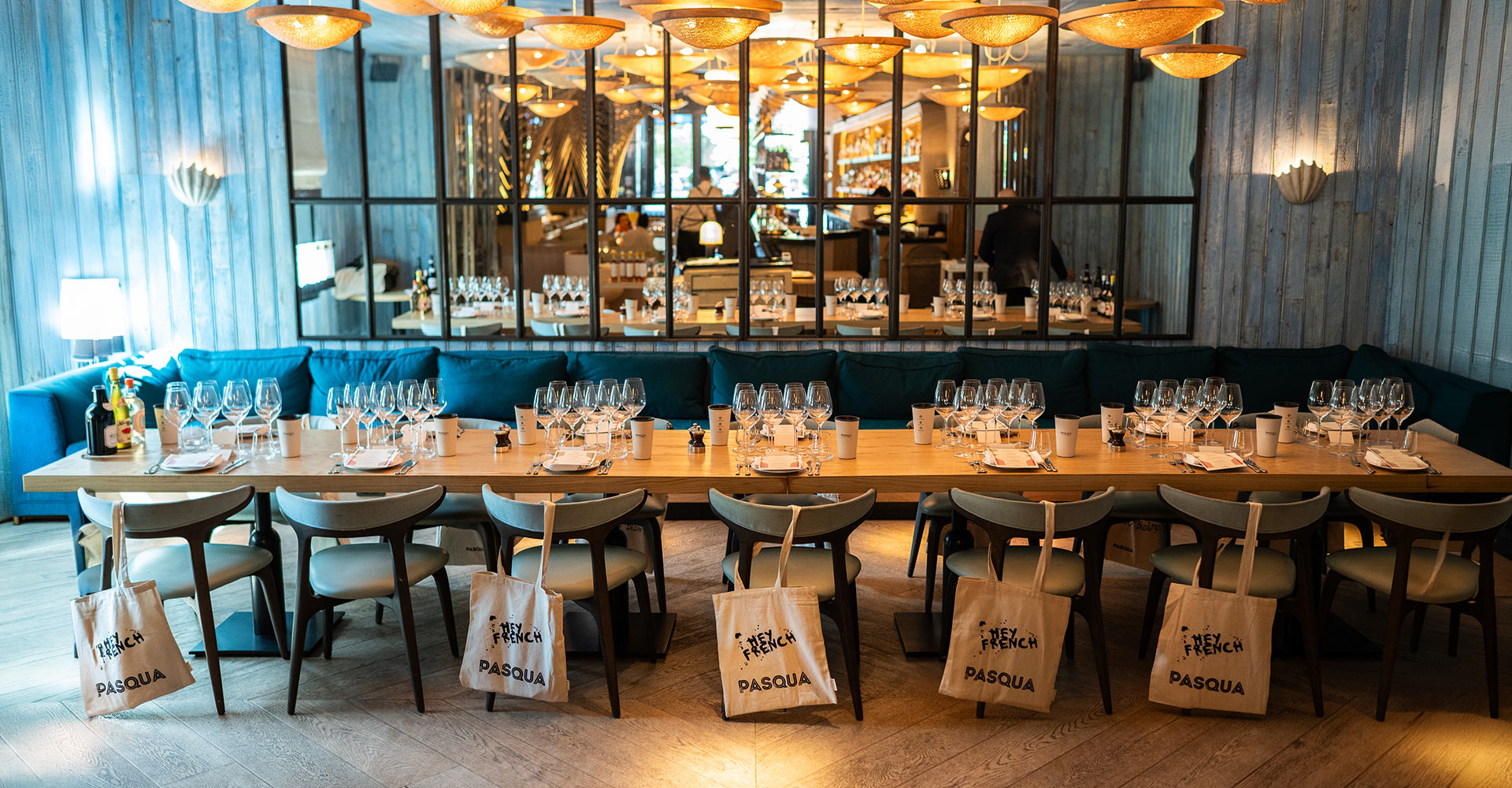
Azzurra was a very fitting venue for the tasting. The room had that clean, contemporary Italian feel: polished enough to feel special, relaxed enough not to make you fear the bread plate.
The menu had been put together with Chef Massimo Pellegrini, who brings more than 30 years of London experience while remaining unmistakably Italian in his cooking. The result was a lunch that felt considered rather than constructed. Italian food, Italian wines, and a clear sense that the pairings had been thought through rather than matched by someone panic-Googling “what goes with fish?”
The menu moved through Mediterranean flavours with an opening taste of Sangue d’Oro alongside savoury island-inspired bites, then red prawns, beef meatballs, lorighittas with octopus and fillet of turbot. It created a proper tasting journey rather than the usual “here is a wine, here is a plate, please clap” routine.
The turbot course was a particularly good moment. Braised in red wine and served with baby carrots, fennel and shimeji mushrooms, it had enough richness to handle Pinot Noir without trampling the fish.
That’s the trick with good restaurant pairing: it should feel inevitable afterwards, not like a sommelier lost a bet.

Sangue d’Oro: sweet wine escapes the dessert table
The lunch began, unusually and brilliantly, with Carole Bouquet’s Sangue d’Oro Passito di Pantelleria 2022.
This was a clever move. Sweet wine is too often treated like the final guest at a dinner party, brought out only when everyone is already full and slightly glazed. Cecilia made the point beautifully: call it “dessert wine” and you immediately tell people when they’re allowed to drink it. But sweet wine can work in far more interesting places, particularly with savoury, salty and tangy food.
Pantelleria is a small island off the coast of Sicily, closer to Tunisia than mainland Italy. It is only around 80 square kilometres and is famously windy, with Cecilia describing it as windy for roughly 340 days a year. Viticulture there is limited and genuinely heroic. Not heroic in the “I replied to emails on a Sunday” sense. Proper heroic. Old bush vines, planted in little hollows to protect them from the wind, worked entirely by hand.
The estate was previously owned by Carole Bouquet, who fell in love with the island around 20 years ago and invested in the property. The site totals around 30 hectares, but only about 4.6 hectares are planted with vines, many of them around 80 years old. This is small, precious production, and Pasqua’s involvement is about protecting a wine style and denomination that has been shrinking on the island.
Sangue d’Oro is made from Zibibbo, the local name for Muscat of Alexandria. In the glass, it was amber-gold, rich and aromatic, with dried apricot, orange peel, honey, spice and that essential balancing freshness that stops sweet wine becoming syrup.
With capers and Venetian-style sweet-sour savoury flavours, it made complete sense. The salinity of Pantelleria comes through in the wine, carried by the wind and the island’s marine environment, and that salty edge keeps the sweetness lively.
This wasn’t pudding wine waiting politely for a tart. It was an aperitif with a Mediterranean passport and a mischievous grin.
Hey French: the white wine with a raised eyebrow
Hey French Bianco Veneto IGT arrived with red prawns.
As names go, this is not a shy wine. “You Could Have Made This But You Didn’t” is part provocation, part wink, and part Italian hand gesture aimed vaguely north-west.
Cecilia explained that Hey French is one of Pasqua’s most unusual and innovative wines, inspired by the Champagne tradition of blending different vintages. In this fifth edition, it brings together six vintages, creating a layered white wine built around complexity rather than the neat simplicity of a single year.
The fruit comes from Monte Calvarina, in the easternmost part of the Soave Classico area. This matters because Soave Classico has a strong volcanic component, with basaltic soils that give a very different angle to white wines from the region. The vineyards sit in three plots and reach up to around 500 metres in elevation, which is high for the area.
The blend is predominantly Garganega, supported by Sauvignon Blanc and Pinot Blanc. The Garganega gives body, texture and regional identity. The Sauvignon Blanc adds lift without taking over the room like an overexcited guest. The Pinot Blanc helps add body and shape.
Cecilia also explained that the name was born from collaboration with an artist, and that while it is deliberately provocative, it is also a homage to France. Pasqua sees white Burgundy and top oak-aged Chardonnay as useful benchmarks for age-worthy white wine, while making the point that Soave can produce some of the most age-worthy whites in Veneto.
In the glass, Hey French had citrus, stone fruit, peach, herbs, almond and a lovely mineral line. Served with the beef meatballs in tomato sauce, it brought freshness and texture to the pairing, balancing the richness of the meat while its acidity and savoury complexity worked neatly with the tomato-based sauce.
This is not a “safe” white wine. It’s not the bottle you pour for someone who wants their wine to be neutral and easy to ignore. It has structure. It has attitude. It also has a name that practically elbows you in the ribs until you pay attention.
Y by 11 Minutes: rosé gets its grown-up shoes on
Served with the red prawns, this rosé showed exactly why serious rosé deserves a place at the table. Bright, textured and food-friendly, it had the freshness to complement the sweetness of the prawns while bringing enough depth and savoury character to make the pairing genuinely memorable.
Cecilia explained that 11 Minutes is the younger, fresher rosé in the family, while Y by 11 Minutes is the more serious, gastronomic version. The “Y” represents the three grape varieties: Corvina, Trebbiano di Lugana and Carmenère.
The Carmenère has an interesting local story. It was planted in the Lake Garda area because it was originally thought to be Cabernet Franc. Later, it was recognised as Carmenère, and a small amount remains in the area. In Y by 11 Minutes, it helps bring structure and character.
The wine comes from organically grown vineyards, with the red and white varieties fermented separately before blending. It stays on lees for around three months, and around 40% of the wine finishes fermentation in oak, giving extra texture, richness and a touch of smokiness. It is released slightly later than its younger sibling, which helps explain the added depth.
This wasn’t a poolside whisper of pale pink. It had shoulders. Still fresh, still bright, still dangerously drinkable, but with enough weight and savoury grip to handle the richness and delicate sweetness of the prawns while maintaining its freshness and poise.
Rosé has spent years being treated like a summer accessory, somewhere between sunglasses and poor decisions. This was a reminder that good rosé can absolutely sit at the grown-up table.
Cecilia Beretta Mizzole Valpolicella Superiore 2019: quiet confidence
The Cecilia Beretta Mizzole Valpolicella Superiore 2019 came with lorighittas and octopus, with garlic, chilli and tomato sauce.
This was one of the most elegant pairings of the lunch.
Cecilia described this as a pure expression of Valpolicella, without appassimento, without ripasso, and without the drying process associated with Amarone. Just straight, pure juice from a single vineyard called Mizzole, on the eastern side of Valpolicella.
That distinction matters. Valpolicella is often viewed through the lens of Amarone and Ripasso, which are wonderful styles, but they can also overshadow the beauty of fresh, pure, age-worthy Valpolicella. Here, the aim was to show fruit, place and evolution.
Pasqua’s winery is about 10 kilometres from the centre of Verona, already in Valpolicella, but on the eastern side. Cecilia explained that Valpolicella is divided broadly between the Classico area to the west, towards Lake Garda, and the eastern side, which runs towards Soave and Vicenza. Pasqua has been making Valpolicella in this area for more than 100 years.
The blend is based on the traditional Valpolicella varieties Corvina, Corvinone and Rondinella. These grapes provide the wine’s characteristic cherry fruit, freshness and structure, helping it develop complexity with age.
In the glass, it had cherry, dried herbs, spice and a supple structure. It wasn’t trying to shout. It didn’t need to. Good Valpolicella Superiore often has that wonderful ability to be serious without wearing a waistcoat.
With the octopus, garlic and tomato, it found a lovely balance: enough acidity for the sauce, enough savoury depth for the seafood, enough polish to keep everything feeling elegant.
Cecilia made a very good point: Valpolicella can be fresh, versatile, age beautifully and even be served slightly chilled. It can also be a great alternative to Pinot Noir, which made the next pairing particularly clever.
This was the wine equivalent of someone at lunch who says less than everyone else but makes the best point in the room. It was also my favourite of the tasting.
Pasqua + Smith Pinot Noir: when Veneto meets rock-and-roll Washington energy
The fillet of turbot was paired with Pasqua + Smith Pinot Noir Veneto IGT, Edizione 1.
This is where the Pasqua story becomes especially interesting. The collaboration with Charles Smith brings together two producers with a shared appetite for creative disruption.
Cecilia explained that Riccardo and Alessandro Pasqua met Charles Smith through their work in the United States, where Pasqua has direct distribution. Riccardo had lived there for more than eight years and had long admired Smith’s winemaking and his ability to communicate with consumers differently. The labels are eye-catching and innovative, but the winemaking remains elegant, pure and clean.
Pasqua now distributes Charles Smith’s wines internationally, and the relationship has developed into this Pinot Noir project.
The wine itself is 100% Pinot Noir from Valpolicella. That alone is unusual. Pinot Noir is not widely planted there, but Pasqua found a site that made sense: around 10 hectares of vines, close to 30 years old, planted by a grower Cecilia described as a pioneer for Pinot Noir in the area.
The vineyard sits at around 600 metres elevation, which is key. Pinot Noir needs a cooler climate, and the altitude gives freshness, while the diurnal shift helps develop flavour. The soils include clay and limestone, with good drainage, and the site has an amphitheatre-like shape that helps with light exposure.
The wine is also multi-vintage, drawing on Pasqua’s experience with Hey French. This first edition blends 2018, 2022, 2023 and 2025.
In the glass, it had red fruit, spice, freshness and a supple texture. With the turbot, braised in red wine and served with baby carrots, fennel and shimeji mushrooms, it made complete sense. The wine had enough delicacy for the fish and enough savoury shape for the dish.
Pinot Noir can be a drama queen. Too thin and it vanishes. Too heavy and it starts behaving like a Syrah in ballet shoes. This one kept its balance.
It was also a neat demonstration of what Pasqua does well: take a classic idea, tilt it slightly, and make you reconsider where the boundaries are.
The branding lesson: Pasqua understands attention
There’s a useful commercial point here too.
Pasqua’s wines are not just well-made, they are well-positioned. That distinction matters.
The modern wine shelf is brutal. Thousands of bottles, tiny windows of attention, consumers who are curious but often overwhelmed, and labels competing silently like contestants in a very polite beauty pageant.
Pasqua gives people a reason to stop.
Sangue d’Oro does it through rarity, place and preservation. Hey French does it with provocation and ambition. Y by 11 Minutes adds premium shape to rosé. Cecilia Beretta delivers regional credibility. Pasqua + Smith brings collaboration and creative energy.
This is not random. It’s portfolio architecture.
Wine brands often talk about “storytelling” as if sticking a family crest on a back label is enough. Pasqua shows what modern wine storytelling can look like when it is connected to design, product quality, cultural confidence and actual drinking pleasure.
Bottom line: the wines were excellent, but the story made them stick
The strongest tastings are the ones where the wines are good enough to impress you in the moment, and the story is good enough to stay with you afterwards.
That was the case here.
The wines showed range, from golden Passito and textured white to gastronomic rosé, elegant Valpolicella and expressive Pinot Noir. The restaurant gave them a strong platform. The food pairings were thoughtful and tasted excellent. The atmosphere was relaxed, polished and generous.
Most importantly, Cecilia from Pasqua gave the tasting context and life. A good host doesn’t just explain the wines. They connect the dots between vineyard, family, brand, bottle and glass.
That’s what made the lunch work.
Final thoughts
Pasqua is a fascinating producer because it doesn’t seem trapped by the false choice between tradition and modernity.
It respects Veneto. It understands Valpolicella. It knows the value of heritage. But it also knows that heritage alone is not enough if the next generation of drinkers doesn’t care.
So it experiments. It designs boldly. It names wines with personality. It partners creatively. It invests in projects that protect fragile wine traditions. It makes bottles that look contemporary but still deliver in the glass.
That last part matters most.
Because a striking label may get someone to pick up the bottle once. The wine has to make them come back.
On this showing, Pasqua does both.
A huge thank you to Cecilia from Pasqua for a generous, insightful and genuinely enjoyable tasting, and to Azzurra for hosting a lunch that gave the wines the stage they deserved.
The House of the Unconventional poured very well indeed.