Wine by the glass used to mean playing it safe with the house Sauvignon or gambling on a red that may have been open since Tuesday. Not anymore. Better preservation technology, changing drinking habits and a desire to drink less but better are transforming restaurant wine lists, putting mature, unusual and genuinely exciting bottles within reach, one glass at a time.
Wine by the glass has finally become interesting
There was a time when ordering wine by the glass felt like the vinous equivalent of choosing the airport sandwich. It would probably be fine, you knew roughly what you were getting, and expectations were sensibly kept under control.
Thankfully, things have changed.
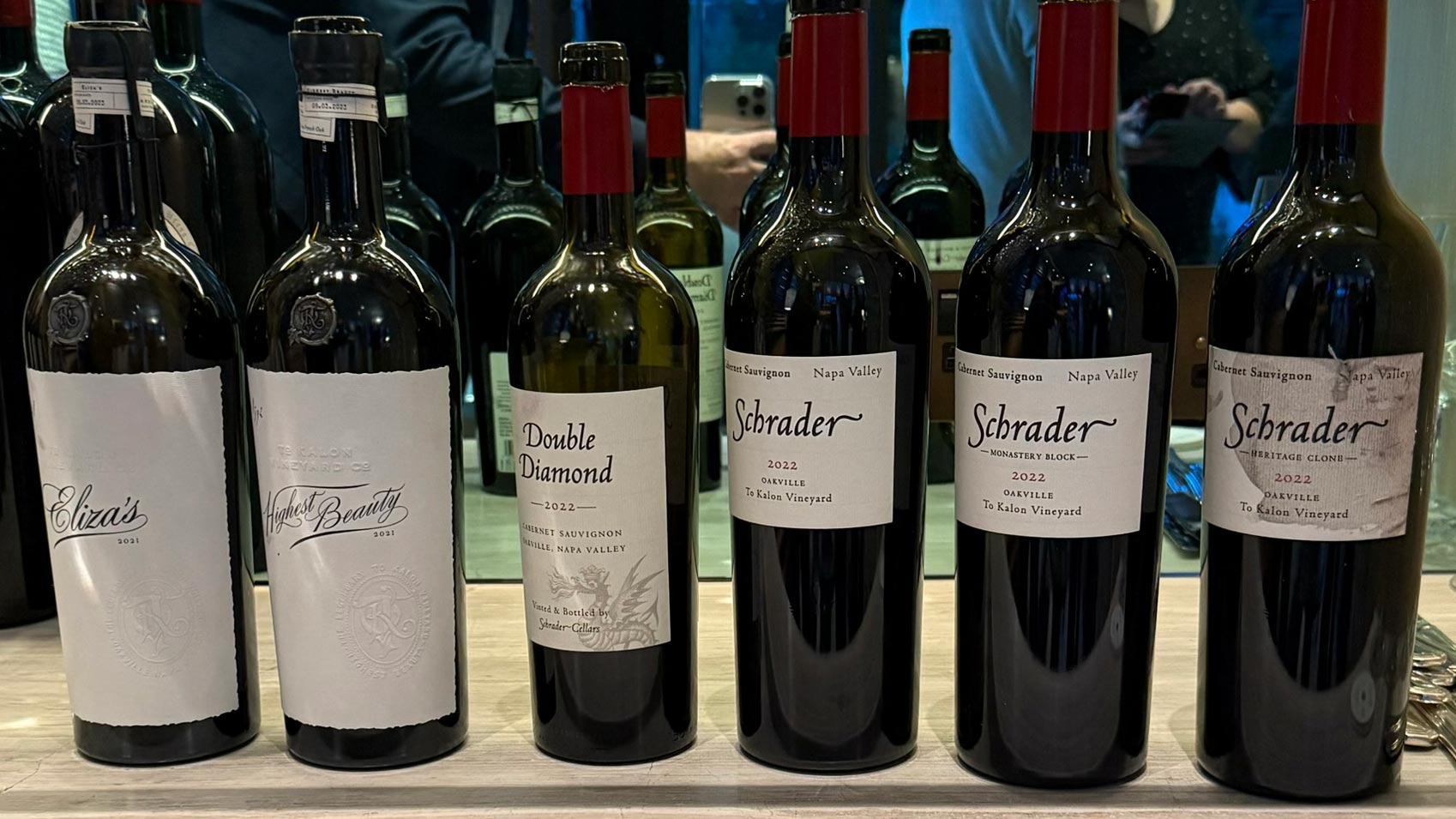
Some of the most interesting restaurant wine lists now offer genuinely serious wines by the glass: mature Bordeaux, Premier Cru Burgundy, Northern Rhône Syrah, grower Champagne, indigenous Italian varieties and wines from regions many diners would hesitate to buy by the bottle.
Part of this is technological. Part is economic. And quite a lot of it comes down to the fact that our drinking habits are changing.
Research in the Liberty Wines Premium On-Trade Wine Report 2026 shows UK on-trade wine volumes falling 8% year on year, while premium-sector value has also declined. The proportion of UK wine consumption taking place in pubs, bars and restaurants has dropped from 20% in 2016 to 13.2%.
In other words, we’re drinking more of our everyday wine at home.
So when we do go out, restaurants need to give us something we can’t simply pick up in Waitrose on the way home.
A fascinating glass of wine is one way of doing exactly that.
Why are restaurants offering better wines by the glass?
The simple answer is that people increasingly want to drink less, but drink better.
Bibendum’s 2026 trend research highlights the continuing rise of moderation and low/no drinking, with the low- and no-alcohol category growing 24% in on-trade value.
That doesn’t necessarily mean people have stopped wanting great wine.
It can mean the opposite.
Someone who previously ordered a £65 bottle may now prefer two carefully chosen glasses over dinner. A couple eating different dishes might want completely different wines. And a diner curious about a £150 bottle of Burgundy may happily spend £25 experiencing a glass while being rather less enthusiastic about explaining a three-figure bottle to their bank manager.
This is where premium by-the-glass lists become genuinely clever.
They reduce the financial risk of discovery.
Wine talks endlessly about encouraging consumers to explore, then has traditionally asked them to spend £70 on an unfamiliar grape from an appellation they can’t pronounce. It’s not difficult to see the slight flaw in that arrangement.
A 75ml or 125ml pour changes the equation.
Coravin changed the economics
The biggest enabler has been preservation technology.
A traditional open bottle immediately begins interacting with oxygen. That doesn’t mean it falls over dead the moment the cork comes out, but delicate aromas and flavours gradually deteriorate.
For fast-selling house wines this isn’t much of a problem. If you’re pouring Marlborough Sauvignon Blanc all evening, the bottle probably won’t have enough time to contemplate its mortality.
Rare Burgundy is rather different.
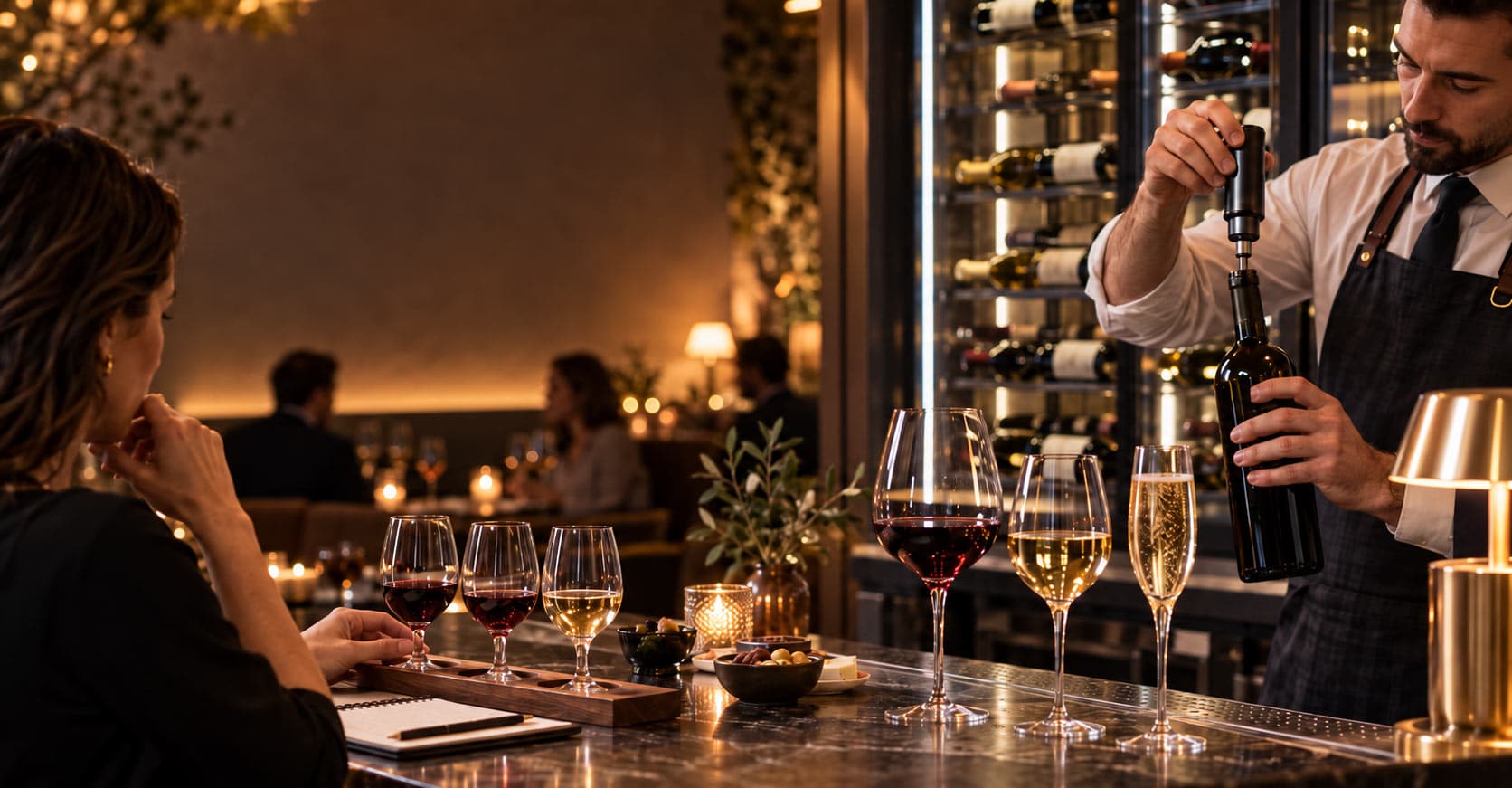
Systems such as Coravin Timeless use a needle to pass through the cork without actually removing it. Wine is extracted while argon replaces the missing liquid, greatly reducing oxygen exposure.
I use Coravin myself, and that’s exactly why I love it. I don’t need to decide that opening an expensive bottle means drinking it that evening. I can have a glass, revisit it later and treat the bottle more like a small personal wine list than an urgent drinking commitment.
For restaurants, the commercial implications are much bigger.
A bottle that previously had to sell within a day or two can potentially be offered over weeks or months, depending on the wine, closure and system being used.
Other restaurants use Enomatic-style dispensers, where opened bottles sit within a controlled inert-gas system. These generally preserve wine for weeks rather than months, but they’re excellent for larger by-the-glass programmes.
Sparkling wine has also joined the party. Dedicated systems such as Coravin Sparkling maintain pressure using CO₂, allowing Champagne and other sparkling wines to remain viable after opening.
None of these systems performs miracles. They can’t cure cork taint, reverse heat damage or resurrect a bottle that’s already past its best.
Wine technology has become impressive. It has not yet achieved necromancy.
Bottom Line
If you see serious wines being offered through Coravin or a professional dispensing system, that’s usually a very good sign. It means the restaurant can offer more ambitious bottles without depending on someone ordering the remaining four glasses before closing time.
Why can one glass look so expensive?
This is where diners sometimes become suspicious.
A bottle costs £60 on the wine list, yet a 175ml glass is £18. Four glasses would generate considerably more than the bottle price. Cue muttering about restaurant mark-ups.
But by-the-glass wine carries different economics.
Restaurants have to account for potential wastage, preservation gas and equipment, refrigeration, staff training, cellar management and considerably more glassware going through commercial dishwashers.
Premium programmes add another complication: inventory risk.
A restaurant buying a £50 wholesale bottle and selling it whole knows its stock has gone in one transaction. Selling the same wine in small pours may take days or weeks.
The research supplied for this article indicates that many venues effectively price the first substantial glass to recover much of the bottle’s wholesale cost. High-end hospitality may work towards gross margins of 75% to 80% on some by-the-glass wines, although the true contribution falls once preservation, staffing, glassware and wastage are included.
My day job is branding and marketing, including work across hospitality and premium businesses, and this is where wine pricing becomes commercially interesting. Customers don’t care what your margin model says if the experience feels poor.
Conversely, I’ll happily pay a premium for a beautifully served glass of something I’d never justify buying by the bottle.
Value and cheapness are not the same thing.
The best wine-by-the-glass lists encourage discovery
One of the most exciting results of better preservation is that sommeliers can take more risks.
Liberty’s research shows increasing interest in grape varieties outside the traditional top sellers, with Portugal, Spain and Italy benefiting particularly from curiosity around indigenous grapes.
Bibendum similarly identifies growing interest in fresher, terroir-driven wines. Fiano reportedly achieved 63% annual volume growth, while regions such as Savoie and Jura have become increasingly visible on premium UK restaurant lists.
Aligoté has also enjoyed something of a rehabilitation. Once treated as Burgundy’s relative who was asked to use the side entrance, it’s increasingly appearing on serious lists in its own right.
The same thing is happening in sparkling wine, where Crémant, English sparkling wine, Cava and Cap Classique increasingly sit between everyday Prosecco and expensive Champagne.
This is exactly what a good by-the-glass list should do.
It should allow you to explore without requiring an act of financial courage.
Where is the best value on a wine list?
Very often, not at the bottom and not at the top.
Entry-level wines can carry substantial percentage mark-ups because they’re high-volume sellers. Famous luxury labels can also command generous margins because customers recognise them.
The interesting territory is frequently somewhere in the middle.
Look for regions such as Chinon, Bierzo, Gavi, Lugana, lesser-known parts of Portugal or emerging South American regions. These wines often give sommeliers more freedom because diners aren’t carrying a fixed retail price around in their heads.
A restaurant may therefore price them more attractively simply because it wants people to try them.
This is one of my favourite ways to order wine. Rather than asking, “What’s your best red?”, give the sommelier a price and a little freedom.
Something along the lines of: “I’m around £15 to £20 a glass. What have you got that’s interesting and drinking particularly well?”
You’re far more likely to discover something memorable.
In the UK, remember the 125ml rule
There’s also a useful bit of UK wine law many diners overlook.
Licensed premises selling still wine by the glass must make 125ml measures available, alongside the familiar 175ml and 250ml options.
That’s particularly useful if you want to explore several wines with different courses.
Instead of two enormous glasses of one wine, you might have 125ml of white with your starter and 125ml of red with the main.
Even more interestingly, measures below 75ml sit outside the standard specified-quantity requirements. This is why restaurants can offer 25ml or 50ml tasting pours and wine flights.
So if you’ve spotted a spectacular wine being Coravined at £40 for 125ml, ask whether they’ll pour 50ml.
Some will.
Suddenly that £200 bottle you’ve always wondered about becomes a much more manageable experiment.
Three red flags when ordering wine by the glass
There are a few things I’d watch for.
First, vague wine descriptions. A list that says only “Sauvignon Blanc, New Zealand” tells you very little. Good lists tend to identify the producer, region and, where relevant, vintage.
Second, expensive open bottles sitting warm on a back bar. Wine deteriorates faster when warm. Serious by-the-glass bottles should either move quickly or be properly refrigerated and preserved.
Third, nobody knows when the bottle was opened. Good wine teams monitor open bottles and regularly taste them. If you’re paying premium money and the waiter looks startled by the question, that’s useful information in itself.
And if an expensive wine has been opened conventionally, there’s absolutely nothing wrong with asking for a small taste before accepting the glass.
A good restaurant would much rather discover an oxidised bottle before you’ve paid £28 for it.
Bottom Line
Ask three simple questions: How is it preserved? When was it opened? Can I taste it? None is remotely unreasonable when you’re buying premium wine by the glass.
How to order wine by the glass smarter
My approach is increasingly simple: use by-the-glass wine to drink things you wouldn’t normally order.
Try the unfamiliar grape.
Compare two regions.
Ask for a smaller pour of something expensive.
Match different wines to different courses rather than forcing one bottle to negotiate diplomatic relations between sea bass and steak.
Most importantly, talk to the sommelier and give them a real budget. Pointing at a price on the list is perfectly acceptable if you don’t want to announce your spending limit to the table.
The resurgence of premium wine by the glass is good for restaurants because it creates opportunities to trade customers up and makes ambitious cellar stock more commercially viable.
But it’s arguably even better for us.
For years, one of wine’s great contradictions has been that we’re constantly encouraged to explore while being financially rewarded for sticking to what we already know.
Modern by-the-glass programmes are finally changing that.
And if somebody wants to pour me 50ml of excellent old Burgundy rather than insisting I remortgage the house for the bottle, I’m very much here for it.