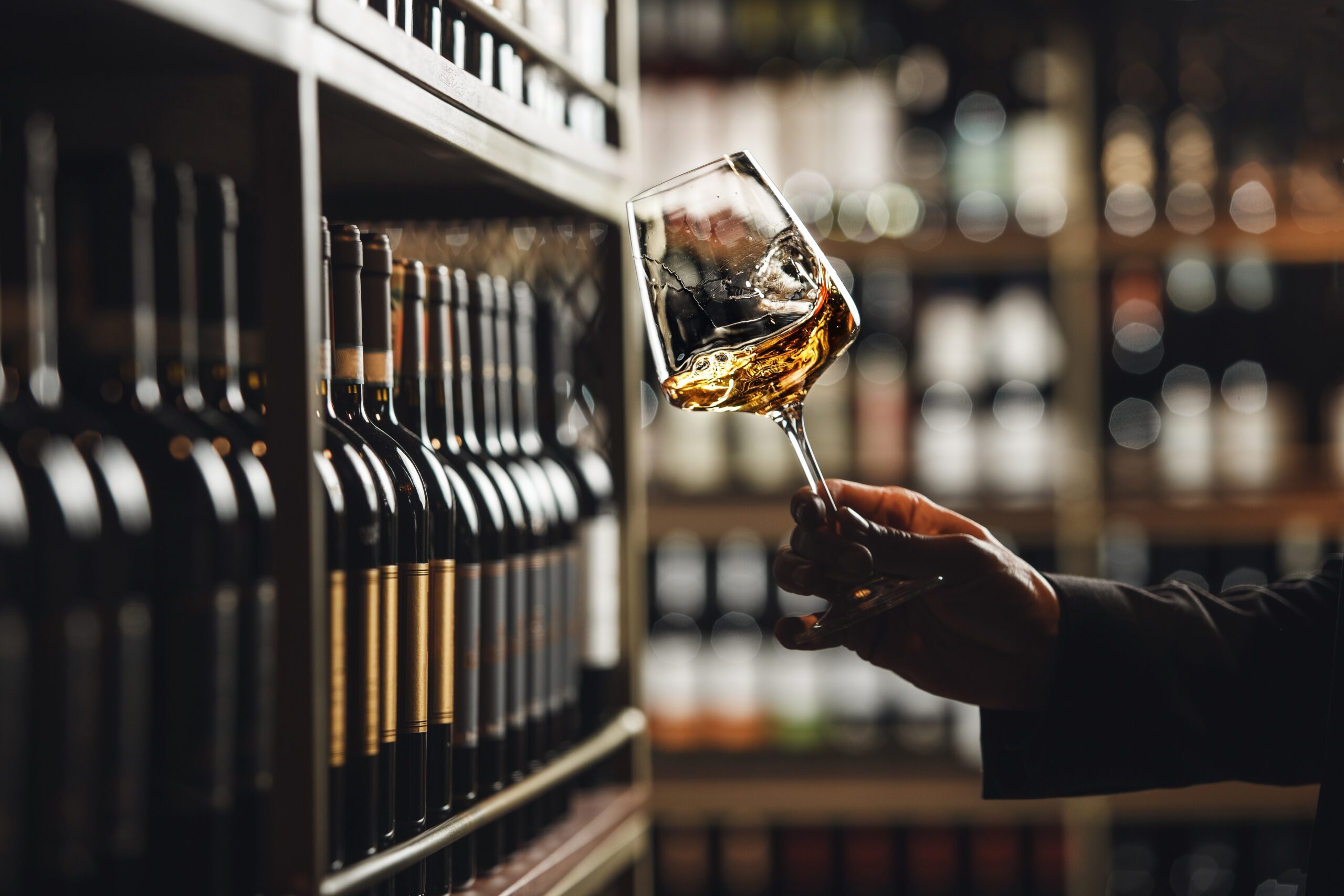
The short answer
Wine tastes different to everyone because your brain is doing far more work than your palate. Genetics, mood, environment, expectations, and even who you’re sitting with all shape what you experience. The wine isn’t changing. You are.
From experience, this is exactly why buying a case or two straight after a big tasting isn’t always the masterstroke it feels in the moment. Surrounded by energy, conversation, and a bit of momentum. Wines often show brilliantly. isn’t always the masterstroke it feels in the moment. Surrounded by energy, conversation, and a bit of momentum, wines often show brilliantly. Open them weeks later at home and they can feel… different. Equally, that unforgettable bottle on a Tuscan hillside seems to carry the memory with it. You’re not just tasting the wine again, you’re reliving the moment. That’s not imagination. It’s how perception works.
The great wine illusion (and why it matters)
Here’s the slightly inconvenient truth for anyone who’s ever nodded knowingly while someone says “I’m getting a hint of truffle”.
Wine isn’t objective.
It feels like it should be. It looks precise, scientific, almost clinical at times. But in reality, what you’re tasting is less about what’s in the glass and more about what’s going on inside your head.
Wine is a personal affair. Not in the romantic sense, although a good Bordeaux has been known to cause a few long-term commitments. It’s personal because every sip is filtered through your biology, your memories, your expectations, and your surroundings.
Same bottle. Different people. Completely different experience.
Let’s unpack why.
Your genes are quietly judging your wine
Before you even swirl the glass, your genetics have already decided what kind of taster you are.
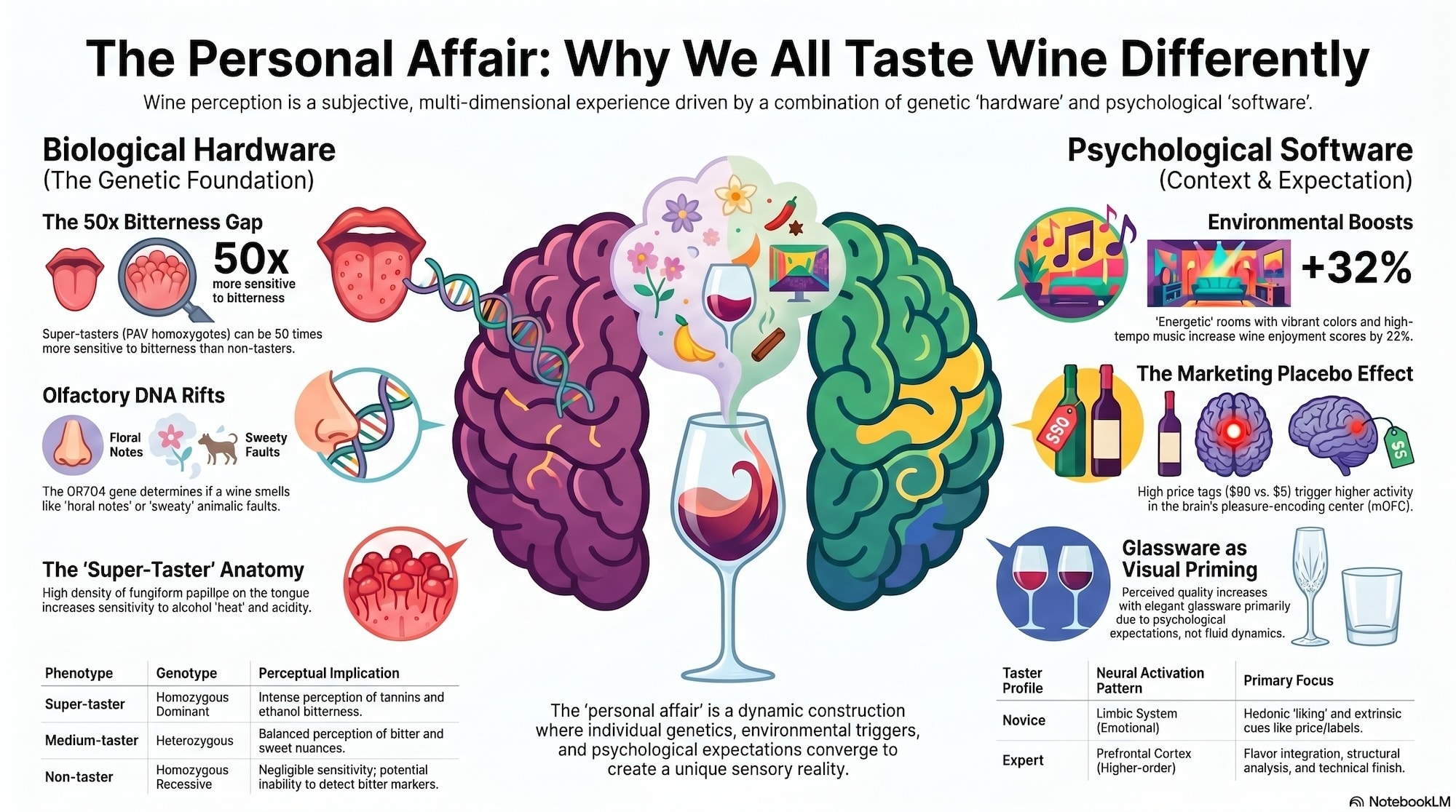
Some people are what science calls “super-tasters”, often the ones who end up as wine professionals. Others are blissfully less sensitive. The difference comes down to tiny variations in your DNA, particularly in receptors that detect bitterness.
In simple terms:
- Some people find tannins bold and structured
- Others find them aggressive and borderline offensive
That big, muscular Brunello you love? Someone else might experience it as a mouth-drying assault.
Neither of you is wrong. You’re just wired differently.
It doesn’t stop at taste. Smell, which does most of the heavy lifting in wine, varies wildly too. Certain aroma compounds can smell floral and elegant to one person and… let’s say less elegant to another.
So next time someone disagrees with your tasting notes, it might not be their palate. It might be their biology.
It reminds me of my father, who introduced every bottle with absolute confidence as, “this is the best bottle you’ll ever taste.” Slightly biased, obviously. But it worked. The expectation was set, the moment elevated, and somehow the wine always seemed to rise to the occasion.
The room matters more than you think
Ever noticed how a wine tastes better on holiday?
That’s not nostalgia talking. That’s your brain stitching together the entire environment into the experience.
Research shows that:
- Lively, energetic settings can boost enjoyment significantly
- Music can subtly change how we perceive flavour
- Lighting and atmosphere influence how “good” a wine feels
Which explains the classic problem. Studies have shown that environment alone can significantly increase perceived enjoyment, so what feels exceptional in the moment doesn’t always travel home with the bottle. You discover a rosé in Provence that feels like the best thing you’ve ever tasted. You bring a case home, open a bottle on a rainy Tuesday in Coventry… and suddenly it’s just decent.
The wine didn’t change. The setting did.
It’s not the glass. It’s what you think about the glass
Let’s address a sacred cow.
Glassware matters… but not always for the reason people think.
Yes, shape can influence aroma delivery slightly. But the bigger impact is psychological. Hand someone a thin, elegant glass and they expect quality. And that expectation feeds directly into their perception.
Same wine. Different glass. Suddenly more “refined”.
Your brain is easily impressed.
Other people are quietly influencing your palate
Wine tasting isn’t just sensory. It’s social.
Put people in a group and something interesting happens. They start to influence each other, often without realising.
If someone says, “I’m getting blackberry and spice”, there’s a good chance others will start to find it too.
Not because they’re pretending. Because expectation shapes perception.
I’m exactly the same. If I know the grape profile, I find myself looking for those flavours. And if someone says “peach”, suddenly… there it is. My palate isn’t always the most reliable narrator, but it’s a perfect example of how easily suggestion can steer what we taste.
We’re social learners. We adapt, align, and occasionally override our own senses to fit the group.
Which is why the bravest person at a tasting is the one who says, “I actually don’t get that at all.”
Expertise rewires your brain (literally)
Here’s where it gets interesting.
Experienced wine drinkers don’t just know more. Their brains work differently.
Beginners tend to focus on whether they like a wine or not. Simple, emotional, instinctive.
Experts? They analyse structure, balance, finish. They’ve built a mental framework that lets them break wine down into components. For example, instead of just thinking “I like this”, they might recognise the vanilla note from oak ageing, the grip of tannins, or how acidity lifts the finish.
It’s not about being better. It’s about being trained to notice different things.
Think of it like music. A casual listener hears a song. A trained musician hears layers, technique, and structure.
Same principle. Same glass.
Here’s where it gets interesting.
Experienced wine drinkers don’t just know more. Their brains work differently.
Beginners tend to focus on whether they like a wine or not. Simple, emotional, instinctive.
Experts? They analyse structure, balance, finish. They’ve built a mental framework that lets them break wine down into components.
It’s not about being better. It’s about being trained to notice different things.
Think of it like music. A casual listener hears a song. A trained musician hears layers, technique, and structure.
Same principle. Same glass.
Price changes how wine tastes. Seriously.
This is where things get a bit awkward.
Studies have shown that when people believe a wine is more expensive, they actually enjoy it more. Not pretend enjoyment. Real, measurable pleasure.
Brain scans confirm it. The part of the brain linked to reward lights up more when the price is higher.
Which means:
- Expensive wine can taste better because you expect it to
- Cheap wine can taste worse because you assume it should
Your brain isn’t lying. It’s just… helping.
Which is exactly why blind tastings are so valuable. Strip away the price, the label, the story, and you’re left judging the wine on what’s actually in the glass. In my experience, it’s often a humbling reset and a far more honest way to understand what you genuinely enjoy.
Your attention decides what you notice
Wine is full of detail. More than you can possibly process at once.
So your brain makes a choice. It focuses.
If someone mentions acidity, you’ll start noticing freshness. If someone talks about oak, suddenly you’re picking up vanilla everywhere.
It’s not magic. It’s attention.
And once you’ve noticed something, it’s hard to un-notice it. Welcome to the wine version of hearing a new word and suddenly seeing it everywhere.
So what does this all mean?
It means this.
There is no single “correct” way to experience wine.
Your perception is built from:
- Your biology
- Your environment
- Your experience
- Your expectations
- Your focus
Layer all that together and you get something unique. A personal interpretation of what’s in the glass.
Which is exactly what makes wine interesting.
The takeaway (and a bit of honesty)
Wine isn’t just a drink. It’s an interaction.
Between chemistry and consciousness. Between what’s real and what’s perceived.
So the next time you’re tasting a wine and thinking, “Am I getting this right?”
You are.
Because the only thing that matters is what you experience.
Even if it’s not truffle.