As the 2026 growing season unfolds, wine regions across Europe, North America and beyond are once again watching the skies with unease. Wildfires are no longer distant, seasonal anomalies, they are an increasingly familiar backdrop to harvest. What makes this year particularly challenging is not just the presence of smoke, but the difficulty of predicting its impact. A vineyard can look untouched, the fruit can appear perfectly healthy, and yet the chemistry inside the berries may already be changing in ways that only become apparent months later in the bottle. In this environment, growers, wineries and buyers are being forced to manage a risk that is largely invisible, highly variable, and still not fully controllable.
For many winemakers, it also reinforces a harder truth: making wine increasingly feels like a fight against nature that resets every single year. Just when conditions seem stable, a single smoke event can undo months of careful work.
The biggest threat isn’t always the flames
Wildfires have become an unfortunate feature of modern wine growing. From California to Australia, from Portugal to southern France, producers are becoming increasingly familiar with smoky skies during the growing season.
What makes the current moment so difficult is not simply the presence of fire, but the uncertainty it creates. A vineyard may sit under clear skies one day and under a drifting smoke plume the next, with no obvious way to predict duration, intensity or chemical composition.
Most people naturally assume the greatest losses come from vineyards being destroyed by fire. While that certainly happens, it’s surprisingly localised. Entire vineyards are rarely consumed. Smoke, however, has no respect for property boundaries.
A plume can drift for tens or even hundreds of kilometres, settling over valleys that never see a flame. One vineyard may emerge completely unaffected while another, just a few miles away, loses an entire vintage despite every vine remaining perfectly green.
For growers, this is one of the most emotionally difficult aspects of modern viticulture. You can do everything right, canopy management, irrigation, harvest timing, and still lose a year to something you cannot see, smell in the vineyard, or fully measure in time.
Wine has always relied on nature behaving itself. Increasingly, nature is reminding producers that it does not operate on human schedules.
What actually causes smoke taint?
The answer lies in chemistry.
When forests burn, lignin within wood breaks down, releasing volatile phenols including guaiacol, cresols and syringol. These compounds travel within smoke plumes and eventually settle across vineyards.
Once they reach grape berries they don’t simply sit on the surface.
The compounds pass through the waxy skin and trigger the vine’s own defence mechanism. The grape rapidly converts these volatile compounds into odourless phenolic glycosides by attaching sugar molecules using naturally occurring UDP-glycosyltransferase enzymes.
At this stage there is often little to smell.
That’s precisely what makes smoke taint so commercially dangerous.
From a winemaker’s perspective, this is where the real anxiety begins. Fruit can look pristine at harvest, ferment normally, and still reveal problems later in tank or bottle. It is not uncommon for producers to describe it as one of the most frustrating forms of uncertainty in modern winemaking, because the damage is effectively “hidden” until chemistry decides to release it.
Why smoke doesn’t affect every vineyard equally
One of the most frustrating aspects of smoke exposure is its unpredictability.
Distance from a wildfire is only one factor.
Fresh smoke contains much higher concentrations of volatile phenols than smoke that has travelled for many hours. As plumes move through the atmosphere they become diluted, chemically altered and dispersed.
Topography adds another layer of complexity.
Mountain passes, river valleys and evening temperature inversions can funnel dense smoke into one vineyard while neighbouring blocks escape almost untouched.
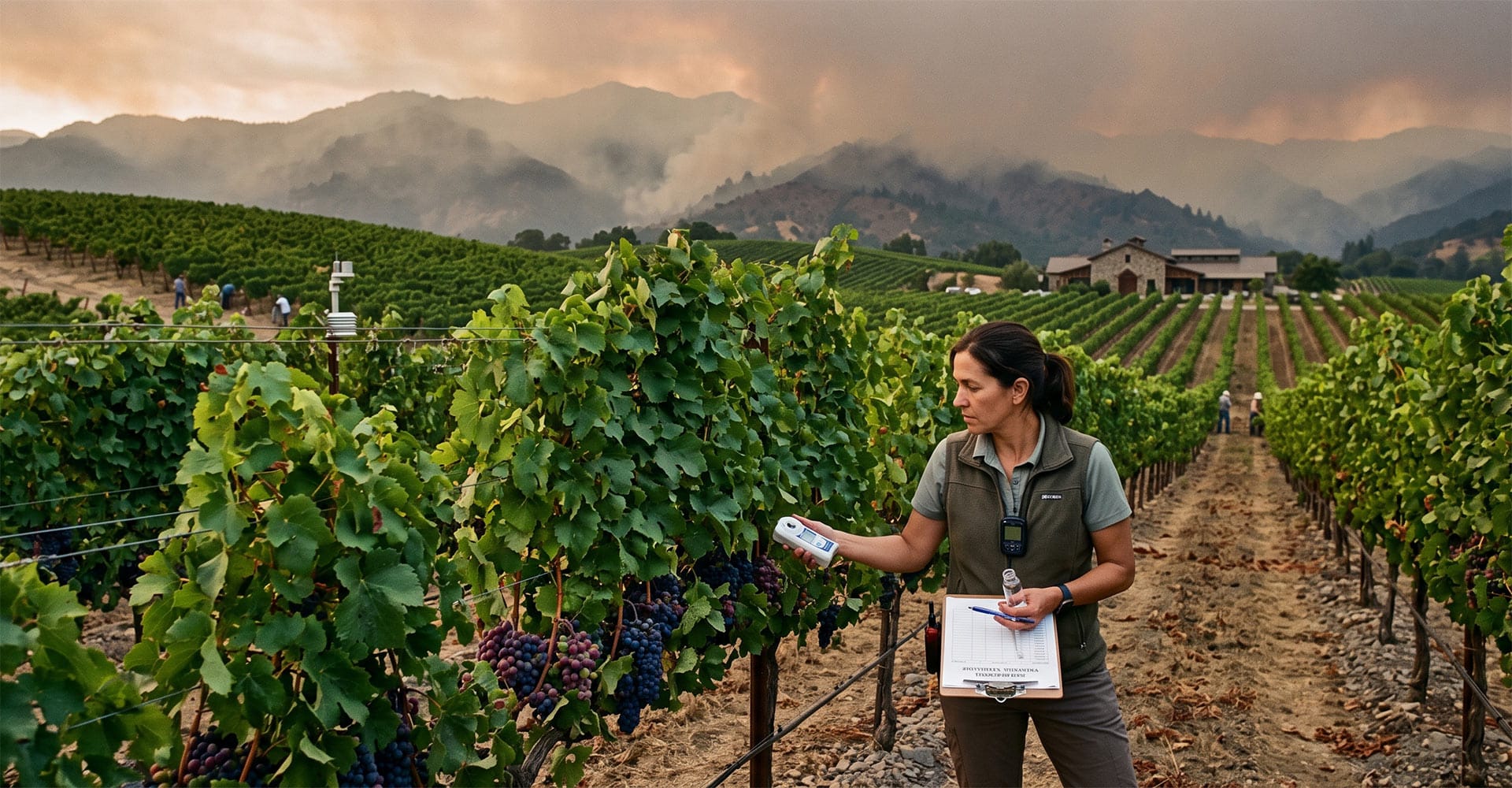
At the moment, growers are often making decisions in real time with incomplete information, relying on wind shifts, satellite imagery and lab results that may lag behind the actual exposure event.
Two vineyards sharing the same postcode can experience completely different outcomes.
For many producers, this unpredictability is what makes smoke events so devastating. It is not just crop loss, it is the inability to confidently assess whether a crop is safe until it is already too late to intervene.
It’s another reminder that wine continues to be one of agriculture’s most wonderfully frustrating businesses.
Why timing is everything
Smoke exposure isn’t equally dangerous throughout the growing season.
Before veraison, when berries remain hard and green, grapes are relatively resistant to absorbing volatile phenols. Early season smoke events generally have minimal long-term impact.
Everything changes once veraison begins.
As berries soften, sugar levels increase and skins become more permeable, the vine also increases production of enzymes responsible for converting smoke compounds into glycosides.
From this point until harvest, susceptibility rises dramatically.
In practical terms, the same smoke event that might cause almost no damage in June could severely affect fruit exposed in late August.
For growers, that narrow window has become one of the most closely monitored, and most stressful, periods of the vintage.
Many winemakers describe it as a period where every weather alert carries disproportionate weight, because a single afternoon of exposure can determine whether a parcel is bottled, blended, or rejected entirely.
Which grape varieties are most at risk?
Not every variety responds in the same way.
Thin-skinned grapes generally absorb volatile phenols more readily than thicker-skinned cultivars.
Pinot Noir sits firmly at the top of the risk list. Its delicate fruit profile means even relatively low levels of smoke compounds can overwhelm the wine’s subtle aromatics.
Chardonnay and Pinot Gris also present significant challenges. Without substantial tannin or oak structure to disguise smoke-derived flavours, the resulting wines can develop cold ash, medicinal notes and lingering bitterness.
Cabernet Sauvignon enjoys some natural protection thanks to thicker skins and higher tannin levels, although it remains vulnerable under prolonged smoke exposure.
Syrah occupies something of a middle ground, capable of accumulating significant smoke-derived compounds while sometimes masking low concentrations through its naturally bold flavour profile.
As with so many things in wine, there are exceptions to every rule.
Why wines sometimes taste worse years later
Perhaps the most fascinating aspect of smoke taint is that it doesn’t necessarily appear immediately.
During fermentation, yeast enzymes begin breaking down some of the bound glycosides, releasing free volatile phenols into the wine.
However, a significant proportion remains locked away.
Once the wine reaches the consumer, enzymes naturally present in saliva continue breaking down these compounds while the wine is being tasted. This creates the distinctive lingering sensation of ash, burnt wood or medicinal smoke that appears after swallowing rather than on the initial aroma.
Bottle ageing can make matters worse.
As fruit characters gradually fade and acidity slowly hydrolyses more glycosides, additional volatile phenols are released over time.
A wine that appeared perfectly acceptable shortly after bottling may become noticeably smoky several years later.
For producers, this delayed expression is particularly difficult because it means quality risk does not end at bottling, it can continue evolving long after the wine has left the winery.
Can growers protect vineyards?
Until recently, most attention focused on fixing smoke-affected wine after harvest.
That approach has significant limitations.
Activated carbon and reverse osmosis can remove free volatile phenols, but they struggle to eliminate the larger reservoir of bound glycosides. Even worse, they often strip desirable aromas, colour and texture alongside the unwanted compounds.
The industry’s attention is now shifting towards prevention.
Researchers at the University of California, Davis, working alongside the USDA Agricultural Research Service, have been investigating calcium-based foliar sprays applied during veraison.
Calcium strengthens grape skins by reinforcing pectin structures within the berry cell walls. Early trial results suggest thicker, stronger skins may reduce the diffusion of smoke-derived compounds into the fruit.
Other approaches include kaolin clay particle films and specialised lipid coatings designed to create temporary protective barriers across grape clusters before smoke events occur.
None represents a silver bullet, but collectively they offer genuine optimism that growers may soon have practical tools to reduce risk.
The commercial consequences go far beyond the vineyard
Smoke taint is no longer simply an agricultural issue.
It has become a financial one.
Modern grape contracts increasingly include smoke testing before harvest. Wineries purchasing fruit often require laboratory analysis alongside traditional maturity measurements such as Brix, pH and acidity.
For many winemakers, this has added a new layer of pressure to an already high-stakes period. A single failed test can mean losing an entire crop purchase, not just for the grower, but for the winery that had already planned production around it.
In severe years, the knock-on effects are significant: lost revenue for growers, reduced production for wineries, and disrupted supply chains for distributors and retailers. Entire vintage plans can be rewritten in a matter of days.
Institutional investors, fine wine merchants and insurers are also paying much closer attention. Smoke exposure now influences vintage assessments, inventory valuation and supply chain planning across many regions.
Climate change has quietly rewritten part of the wine business model.
The conversation is no longer simply about producing exceptional wine.
It’s increasingly about managing environmental risk before the first grape even reaches the winery.
What does this mean for consumers?
The vast majority of wines reaching shop shelves remain completely unaffected.
Regions experiencing smoke events also employ increasingly sophisticated laboratory testing, allowing wineries to make informed harvesting decisions.
Consumers shouldn’t panic every time they hear about a wildfire near wine country.
They should, however, appreciate the remarkable amount of science now involved in protecting wine quality, and the level of uncertainty producers are now working within each season.
For producers, the challenge is adapting quickly enough to stay ahead of changing environmental conditions. For many, it has become a yearly reminder that even the most carefully tended vineyard is still ultimately at the mercy of forces beyond control.
For wine lovers, it’s another reminder that every bottle represents far more than fermented grape juice. It captures an entire growing season, every weather event, countless human decisions and, increasingly, a battle against forces that can’t even be seen.
Bottom Line
Smoke taint has evolved from an occasional curiosity into one of the defining viticultural challenges of the modern era.
The encouraging news is that science is catching up. Better diagnostics, improved vineyard management and promising preventative treatments are giving producers more options than ever before.
The 2026 vintage may ultimately be remembered not simply for the wildfires themselves, but for how the global wine industry responded. If innovation continues at its current pace, tomorrow’s great wines may owe as much to chemistry and climate adaptation as they do to terroir.
After all, wine has always been a story of resilience. It just happens that today’s vineyard heroes increasingly carry laboratory notebooks alongside their secateurs.