GLOBAL WINE GRAPE VARIETIES AND BIODIVERSITY
The global wine industry relies on a limited number of closely related grape varieties, despite the existence of over 10,000 grape types worldwide.
- Most consumed grapes belong to a small, genetically interconnected family including Cabernet Sauvignon, Chardonnay, and Merlot.
- DNA profiling reveals key ancestral grapes like Savagnin and the genetic instability of varieties like Pinot.
- Heavy reliance on few varieties creates a biodiversity gap, increasing vulnerability to climate change and pests.
- Renewed interest in indigenous grapes supports resilience and distinctiveness, aided by scientific preservation and identification methods.
If you’ve ever stood in a wine shop staring at a wall of bottles thinking, “There’s so much choice,” I’m about to gently ruin that illusion for you.
Yes, there are thousands of grape varieties in the world. Over 10,000, in fact.
But the ones we actually drink? A much smaller, slightly tangled family.
Thanks to DNA profiling, we now know that many of the world’s best-known grapes are closely related. Not in a distant, royal-family-tree kind of way either. More like siblings, parents, and the occasional awkward family secret nobody talks about at dinner.
Let’s take a look at who’s related to whom, and why it matters more than you might think.
The Top 100 Grapes (At a Glance)
Before we dive into the family drama, here’s the reality check. These are the grapes that actually fill most glasses around the world, ranked by global planting volume. Familiar names, a few surprises, and more overlap than you might expect.
| Rank | Variety Name | Color | Primary Regions | Flavor Profile | Key Characteristics |
| 1 | Kyoho | Red | China, Japan | Sweet, Foxy | Table grape; largest global area |
| 2 | Cabernet Sauvignon | Red | France, USA, Chile, Australia | Blackcurrant, Cedar, Bell Pepper | High Tannin; world’s #1 wine grape |
| 3 | Sultana | White | Turkey, USA, China | Neutral, Sweet | Table/Raisin; used for bulk wine |
| 4 | Merlot | Red | France, Italy, USA, Chile | Plum, Black Cherry, Chocolate | Soft Tannin; dominant in Bordeaux blends |
| 5 | Tempranillo | Red | Spain, Portugal, Argentina | Red Fruit, Leather, Tobacco | Flagship of Spain (Rioja) |
| 6 | Airén | White | Spain | Apple, Lemon, Neutral | Highly resilient to drought and heat |
| 7 | Chardonnay | White | France, USA, Australia, Italy | Apple, Citrus, Butter (with oak) | Most successful international white grape |
| 8 | Syrah / Shiraz | Red | France, Australia, USA | Blackberry, Pepper, Smoke | Bold, spicy, and age-worthy |
| 9 | Red Globe | Red | China, Chile, USA | Simple, Sweet | High-volume table grape |
| 10 | Grenache Tinta | Red | Spain, France, Australia | Strawberry, Raspberry, Pepper | High alcohol; key in Southern Rhône |
| 11 | Sauvignon Blanc | White | France, New Zealand, Chile | Grass, Gooseberry, Grapefruit | High acid; aromatic |
| 12 | Pinot Noir | Red | France, USA, Germany, NZ | Cherry, Raspberry, Earth | Thin-skinned; prefers cool climates |
| 13 | Trebbiano Toscano | White | Italy, France (Ugni Blanc) | Lemon, Herbs, Neutral | High acid; used for Cognac/Armagnac |
| 14 | Sangiovese | Red | Italy | Red Cherry, Earth, Tea | Italy’s #1 wine grape; core of Chianti |
| 15 | Bobal | Red | Spain | Raspberry, Cherry, Spice | High acid; intensely colored |
| 16 | Malbec | Red | Argentina, France | Plum, Violet, Blackberry | Flagship of Argentina; deep, inky color |
| 17 | Cabernet Franc | Red | France, Italy, Hungary | Raspberry, Graphite, Bell Pepper | Parent of Cabernet Sauvignon |
| 18 | Pinot Gris / Grigio | White | Italy, France, USA, Germany | Pear, Apple, Citrus | Often light/crisp (Italy) or rich (Alsace) |
| 19 | Mazuelo (Carignan) | Red | Spain, France, Chile | Cranberry, Raspberry, Spice | High acid and tannin; needs heat |
| 20 | Riesling | White | Germany, France, Australia | Lime, Peach, Honey, Petrol | Extremely high acid; terroir-expressive |
| 21 | Macabeo (Viura) | White | Spain, France | Lemon, Green Apple, Floral | Primary white grape in Rioja/Cava |
| 22 | Cayetana Blanca | White | Spain | Citrus, Green Apple, Neutral | High yield; used for blends/brandy |
| 23 | Alicante H. Bouschet | Red | Spain, France, Portugal | Blackberry, Jam, Earth | Red-fleshed (teinturier) |
| 24 | Monastrell | Red | Spain, France (Mourvèdre) | Blackberry, Meat, Pepper | Deep, structured, and gamey |
| 25 | Montepulciano | Red | Italy | Black Cherry, Plum, Oregano | Deeply colored; southern/central Italy |
| 26 | Tribidrag (Zinfandel) | Red | USA, Italy (Primitivo) | Blackberry, Licorice, Pepper | High sugar/alcohol; jammy style |
| 27 | Chenin Blanc | White | South Africa, France | Apple, Quince, Honey | Versatile; high acid; key in Loire |
| 28 | Colombard | White | France, USA, South Africa | Lemon, Peach, Neutral | High acid; used for bulk wine/brandy |
| 29 | Cereza | White | Argentina | Neutral, Light | High yield; used for domestic blends |
| 30 | Catarratto Bianco | White | Italy (Sicily) | Citrus, Lemon, Herbs | Full-bodied Sicilian white |
| 31 | Muscat Blanc | White | Global | Grape, Orange Blossom, Musk | Oldest known variety; highly aromatic |
| 32 | Muscat of Alex. | White | Greece, Spain, Chile | Tropical Fruit, Honeysuckle | Sweet and aromatic |
| 33 | Gamay Noir | Red | France (Beaujolais) | Raspberry, Cherry, Peony | Light-bodied; carbonic maceration |
| 34 | Palomino Fino | White | Spain | Nutty, Saline, Neutral | The grape of Sherry |
| 35 | Prosecco (Glera) | White | Italy | Green Apple, Pear, Peach | Used for sparkling Prosecco |
| 36 | Douce Noire | Red | Argentina (Bonarda), France | Cherry, Plum, Peony | Fresh and fruity; different from Italy |
| 37 | Trebbiano Romag. | White | Italy | Neutral, Lemon | High yield; northern Italy |
| 38 | Cinsaut | Red | France, South Africa | Strawberry, Pomegranate | Blending grape; adds perfume |
| 39 | Verdejo | White | Spain | Lime, Grass, Nutty | Aromatic flagship of Rueda |
| 40 | Sémillon | White | France, Australia | Lemon, Honey, Beeswax | Full-bodied; key in Sauternes |
| 41 | Barbera | Red | Italy, USA | Sour Cherry, Blackberry | High acid, low tannin |
| 42 | Müller-Thurgau | White | Germany, Austria, Italy | Peach, Floral | Early ripening crossing |
| 43 | Viognier | White | France, USA, Australia | Apricot, Peach, Jasmine | Low acid, full body, aromatic |
| 44 | Grüner Veltliner | White | Austria | White Pepper, Green Apple | Savory and peppery; flagship Austria |
| 45 | Criolla Grande | Red | Argentina | Pale Red Fruit | High yield heritage grape |
| 46 | Pedro Giménez | White | Argentina | Neutral | Not same as Spain’s PX |
| 47 | Pinot Meunier | Red | France (Champagne) | Red Fruit, Floral | Adds fruitiness to Champagne |
| 48 | Nero d’Avola | Red | Italy (Sicily) | Black Plum, Spice, Tobacco | Leading red grape of Sicily |
| 49 | Touriga Franca | Red | Portugal | Black Fruit, Floral | Critical for Port blends |
| 50 | Castelão | Red | Portugal | Red Fruit, Cedar | Most planted red in southern Portugal |
| 51 | Fernão Pires | White | Portugal | Citrus, Tropical, Mimosa | Aromatic; widely planted in Portugal |
| 52 | Isabella | Red | USA, Brazil, Russia | Strawberry, Musk | Hybrid (V. labrusca x V. vinifera) |
| 53 | Touriga Nacional | Red | Portugal | Violet, Bergamot, Black Fruit | Portugal’s finest red grape |
| 54 | Blaufränkisch | Red | Austria, Germany, Hungary | Dark Cherry, Black Pepper | High acid, high tannin |
| 55 | Vermentino | White | Italy, France (Rolle) | Lime, Grapefruit, Saline | Thrives in coastal areas |
| 56 | Negroamaro | Red | Italy (Puglia) | Black Cherry, Earth, Tobacco | “Black and Bitter”; Puglia flagship |
| 57 | Carmenère | Red | Chile, France | Raspberry, Bell Pepper, Spice | Chile’s signature red grape |
| 58 | Mencía | Red | Spain, Portugal | Pomegranate, Mineral, Floral | Elegant, cool-climate style |
| 59 | Trincadeira | Red | Portugal | Blackberry, Herbs | Needs heat; used in Alentejo |
| 60 | Listán Prieto | Red | Canary Islands, Chile (Pais) | Red Berry, Smoke, Earth | Historic mission grape |
| 61 | Pinot Blanc | White | France, Germany, Italy | Pear, Apple, Lemon | Clean and crisp |
| 62 | Aglianico | Red | Italy | Black Fruit, Smoke, Leather | “Barolo of the South”; high acid/tannin |
| 63 | Melon (de Bourg.) | White | France (Muscadet) | Saline, Lemon | High acid; neutral; sea-spray notes |
| 64 | Malvasia Bianca | White | Italy, Greece | Apricot, Peach, Honey | Usually aromatic and sweet |
| 65 | Graševina | White | Croatia, Hungary (Welschries.) | Apple, Pear, Floral | High acid; central Europe |
| 66 | Gewürztraminer | White | Germany, France, Italy | Lychee, Rose, Ginger | Extremely aromatic; high alcohol |
| 67 | Pedro Ximénez | White | Spain | Raisin, Fig, Toffee | Used for sweet, dark Sherry |
| 68 | Torrontés Riojano | White | Argentina | Geranium, Peach, Lemon | Aromatic; unique to Argentina |
| 69 | Garganega | White | Italy (Soave) | Lemon, Almond, Herbs | High acid; aging potential |
| 70 | Xarello | White | Spain (Cava) | Green Apple, Lemon, Mineral | Backbone of Cava; high resveratrol |
| 71 | Alvarinho | White | Portugal, Spain | Peach, Citrus, Saline | High acid; high quality |
| 72 | Zweigelt | Red | Austria | Red Cherry, Cinnamon | Austria’s most planted red |
| 73 | Nebbiolo | Red | Italy (Piedmont) | Tar, Roses, Cherry | High acid/tannin; Barolo/Barbaresco |
| 74 | Dornfelder | Red | Germany | Blackberry, Plum | Deep color; juicy style |
| 75 | Petit Verdot | Red | France, USA | Violet, Black Fruit, Sage | Adds color/tannin to blends |
| 76 | Concord | Red | USA | Grape Jelly, Musk | Vitis labrusca; common in juice/wine |
| 77 | Garnacha Blanca | White | Spain, France | Green Apple, Citrus, Herbs | Full-bodied; lower acid |
| 78 | Grillo | White | Italy (Sicily) | Lemon, Thyme, Peach | Traditional Marsala grape; now varietal |
| 79 | Parellada | White | Spain (Cava) | Green Apple, Floral | Late ripening; component of Cava |
| 80 | Pinotage | Red | South Africa | Blackberry, Tobacco, Smoke | Crossing of Pinot Noir x Cinsaut |
| 81 | Síria | White | Portugal | Lemon, Lime, Blossom | High altitude; very fresh |
| 82 | Baga | Red | Portugal | Black Fruit, Tobacco, Earth | High tannin/acid; needs age |
| 83 | Corvina Veronese | Red | Italy (Veneto) | Red Cherry, Spice, Almond | Key for Valpolicella and Amarone |
| 84 | Lambrusco Sal. | Red | Italy | Raspberry, Strawberry | Sparkling red; high acid |
| 85 | Bonarda Piemon. | Red | Italy | Red Berry, Herbs | Not the same as Argentina’s |
| 86 | Silvaner | White | Germany, Austria | Green Apple, Hay, Earth | Moderate acid; earthy style |
| 87 | Lambrusco Maes. | Red | Italy | Plum, Cherry, Cream | Bold, semi-sparkling red |
| 88 | Blauer Portug. | Red | Austria, Germany | Red Currant, Peony | Light-bodied and fruity |
| 89 | Tinto Velasco | Red | Spain | Black Cherry, Licorice | Neutral; used for distillation |
| 90 | Arinto de Bucelas | White | Portugal | Lemon, Steel, Mineral | Very high acid; age-worthy |
| 91 | Caladoc | Red | France | Raspberry, Blackberry | Crossing of Grenache x Malbec |
| 92 | Ruby Cabernet | Red | USA, South Africa | Blackcurrant, Green Pepper | High yield; crossing for hot climates |
| 93 | Tannat | Red | Uruguay, France | Black Plum, Smoke, Tobacco | Highest tannins; flagship of Uruguay |
| 94 | Chelva | White | Spain | Lemon, Herbs | Local Spanish white |
| 95 | Tinta Barroca | Red | Portugal | Blackberry, Raspberry | Adds sugar/softness to Port |
| 96 | Bianca | White | Hungary | Citrus, Green Apple | Disease-resistant hybrid |
| 97 | Rubired | Red | USA | Earthy Dark Berries | Teinturier; used for blending color |
| 98 | Inzolia | White | Italy (Sicily) | Nutty, Citrus, Floral | Sicilian white; used for Marsala |
| 99 | Loureiro | White | Portugal | Orange Blossom, Laurel | High acid; aromatic |
| 100 | Verdicchio Bian. | White | Italy | Lemon Peel, Almond, Saline | Italy’s finest age-worthy white |
Savagnin: The Grape That Doesn’t Show Off (But Should)
Savagnin isn’t flashy. It’s not the grape people name-drop at dinner parties. You won’t hear someone say, “Ooh, I’ve brought a lovely Savagnin.”
And yet, it’s basically the grandparent of modern white wine.
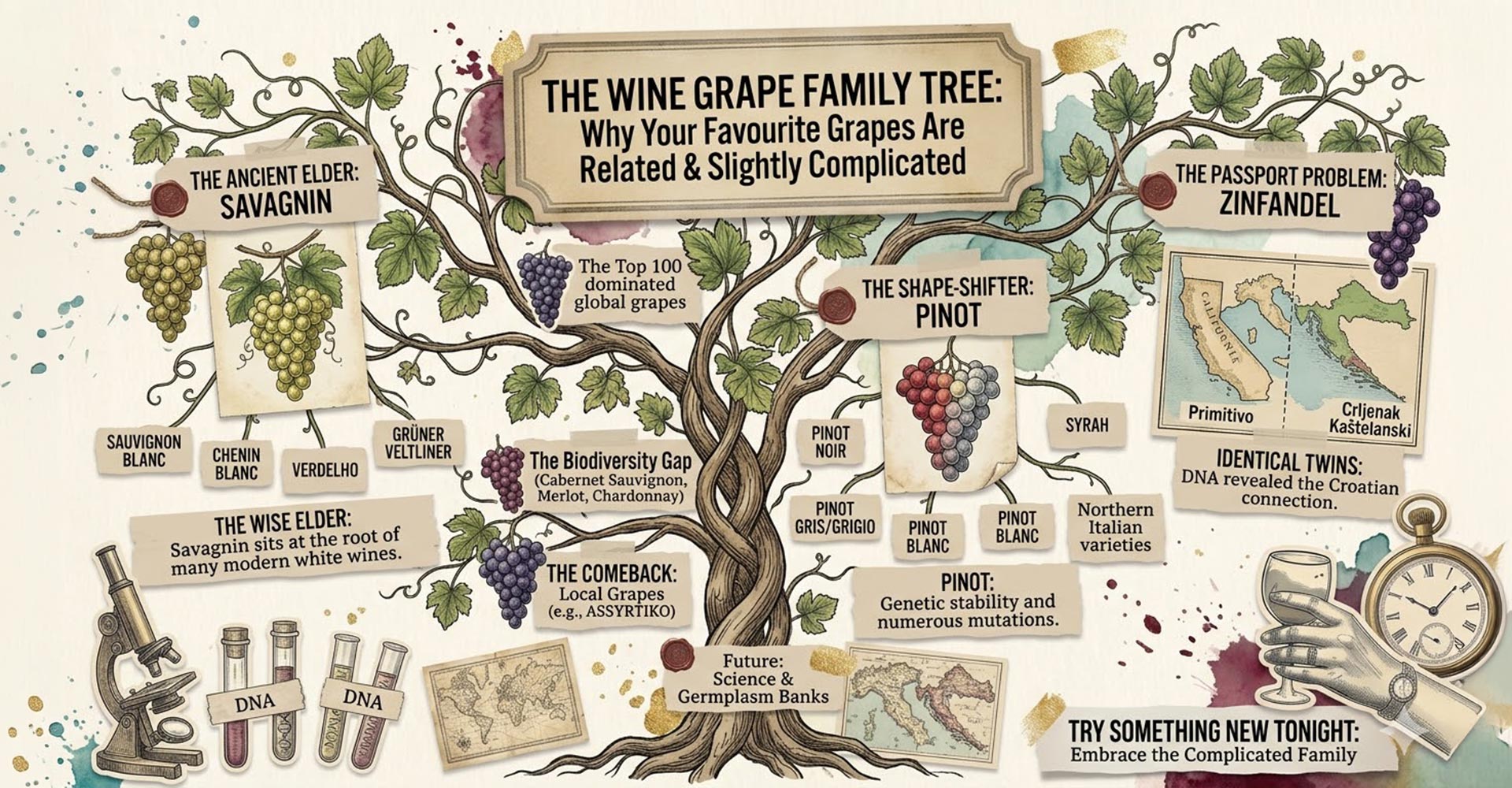
DNA analysis shows that Savagnin sits at the root of several big-name varieties, including Chenin Blanc, Grüner Veltliner, Sauvignon Blanc, and Verdelho.
So while everyone’s busy arguing about Sauvignon Blanc from Marlborough versus Sancerre, Savagnin is quietly sitting in the corner thinking, “You’re welcome.”
It also tells us something important. Regions like Jura weren’t just making niche wines for curious sommeliers. They were shaping the genetic future of vineyards across Europe.
Not bad for a grape most people struggle to pronounce after their second glass.
Pinot: The Shape-Shifter of the Wine World
If Savagnin is the wise elder, Pinot is the slightly unpredictable cousin who reinvents themselves every few years.
Pinot is one of the oldest grape varieties around, but it’s also genetically unstable. Which sounds dramatic, but in practice means it mutates more often than most.
That’s how we ended up with:
- Pinot Noir (red)
- Pinot Gris or Grigio (grey)
- Pinot Blanc (white)
Same grape. Different outfits.
It’s essentially the wine equivalent of turning up to a party in three different costumes and insisting you’re three different people.
And it doesn’t stop there. Pinot also has genetic links to Syrah and several northern Italian varieties, making it less of a grape and more of a sprawling extended family.
If grapes had a group chat, Pinot would be in all of them.
Zinfandel: The Grape With a Passport Problem
For years, Zinfandel proudly waved the Californian flag.
Big, bold, sunshine in a glass.
Then DNA testing came along and said, “Well… not quite.”
It turns out Zinfandel is genetically identical to Italy’s Primitivo and, more importantly, to an ancient Croatian grape called Crljenak Kaštelanski.
Which is not the easiest name to drop casually at a wine bar.
The final proof came from a 90-year-old vine found in a garden in Split. Somewhere, someone was quietly watering a piece of wine history without realising it.
It’s a brilliant reminder that wine isn’t just about branding. It’s about history, travel, and the occasional identity crisis.
The Slightly Awkward Truth: We’re All Drinking the Same Grapes
Here’s where things get a bit more serious.
Despite all this diversity, the global wine industry leans heavily on a small group of grapes. Cabernet Sauvignon, Chardonnay, Merlot. Reliable, recognisable, and easy to sell.
From a business point of view, it makes perfect sense.
From a biodiversity point of view, it’s a bit like eating the same three meals for the rest of your life and hoping nothing goes wrong.
This trend has created what’s known as a biodiversity gap. Vineyards around the world are becoming more uniform, which makes them more vulnerable to climate change, disease, and pests.
In short, we’ve traded variety for consistency.
And nature doesn’t always reward that decision.
The Comeback: Local Grapes Having Their Moment
The good news is that the wine world is starting to remember what it forgot.
Winemakers, especially across Europe, are rediscovering indigenous grape varieties. Not because it sounds romantic, but because it works.
These grapes have spent centuries adapting to their local conditions. They know how to handle the heat, the drought, and the quirks of their environment.
Take Greece, for example. Instead of chasing international varieties, producers are focusing on Assyrtiko.
The result? Wines that are distinctive, resilient, and impossible to copy anywhere else.
Which, funnily enough, is exactly what drinkers are looking for now.
Less “same again,” more “that’s interesting, I’ll have another glass.”
The Future: Science, Survival, and a Bit of Hope
This is where things get quietly exciting.
Technology is now helping to protect the future of wine. DNA profiling and advanced spectroscopic tools can identify grape varieties with remarkable accuracy, helping ensure authenticity and avoid costly mistakes.
At the same time, germplasm banks are preserving thousands of lesser-known varieties.
Think of them as a kind of wine ark. A place where rare grapes are kept safe, just in case we need them.
Because one obscure vine tucked away in a Balkan hillside today might hold the key to surviving the climate challenges of tomorrow.
No pressure, then.
Final Thought: Maybe Try Something New Tonight
The wine world might feel vast, but it’s built on a surprisingly small family of overachievers.
The real magic lies in the grapes you haven’t tried yet. The ones that don’t appear on every supermarket shelf or restaurant list.
So next time you’re choosing a bottle, take a small risk.
Pick the name you can’t pronounce.
Worst case, you learn something.
Best case, you discover your new favourite wine before everyone else catches on.
And you get to sound slightly smug about it, which is always a bonus.