The 2026 spring frosts have delivered a brutal reminder that vineyards don’t operate on neat commercial calendars. After a warm start pushed vines into early growth, late cold snaps tore through regions from Champagne to Hungary, the UK and the US Mid-Atlantic. The result is lower yields, rising costs, supply pressure and a wine industry forced to rethink risk, reserves and resilience.
The frost didn’t just hit the vines. It hit the business model.
Wine has always had a slightly theatrical relationship with weather. A bit of rain becomes a talking point. A warm August becomes a personality trait. A difficult vintage becomes a seminar with tasting notes.
But the spring frosts of 2026 were not just another vintage wobble.
They were a full-blown operational shock.
After unusually warm conditions in March and April, vines across several regions moved into growth far earlier than usual. Buds that should still have been tucked up in their winter pyjamas were suddenly awake, green and vulnerable. Then the cold arrived.
In parts of Europe, the UK and North America, temperatures plunged just when the vines were at their most exposed. The damage was not simply about how cold it became, but when it happened. A vine can cope with winter. It is considerably less enthusiastic about being tricked into spring and then slapped by a polar air mass.
That timing is the heart of the 2026 problem.
Climate change is not just making seasons warmer. It is making them less reliable. And for wine, reliability is not a luxury. It is the quiet machinery behind stock planning, pricing, allocations, cash flow, labour, exports and the small matter of having grapes to ferment.
Why early budbreak made the damage worse
The core issue was phenology, which is a beautifully serious word for the vine’s biological calendar.
Warmer early-season temperatures encouraged vines to begin their vegetative cycle ahead of schedule. In some regions, growth was tracking two to three weeks earlier than historical norms. In northern European areas, the gap may have been even wider.
That created what the research describes as a longer “vulnerability window”. Instead of a relatively short period when tender buds and shoots could be damaged by frost, growers faced several weeks of heightened risk.
This is the cruel little trap now facing modern viticulture.
A warm spring feels like good news until it isn’t.
Once the buds open, they are full of water and highly vulnerable. When temperatures fall to around -2°C to -4°C, especially after damp conditions, the tissues can freeze and die. In some cases, dry buds might tolerate slightly lower temperatures, but wet young growth is less forgiving.
The industry has always understood frost. What is changing is the frequency with which frost arrives after vines have already been lured out of dormancy.
It is less “act of God” and more “the calendar has had too much espresso”.
Champagne’s painful lesson in reserves and regional inequality
Champagne has been among the most closely watched regions in the 2026 frost story.
The Comité Interprofessionnel du Vin de Champagne confirmed that around 38% to 40% of buds were destroyed, with the Aisne sector suffering losses of 65% to 85%. The Ardre Valley and Côte de Bar were also badly affected, while other areas saw more moderate damage.
This unevenness matters.
Champagne may be one famous name on a label, but it is a patchwork of villages, slopes, soils, grape varieties and growers. A regional average can sound severe but manageable. On the ground, one grower may have a bruised harvest while another has almost nothing.
The pressure is compounded by vine age and reserve levels.
The research points to an average vineyard age of 36 years in Champagne, alongside falling yield potential over recent decades. Older vines can produce wonderful fruit, but they do not always offer the same volume security as younger, more vigorous plantings.
Then there is the réserve individuelle system, Champagne’s famous safety net of stored base wines from stronger years. On paper, the regional reserve looks robust. In reality, reserves are unevenly distributed. In the Aube, more than half of growers reportedly hold reserves below 5,000 kg/ha.
That is where the commercial headache begins.
A big house with deeper reserves may be able to manage the shock through blending, allocation and pricing. A small grower with limited reserves and severe frost damage may be staring at a very different conversation with the bank.
The damage was global, fragmented and commercially awkward
The 2026 frost pattern was not confined to one celebrated European region.
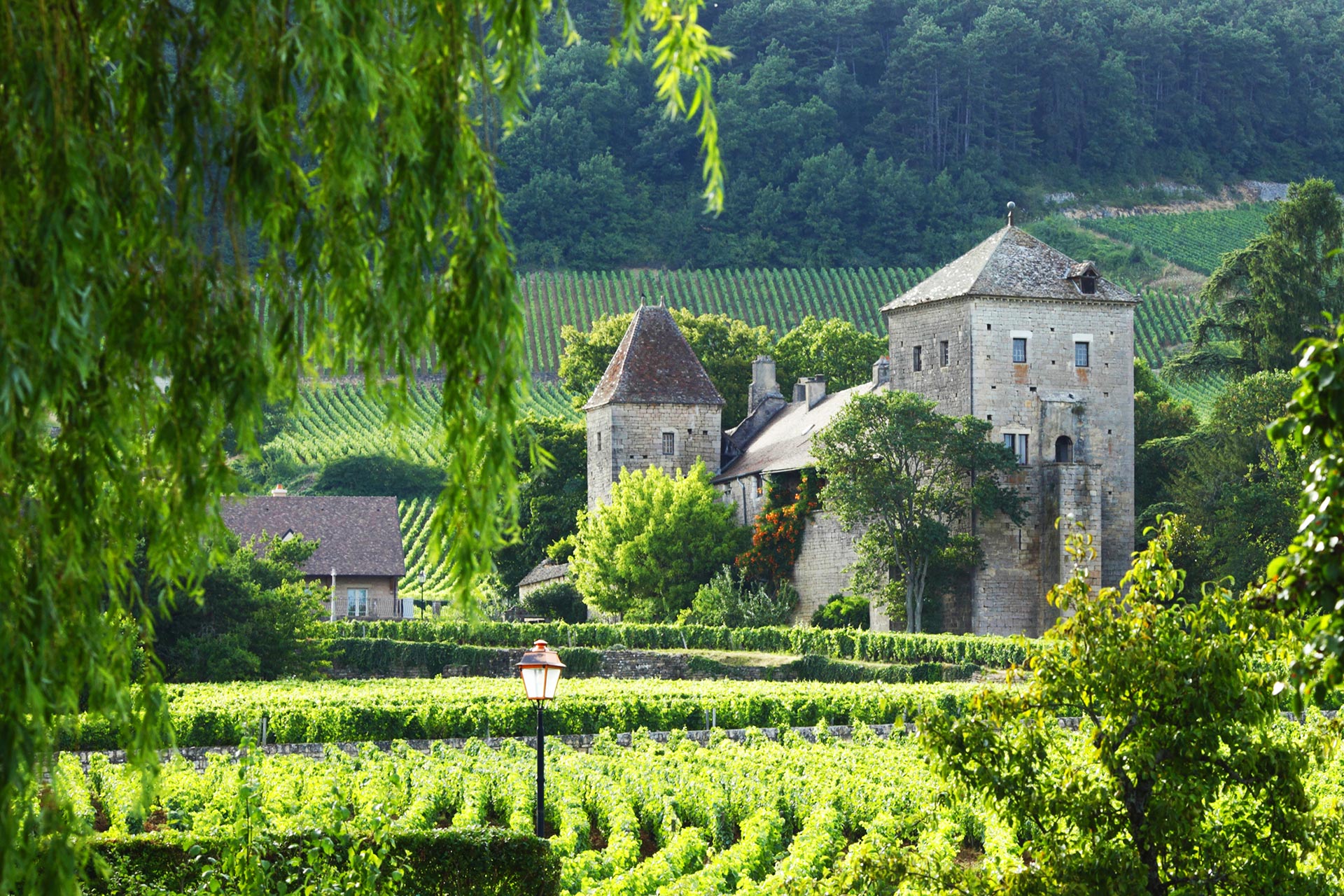
In Burgundy, Chablis saw temperatures fall as low as -6°C in the worst-affected areas, with localised losses of 25% to 40% in unprotected vineyards. In the Loire, appellations including Sancerre and Touraine were placed under pressure after late March cold snaps.
In the UK, repeated cold events from before Easter through late May caused significant losses in Hampshire, East Sussex, Kent and Berkshire. Some affected estates faced average crop losses of 40% to 50%, with specialised trial blocks reportedly seeing near-total destruction.
Hungary’s Great Plains region suffered especially severe damage after temperatures fell to between -5°C and -6°C on 1 May. The research indicates that nearly 80% of the region’s 23,000 hectares of vineyards suffered complete primary bud damage, with Kunság and Hajós-Baja facing a devastating harvest outlook.
Across the Atlantic, the US Mid-Atlantic freeze on 21 April hit vineyards from New York to Virginia. Maryland estates reported 100% primary bud loss across large areas, while Virginia’s elevated and sloping sites fared better than lower-lying blocks.
This fragmentation is commercially awkward.
Wine buyers like clarity. Importers like predictability. Consumers like availability. Frost offers none of these things. It creates a market where one producer has enough wine, another has half a crop, and another has a very expensive collection of disappointed vines.
Why 2026 is different from 2021
The obvious comparison is 2021, another famously brutal year for European vineyards.
That year, severe spring frosts combined with wet summer conditions, disease pressure and ripening problems. France’s national wine production fell by around 24% to 30% compared with 2020, and many regions fought a miserable mix of frost, rain and mildew.
The 2026 crisis is different.
According to the supplied research, 2026 has been defined not by excessive moisture after the frost, but by dryness. Limited rainfall since late March created surface soil stress and reduced immediate downy mildew pressure. Powdery mildew has appeared early on some sensitive Chardonnay plots, but the broader sanitary picture is not the same as 2021.
That matters for quality.
A frost-hit vintage is not automatically a poor-quality vintage. It may be a low-volume vintage. If surviving grapes ripen well, concentrated and impressive wines are still possible.
This is the sort of sentence that sounds reassuring until you remember that “small but excellent vintage” is often wine-trade code for “lovely, scarce and not getting any cheaper”.
The cost of fighting frost is becoming harder to justify
Growers have many tools for frost protection, but none are magic.
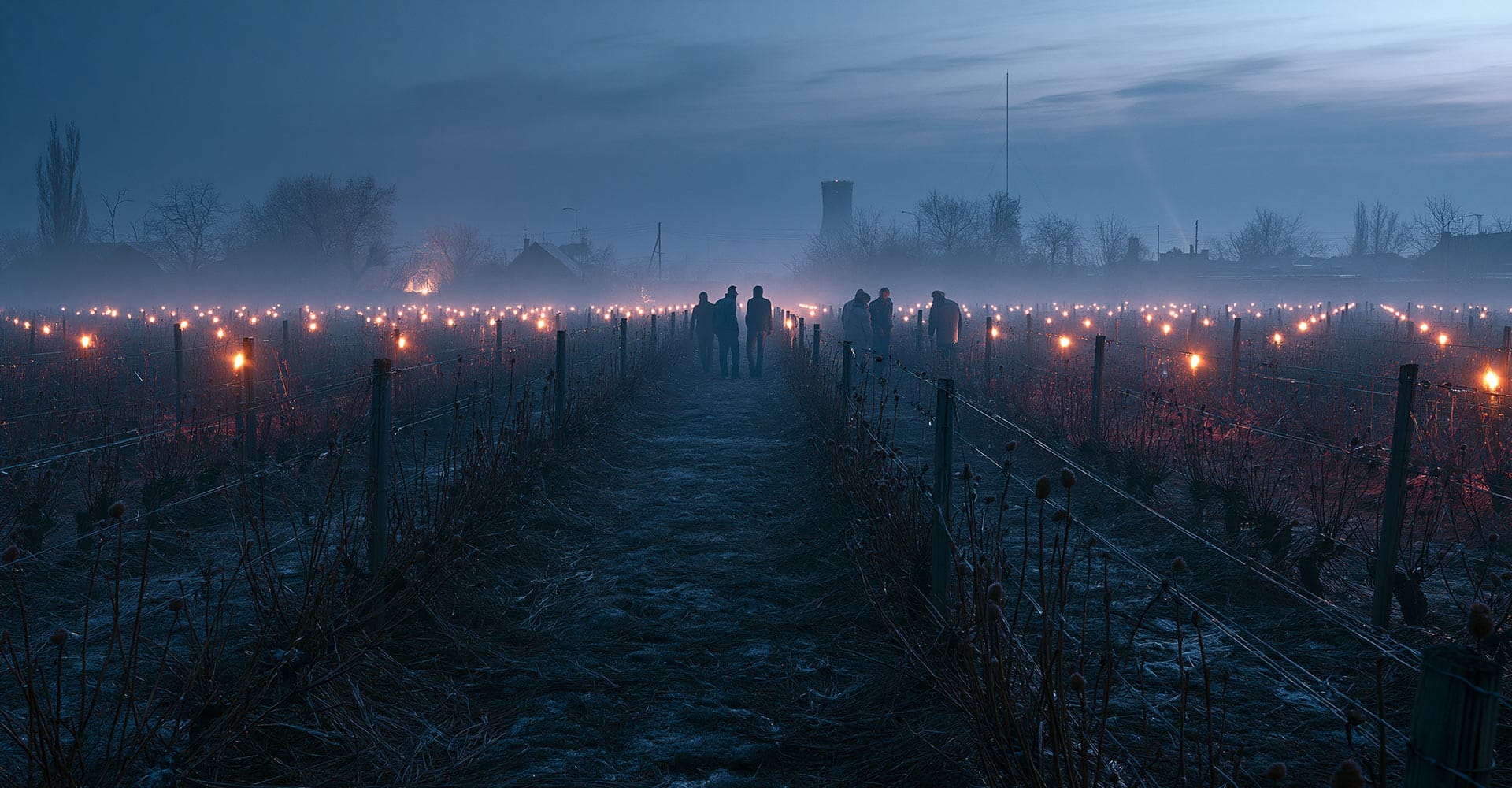
Candles and bougies can help warm vineyard air. Wind machines can move cold air and disrupt inversions. Sprinklers can protect buds through controlled ice formation. Tractors and smoke systems can offer additional mitigation in certain conditions.
All of this costs money.
A lot of money.
The research highlights the growing connection between frost protection, energy markets and operational budgets. Fuel, electricity and labour costs all rise when growers are forced into repeated overnight frost battles.
Some wineries reportedly spent up to five times their planned seasonal frost-protection budget.
That creates a brutal decision.
Spend heavily to save the crop, with no guarantee of success, or accept losses and preserve cash. For organic, biodynamic and sustainability-focused estates, there is also a philosophical problem. Burning fossil fuels to protect vines from climate-driven extremes is not exactly the cleanest line in the sustainability brochure.
The image of vineyards glowing with frost candles may look romantic on Instagram.
In commercial reality, it is expensive, carbon-intensive and usually accompanied by a grower who has not slept properly for three nights.
“DNA over postcode” becomes a serious buying strategy
One major commercial response to the crisis is the rise of “DNA over postcode” sourcing.
In plain English, this means buyers and producers looking for wines that share the character of famous regions without carrying the same famous price tag or supply risk.
If Margaux becomes tighter or more expensive, attention moves to elegant Cabernet blends from Margaret River, Stellenbosch or Stag’s Leap. If Pomerol-style Merlot is harder to justify at the top end, merchants look to Tuscany, Sonoma or Hawke’s Bay. If Sancerre keeps climbing, buyers explore Friuli, Touraine or Quincy.
This is not about pretending one region is another.
It is about recognising style, structure, climate, soil and consumer expectation.
For restaurants, retailers and importers, this kind of substitution is becoming more important. Customers may still want freshness, minerality, elegance, perfume or texture. They may not always need the exact postcode that usually provides it.
That is both a threat and an opportunity for established regions.
Prestige still matters, of course. Wine loves prestige almost as much as it loves a complicated map. But when price, scarcity and availability become difficult, curiosity becomes commercially useful.
What consumers may notice next
For consumers, the 2026 frost crisis is unlikely to appear as one simple headline.
It will show up gradually.
Certain wines may become harder to find. Allocations may tighten. Prices may rise. Some producers may release smaller quantities. Merchants may recommend alternative regions more confidently.
Premium sparkling wine buyers may see more interest in Crémant, Cava and high-quality traditional-method sparkling wines from outside Champagne. White Burgundy and Chablis fans may be nudged toward Austria, Germany or other high-acid mineral styles. Red Burgundy lovers may find themselves exploring Baden Spätburgunder with rather less emotional damage at the checkout.
This could be healthy.
Not the frost, obviously. Nobody is raising a glass to crop devastation.
But the commercial response may encourage drinkers to explore beyond the classic labels. The wine world is full of brilliant alternatives that have spent too long standing politely behind famous regions at the bar.
From personal experience, some of the most rewarding discoveries come when you stop chasing the most famous name on the label. Franciacorta, for example, remains one of my favourite sparkling wine regions. Produced using the traditional method and capable of remarkable finesse, complexity and ageing potential, it consistently demonstrates that world-class sparkling wine is not exclusive to Champagne. Spending time tasting across the region has only reinforced how much quality, character and value can be found beyond the most celebrated appellations.
The bottom line for the wine trade
The 2026 frost crisis is not just a weather event. It is a strategic warning.
Vineyard owners need more resilient site planning, including better use of altitude, slopes, cold-air drainage and late-pruning techniques. Regional bodies need stronger reserve strategies and support structures for exposed growers. Merchants need broader sourcing models. Producers need to reduce reliance on heavy, carbon-intensive frost defence where possible.
The old assumption that historical climate patterns could guide future planning is looking increasingly fragile.
Wine has always been agricultural first and romantic second, even if the brochures sometimes reverse the order.
This year has made that painfully clear.
Conclusion: the vintage that forced the conversation
The 2026 spring frost shocks may eventually be remembered as a turning point.
Not because frost is new, but because the commercial stakes are now so exposed. Earlier budbreak, volatile cold snaps, depleted reserves, rising energy costs and uneven regional resilience have collided in one difficult season.
The industry can still adapt.
It can rethink pruning, trellising, clones, reserves, sourcing, packaging, pricing and communication. It can support vulnerable growers more effectively. It can teach consumers to value alternative regions without making them feel they are buying a consolation prize.
But it cannot carry on pretending that climate volatility is an occasional inconvenience.
The vines have already read the memo.
Now the boardroom needs to catch up.