For years we’ve happily discussed Champagne vintages with a sort of hushed reverence. 2008. 2012. 1996. Whispered like sacred codes.
And yet, when it comes to English sparkling wine, we tend to shrug and say, “It’s all quite good, isn’t it?”
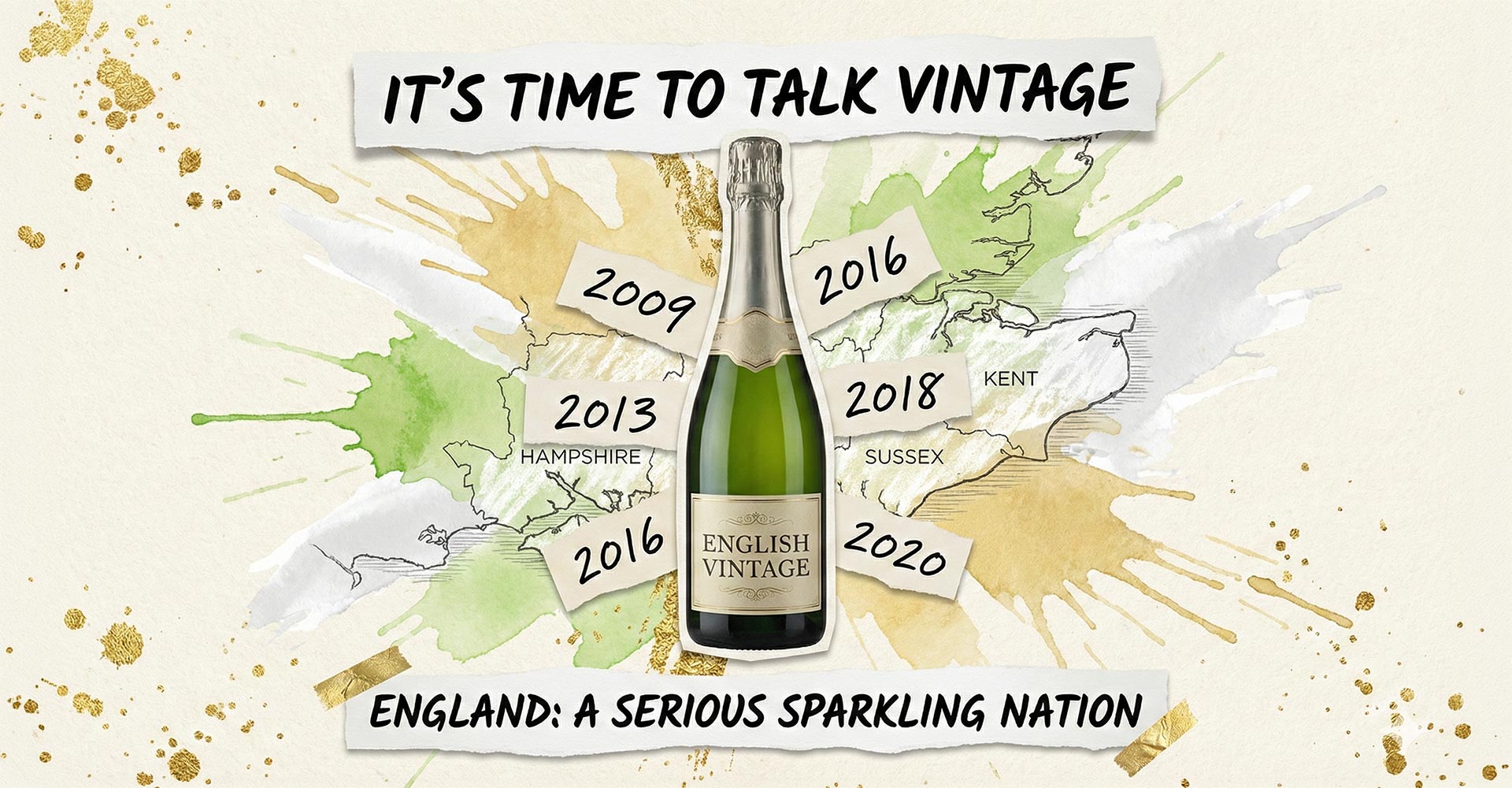
It is quite good. In fact, it’s often brilliant. And it’s high time we started talking about vintages properly.
England is no longer a curiosity. It’s a serious sparkling wine nation, built on chalk soils, cool climate precision and an increasingly confident winemaking culture. If the French can obsess over vintage variation, so should we.
Let’s unpack why.
The Foundations: Why England Can Make World-Class Sparkling Wine
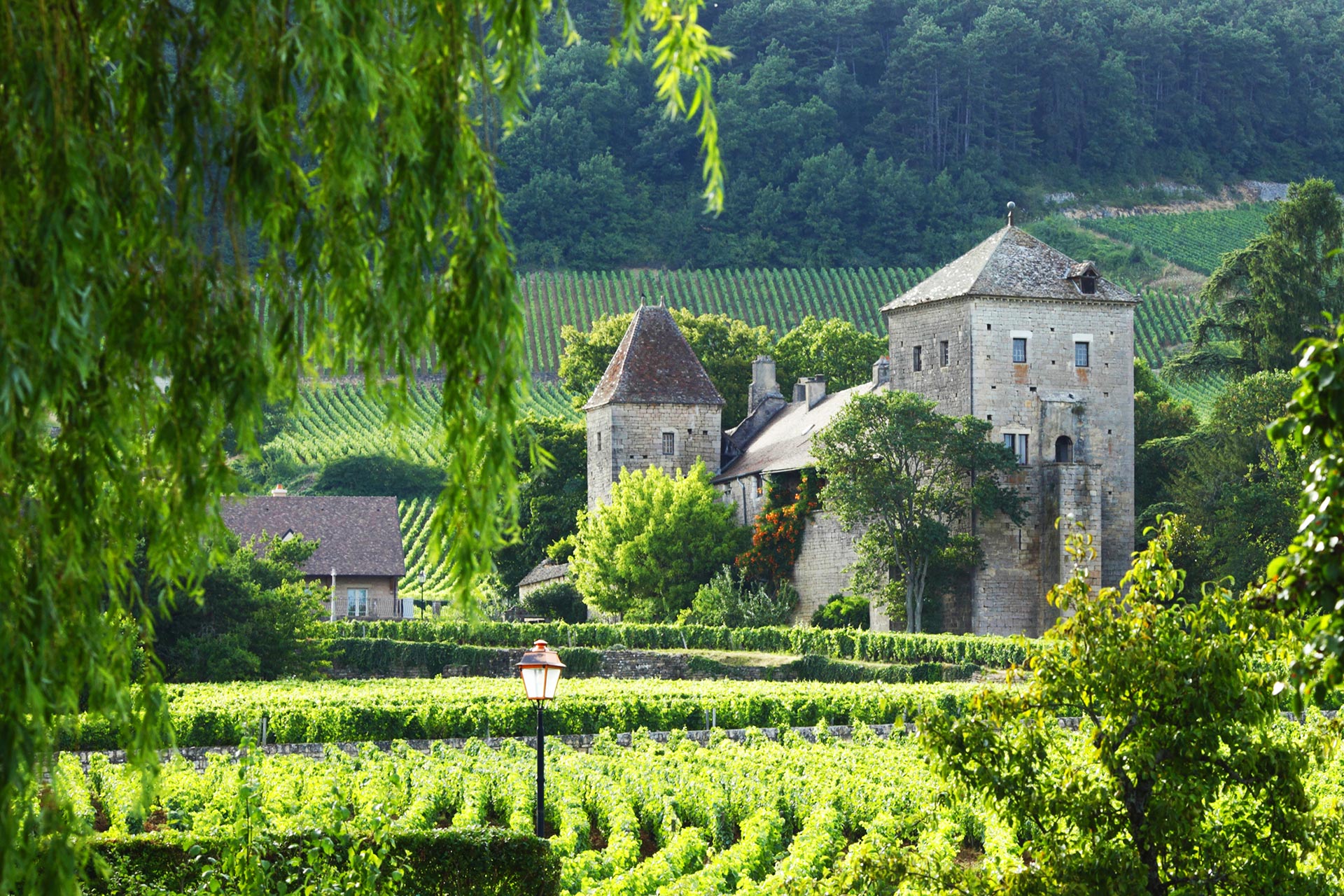
Much of southern England sits on the same Cretaceous chalk seam that runs through Champagne. Kent, Sussex and Hampshire share that famous white bedrock. Chalk drains beautifully, encourages deep roots and delivers that saline, mineral tension we love in top sparkling wines.
But geology is only half the story.
In cool climates like ours, the real drama is in the weather. A great English vintage needs:
- A frost-free spring
- Warm, dry flowering in June
- A long, calm autumn, ideally with an Indian summer
Get that balance right and you have ripe fruit, vibrant acidity and the structure for long ageing. Get it wrong and you have nervous winemakers staring at the sky.
That variability is exactly why vintage matters here.
The Landmark English Vintages
2009 – The Year We Grew Up
If you want proof that England can produce age-worthy sparkling wine, 2009 is your calling card.
Sugrue South Downs’ The Trouble With Dreams 2009 has become something of a legend. With more than a decade in bottle, it shows truffle, honey and brioche while still holding a spine of acidity. This wasn’t a fluke. It was a statement.
2010 – Finesse and Precision
A generous crop and excellent conditions meant producers could be selective. The result was wines with racy acidity and serious elegance.
Ridgeview’s 2010 Blanc de Blancs is a fine example, though many bottles are now entering their later drinking window. If you’ve got one, don’t wait forever.
2013 – The Quiet Achiever
It doesn’t always get the headlines of 2009 or 2018, but for many producers 2013 became a cornerstone vintage, particularly for prestige cuvées and multi-vintage blends.
The season delivered a balanced profile of ripe fruit and firm acidity. Not flashy. Not overblown. Just structurally sound fruit that rewards long lees ageing.
Digby Fine English and Gusbourne both relied heavily on 2013 for top-tier bottlings. I work closely with Digby, and I’ve always felt Sir Kenelm Digby himself would have been quietly proud of what 2013 delivered. With time in bottle, these wines show youthful citrus layered with emerging toasted almond and brioche notes. It’s a vintage that’s ageing with quiet confidence.
2014 – Mineral and Taut
2014 is one for purists. Cool ripening preserved piercing acidity and a mineral core that makes Blanc de Blancs sing.
Nyetimber and Harrow & Hope produced particularly chiselled wines this year. These are bottles for the patient. Give them time and they reward you.
2016 – Quality Over Quantity
Frost hit hard in 2016. Yields were low, nerves were high.
But a warm summer and long harvest delivered concentrated fruit. Nyetimber’s 2016 Blanc de Blancs, especially in magnum, shows intensity, citrus zest and chalky length. A vintage that proved resilience matters as much as sunshine.
2018 – The Hallmark Year
If one vintage defines modern English sparkling wine, it’s 2018.
Warm, settled conditions led to record yields and superb ripeness. Around 15.6 million bottles were produced, and quality was consistently high.
2018 wines are generous yet balanced. Ripe orchard fruit meets clean acidity. This is the year England stopped being an underdog and started being a benchmark.
2020 – Concentrated and Exotic
One of the hottest, driest seasons on record.
Expect intensity. Riper citrus, hints of kiwi and tropical notes in Chardonnay, but still with freshness. Leonardslee’s 2020 Blanc de Blancs shows how warmth can bring richness without losing structure.
2023 – Record Volumes, Impressive Chardonnay
A nervous summer turned around by a September Indian summer.
Chardonnay from 2023 has impressed many growers. Early signs suggest this could be a sleeper vintage with both volume and quality.
2025 – One to Watch
Reports from growers suggest 2025 may be historic, particularly for still wines. An early harvest and exceptional ripeness hint at a new chapter for English viticulture.
We’ll know for certain in a few years, but it’s one to keep on your radar.
The Producers Setting the Standard
Nyetimber
Often described as the global benchmark for English sparkling wine. Their prestige cuvée, 1086, regularly competes with top Champagne in blind tastings. Precision, consistency and ambition in equal measure.
Sugrue South Downs
Dermot Sugrue crafts some of the most complex wines in the country. Extended lees ageing and old oak fermentation create savoury, saline depth. His Cuvée Dr Brendan O’Regan changed perceptions overnight.
Gusbourne
Single-estate focus and clinical precision. Their Blanc de Blancs and Blanc de Noirs are regular award winners. Clean lines, pure fruit, serious intent.
Langham Wine Estate
Dorset’s rising star. A low-intervention philosophy and a clever perpetual reserve system give real depth to their blends. Increasingly a sommelier favourite.
Hundred Hills
From the chalk slopes of the Chilterns, producing handcrafted, long-lees-aged wines now found in Michelin-starred restaurants. Proof that micro-terroir in England matters.
Digby Fine English
Rooted in the legacy of Sir Kenelm Digby, Digby Fine English blends heritage with modern precision. Their vintage wines, particularly from structured years like 2013/2014, show fine mousse, layered citrus and a poised, quietly confident style that rewards ageing. Their 2018 Vintage Rosé underlined that ambition, earning 97 points and a Platinum award from Decanter.
You can learn more about Digby at https://digby-fine-english.com/
Why Vintage Matters More Than Ever
English sparkling wine is defined by tension. High natural acidity, slow ripening and aromatic clarity.
As vintages warm, dosage levels are dropping. Extra Brut and zero dosage styles are becoming common. Oak, once rare, is now a tool for prestige cuvées, adding subtle smokiness and texture.
And here’s the important bit.
A 2014 does not taste like a 2018. A 2018 does not taste like a 2020.
Climate variation, frost events and harvest timing shape style dramatically. Ignoring vintage means ignoring personality.
England vs Champagne
In blind tastings, top English sparkling wines now score almost identically to leading Champagne houses. Critic averages hover around 90.6 for England versus 90.8 for Champagne.
That gap is statistical noise.
Yet we still hesitate to talk about our vintages with the same confidence. Perhaps it’s cultural modesty. Perhaps it’s habit.
Either way, it’s outdated.
The Collector’s Shortlist
If you’re buying now with intent, consider:
- 2013 for structured elegance and long lees ageing potential
- 2014 for mineral precision and ageing potential
- 2018 for balance and generosity
- 2020 for concentration and richness
And if you see 2009 in good condition, treat it with respect.
Final Thought
English sparkling wine is no longer a novelty poured with a wink and a patriotic grin.
It is a serious, age-worthy, globally competitive category.
And like all serious wine regions, it deserves proper vintage conversation.
So next time you open a bottle of English fizz, don’t just ask who made it.
Ask which year.
Cheers.