Overproduction, trade barriers and changing drinking habits are forcing Europe’s wine industry to confront an uncomfortable truth: a prestigious label no longer guarantees a willing buyer. From Piedmontese vinegar to shrinking vineyard yields, the current surplus is not simply another difficult vintage. It marks the beginning of a new global era in which wine value must be created, not merely assumed.
Over the past year, I’ve spoken with producers, merchants and importers who describe the same problem in slightly different ways: wine is taking longer to sell, stock is sitting in cellars, cash is tied up and decisions that would once have appeared unthinkable are now being discussed openly.
Turning premium wine into vinegar sounds extraordinary. Commercially, it is becoming an entirely rational conversation.
There are few more brutal illustrations of an industry in distress than watching fine wine become a condiment.
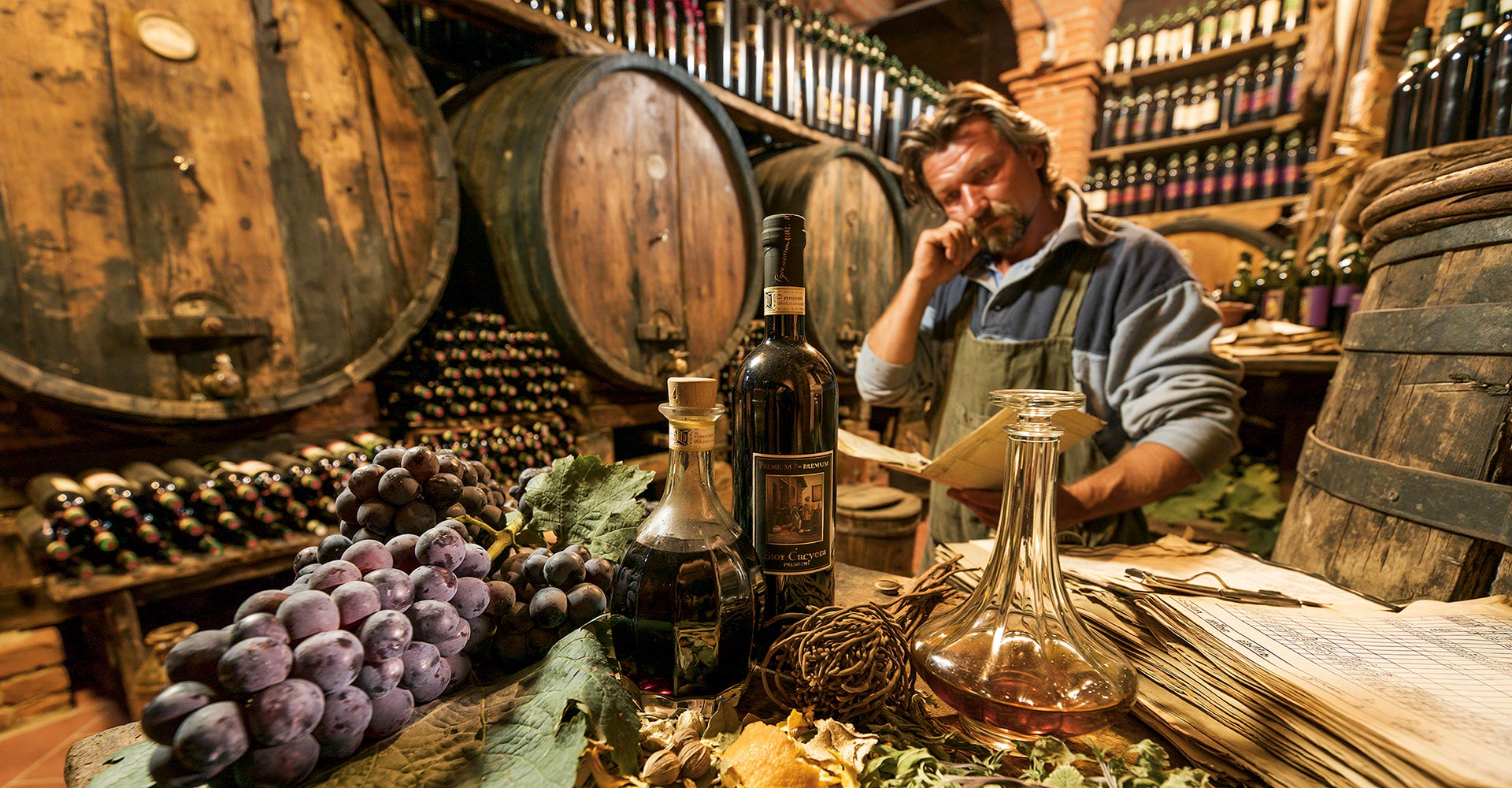
Not a bad condiment, admittedly. This is Piedmont, so even the emergency disposal plan comes with provenance, regional pride and probably a discussion about which dish best reveals the Barbera’s acetic complexity.
Yet behind the faint absurdity is a serious commercial warning. Producers around Asti are considering diverting surplus red wine into vinegar because their cellars are full, bulk prices have collapsed and traditional export markets are becoming harder to reach.
Wine has spent decades teaching consumers that scarcity creates value. The current crisis presents the opposite problem: what happens when the world has more wine than it wants to drink?
Why is Italy holding so much unsold wine?
Italy’s wine surplus is being caused by falling demand rather than one unusually large harvest.
By May 2026, Italian cellars reportedly contained more than 53 million hectolitres of wine and must, 7.3% more than in May 2025. That is approximately the volume of an entire annual Italian harvest sitting in storage.
Earlier figures from Italy’s ICQRF inspectorate placed stocks at 55.9 million hectolitres at the end of March, alongside 5.3 million hectolitres of must and more than 165,000 hectolitres of wine still fermenting.
The awkward part is that this inventory accumulated after three relatively light harvests between 2023 and 2025. Producers cannot simply blame an enthusiastic growing season and promise to be more restrained next year. Supply has remained too high because the market beneath it has contracted.
The problem is also highly concentrated. Of Italy’s 523 geographical indications, only 20 account for 58.3% of national stocks. Prosecco DOP alone represents 11.3%. Northern Italy holds 56.5% of all inventory, with Veneto responsible for more than a quarter.
This is the risk of industrial success. A region builds global distribution, increases production to service it, then discovers that international demand is rather less loyal than the vineyards.
Italian supermarket wine sales fell by 2% between January and May 2026. Export volumes dropped by 4% in the first quarter, while export value declined by 8.3%. During the first four months of the year, export value was reportedly down by 15.4%, following a 9.2% fall at the end of 2025.
Piedmont performed slightly better, helped by the international strength of Barolo and Barbaresco. Veneto and Tuscany were less fortunate, recording export contractions of 9.7% and 8.3% respectively.
Prestige still helps, but it no longer makes a region recession-proof.
Having spent more than three decades advising businesses and premium brands, one part of this feels remarkably familiar. Companies often mistake historic demand for permanent demand. When something has sold successfully for years, the organisation begins to assume the market will continue turning up out of habit.
Wine is now learning the same uncomfortable lesson that has confronted many established industries: heritage creates interest, but it does not guarantee future sales.
Why are DOC and DOCG wines being downgraded?
Downgrading allows producers to sell protected wine under a cheaper classification, sacrificing some of its potential value to generate immediate cash.
When a DOCG or DOC wine cannot be sold at the expected price, a winery may declassify it as IGP or ordinary table wine. The liquid has not suddenly forgotten where it came from, but commercially it has been moved several rows down the seating plan.
The Unione Italiana Vini estimated that widespread declassification erased around €516 million from the Italian wine sector in early 2026. DOP wines suffered an estimated 10% value hit, while IGP categories declined by 14%.
As more declassified wine entered the bulk market, ordinary wine prices also fell sharply. This created a downward spiral: premium wine was downgraded to clear stocks, the extra volume depressed lower-category prices, and producers then had even less incentive to release further wine.
Several regional consortia have responded by limiting production. Chianti, Chianti Classico, Brunello di Montalcino, Soave and Barbera d’Asti have introduced or requested yield reductions of between 10% and 20% for the 2026 harvest.
Wine regions are effectively rediscovering one of luxury’s less romantic rules: scarcity only works when somebody controls the supply.
Bottom Line
Italy’s inventory problem cannot be solved purely through discounting. Selling more premium wine as cheaper wine may free individual cellars, but it destroys category value and drags down prices across the wider market. Production must ultimately move closer to real demand.
Why turn surplus wine into vinegar?
Converting wine into vinegar creates a saleable premium product while preserving more of its origin and value than industrial distillation.
Europe’s traditional solution to surplus wine has been crisis distillation. Governments subsidise the purchase of excess stocks, which are then converted into industrial alcohol, biofuel or sanitiser.
It clears the tanks and gives growers temporary financial support. It also turns years of farming, ageing and regional storytelling into something that might clean a hospital corridor.
France and the European Union committed around €200 million to distillation support in 2023. Portugal allocated another €15 million in 2024. Such programmes may prevent immediate collapse, but they do little to correct the structural gap between production and consumption.
Piedmont’s vinegar proposal is more commercially interesting. Regional officials and Vignaioli Piemontesi have discussed a €1.7 million support package to divert surplus Asti-area red wine into vinegar production.
Bulk Barbera d’Asti has reportedly fallen to approximately €0.80 per litre. Ghemme-based vinegar producer Ponti has shown interest in buying suitable wine for an additional €0.45 per litre.
For growers, this would provide a price floor and release valuable cellar capacity. For vinegar producers, it offers traceable, high-quality material with a recognisable grape variety and geographic story.
The opportunity is not insignificant. The global red wine vinegar market was valued at around $1.05 billion in 2025 and is forecast to reach $1.68 billion by 2034. Consumers are increasingly interested in single-variety condiments, clean-label ingredients and products with genuine provenance.
A bottle of Barbera vinegar will never command the emotional pull of a mature Barolo. It may, however, be considerably more profitable than a tank of wine nobody wants.
Could vermouth provide another outlet?
Vermouth offers producers a more glamorous way to convert surplus base wine into a longer-lasting, higher-value product.
Piedmont has an obvious historical advantage. Vermouth combines wine with spirit, herbs and botanicals, producing a shelf-stable apéritif that fits comfortably within modern cocktail culture.
Global vermouth trade reached approximately $821 million in 2024, up 6.89% on the previous year. Italy accounted for about $327 million, or 37% of global exports, while the United States remained the largest importer.
Not every surplus wine can or should become vermouth. Production requires technical expertise, botanical development, branding, distribution and an ability to compete in an increasingly crowded drinks category.
Still, the principle matters. Wine businesses need several commercially credible destinations for their agricultural output. Depending entirely on the traditional 750ml bottle is beginning to look less like integrity and more like an unusually elegant form of operational risk.
How are US tariffs affecting European wine?
The 15% US tariff on European exports provides predictability, but embeds a permanent cost increase in one of Europe’s most valuable wine markets.
The EU-US agreement that took effect on 1 July 2026 established a 15% tariff ceiling through the end of 2029. It removed the threat of far more punitive duties, including previous warnings of tariffs reaching 100% or even 200% on some European products.
That is the good news, in the same way that being told precisely how much your margins will be squeezed is better than being surprised at customs.
The greater problem is how tariffs move through America’s three-tier distribution system. Importers, distributors and retailers each add percentage-based margins to the landed cost. A relatively modest charge at the border can therefore become a far larger increase on the shelf.
A $1.50 tariff cost may translate into an additional $3 to $8 for the consumer by the time everyone in the chain has applied their margin.
This particularly damages the middle of the market. Iconic wines may retain buyers because scarcity and status outweigh modest price increases. Cheap wine competes primarily on price and can be reformulated, redirected or heavily promoted.
Mid-priced premium wines have less room to manoeuvre. They are expensive enough for consumers to notice a price rise but not rare enough to make price irrelevant.
Italian PDO exports to the US have reportedly fallen by almost 12% in value since mid-2025. Many producers have absorbed part of the tariff themselves, protecting volume at the cost of their own profitability.
The tariff has not closed the American market. It has made every bottle work harder to justify its presence there.
Why are younger consumers drinking less wine?
Younger consumers drink less alcohol, have more alternatives and tend to enter wine through social experiences rather than inherited family habits.
Silicon Valley Bank’s 2026 wine industry report describes the end of “passive demand”. For years, wineries could rely on tasting-room visits, distributor orders and ageing Baby Boomers steadily expanding their cellars.
That dependable consumer base is now moving beyond its peak drinking years. Millennials and Generation Z are not replacing the same volume.
They divide their attention between wine, spirits, cocktails, ready-to-drink products and increasingly credible alcohol-free alternatives. Health, moderation and transparency often matter more than hierarchy, critic scores or the reputation of a distant château.
Research from Areni Global across London, Paris, New York, Shanghai, Hong Kong and Singapore also challenges the idea that fine wine appreciation is naturally inherited at the family table.
For under-40 consumers, initial interest is more commonly triggered by friends, travel, dinners and shared tastings. The route into wine is built around access, education and community.
This changes the role of the producer. A technically correct wine with a distinguished appellation is no longer enough. Someone must explain why it matters, create an occasion for discovering it and make the newcomer feel welcome rather than examined.
Wine has occasionally behaved as though confusion were proof of quality. Younger consumers appear unconvinced.
The WineGuide101 view: adaptation without surrender
The vinegar story is not the crisis. The greater danger is that too many producers may still believe demand will eventually return to what it was.
Business history is littered with organisations that understood their product but misunderstood the change happening around it. Kodak developed early digital camera technology but remained deeply committed to the commercial model built around photographic film. The company did not fail because people stopped taking photographs. Quite the opposite. Photography exploded, but the way people captured, stored and shared images changed.
Netflix offers the opposite lesson. It began by posting DVDs, then moved into streaming and eventually original production. It was willing to weaken its existing model before someone else made it irrelevant.
Wine is not photography or home entertainment, of course. A vineyard cannot become a streaming platform, and nor should it try. But the underlying lesson remains useful. Markets rarely rewind. Producers must protect what makes them distinctive while being willing to change how that value reaches the customer.
That could mean smaller harvests, better direct relationships, more welcoming education, different packaging or alternative products such as vinegar and vermouth. Adaptation does not have to mean abandoning tradition. Done well, it may be the only way to preserve it.
Bottom Line
The next generation is not necessarily rejecting wine. It is rejecting the expectation that wine deserves attention automatically. Producers must earn curiosity through experiences, useful education, transparent communication and genuine community.
What should wine producers do next?
The strongest response combines controlled production, closer customer relationships and a broader portfolio of products and formats.
First, wineries must treat retention as seriously as acquisition. Wine clubs and mailing lists should become personalised communities rather than databases that receive the same offer every Thursday afternoon. Tastings, dinners and regional experiences can turn an occasional buyer into a long-term customer.
Second, producers need to diversify without damaging their flagship identity. Premium vinegar, vermouth, lower-alcohol wine and carefully managed private labels can create cash flow while protecting the core estate brand.
Third, packaging must match the occasion. Lightweight bottles, quality cans and larger pouch formats can reduce transport costs and appeal to consumers who value convenience and sustainability. Heavy glass may still signal luxury in some markets, but it also signals higher freight costs with admirable clarity.
Finally, production decisions must be based on what is actually selling. Yield controls, tighter allocations and stronger inventory data will be essential. Wine cannot continue producing for the market it remembers rather than the one standing in front of it.
A new era of wine value, but hopefully not less magic
In my opinion, the next decade will belong to wineries that create the most value from every litre they produce, rather than those that simply produce the most wine.
That may mean stronger direct-to-consumer relationships, lighter packaging, premium vinegar, vermouth or lower-alcohol wines. The common thread is commercial discipline.
I also find that conclusion rather sad.
I understand that wine is a business. Growers need to make a living, wineries need to generate a return and merchants cannot pay their bills with romantic descriptions of limestone soils. Yet I hate the thought of fine wine being viewed as just another commercial product whose value is determined only by stock rotation and margin.
To me, there is still magic in the depth of a bold Cabernet, the elegance of a fine Bordeaux or the way a bottle can evolve during an evening. As a member of Generation X, I do not particularly want that to change.
Opening a great bottle is not like opening another beer. It is an experience, a moment and, occasionally, a memory that stays with you long after the bottle is empty.
Perhaps that emotional connection is precisely what the industry must learn to communicate more effectively. Wine’s future should not depend on stripping away its mystery, heritage or sense of occasion. It should depend on making those qualities relevant and accessible to people who have not yet discovered them.
Scarcity, classification and history still matter. They simply cannot carry the entire commercial burden.
The challenge is to preserve the magic while building a business capable of protecting it. Because if fine wine becomes nothing more than liquid inventory, the industry may balance its books but lose the very thing that made the bottle worth opening.
And when the market genuinely does not need another bottle, a very good vinegar is still better than a very expensive ethanol subsidy. I just hope we never become too comfortable with the idea.