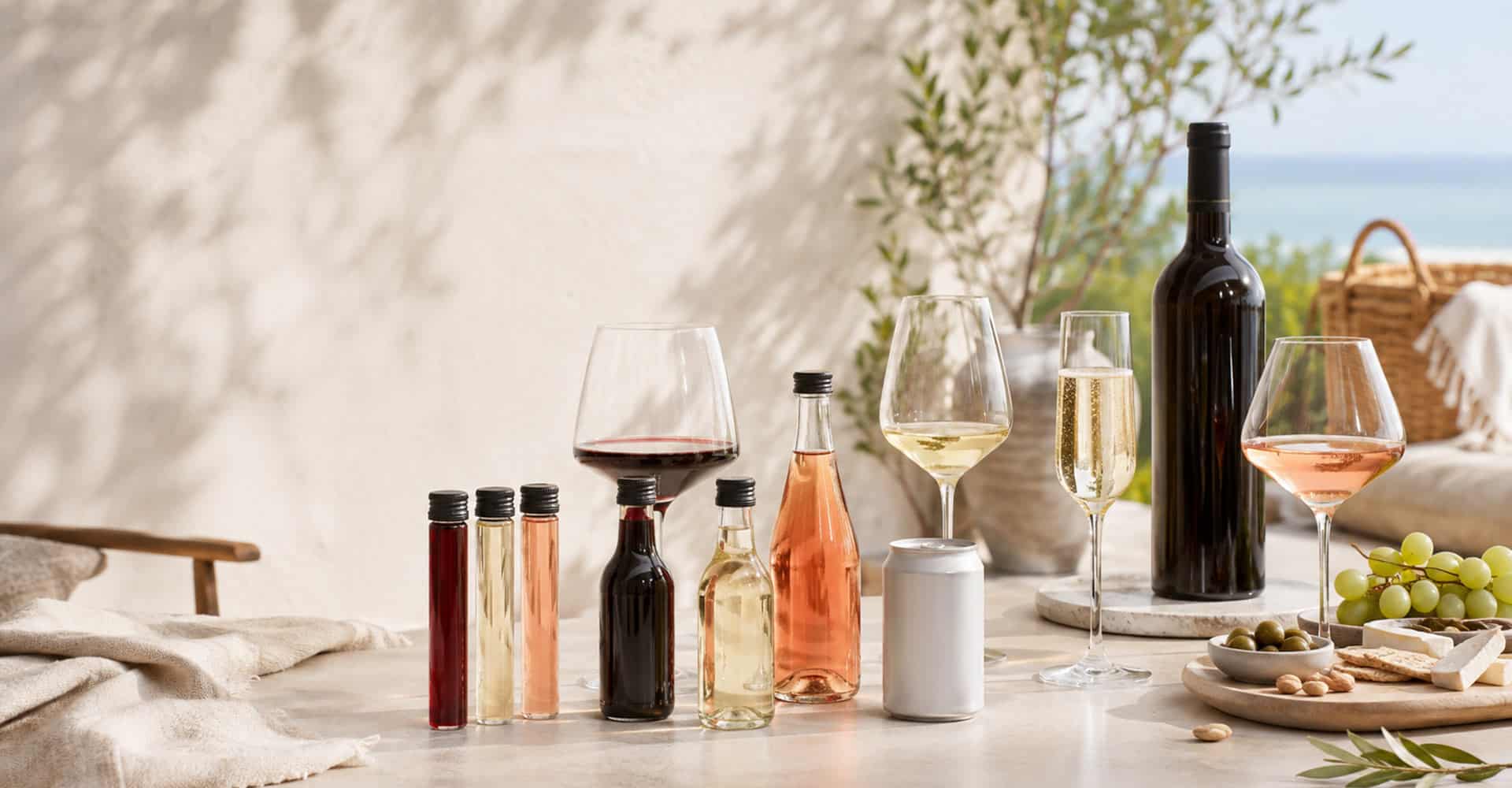
Small wine bottles used to occupy a slightly unglamorous corner of the drinks world: aeroplanes, hotel minibars and the sort of train journey where optimism had already left at the previous station. Now they’re being reconsidered as something rather more interesting. From 100ml fine-wine tasting tubes to 250ml bottles, smaller formats are tapping into moderation, solo drinking, premium discovery and one of wine’s oldest irritations: what to do with the rest of the bottle.
There’s a peculiar contradiction at the heart of wine.
We spend enormous amounts of time discussing whether a vineyard faces south-east, whether the grapes were picked before breakfast and precisely how many months something spent contemplating its existence in French oak.
Then we sell nearly all of it in exactly the same 750ml container.
For couples, families and dinner parties, that works perfectly well. For somebody who wants one glass with dinner on a Tuesday night, less so.
That’s why I find the growth of small wine bottles considerably more interesting than their size suggests. They potentially solve several problems at once: portion size, freshness, experimentation, sampling and, perhaps most importantly, the psychological hurdle of opening a £30 or £50 bottle when you only fancy a glass.
This isn’t necessarily the death of the 750ml bottle. Wine has survived quite happily without reinventing absolutely everything every five minutes.
But the assumption that one bottle size suits every occasion is starting to look increasingly dated.
Why are small wine bottles becoming more popular?
The simplest answer is that the way people drink is changing.
Younger consumers, particularly Millennials and Gen Z, are generally drinking less wine, while moderation and wellness have become much bigger considerations across the drinks industry.
That doesn’t necessarily mean consumers have stopped caring about quality. Quite the opposite. The emerging behaviour is often described as “drink less, drink better”.
That creates an interesting packaging problem.
If I want one decent glass of wine, buying 750ml means purchasing considerably more wine than I actually intend to drink. Yes, preservation systems exist, and plenty of wines will survive happily for several days in the fridge. But there is still a large group of consumers for whom opening a full bottle feels like a commitment.
The rise in single-person households adds another dimension. Even in households with several adults, tastes don’t conveniently align every evening. One person wants red, another white, somebody else isn’t drinking.
Wine has traditionally solved this problem by expecting everyone to negotiate.
Smaller formats remove the negotiation.
A 200ml bottle gives you roughly one generous serving. A 250ml bottle gives you two smaller 125ml pours. Open it, drink it, and there isn’t half a bottle sitting accusingly on the kitchen counter tomorrow.
Are small wine bottles more expensive?
Not always, and this is where things become surprisingly interesting.
The obvious assumption is that miniature bottles must cost considerably more per millilitre because manufacturers still need a bottle, closure, label, filling process and distribution for much less wine.
The examples in the research don’t entirely support that assumption.
M&S Côteaux Varois en Provence Rosé was priced at £4 for 250ml, equivalent to £1.60 per 100ml. Its £12 standard bottle worked out at exactly the same £1.60 per 100ml.
Laithwaites Cabalié Blanc showed an even stranger result. The 187ml bottle at £3.99 worked out at around £2.13 per 100ml, compared with approximately £2.40 for the £17.99 standard bottle.
Lanson Le Black Création NV Champagne provided another example. A 200ml bottle at £13.15 equated to roughly £6.58 per 100ml, compared with around £6.93 per 100ml for a £52 standard bottle.
Not every example favours the miniature. M&S Finca Miguel Cava Rosado Brut was around 25% more expensive per 100ml in its 200ml format.
So there’s no universal small-bottle tax.
Bottom Line
Small wine bottles can cost more per millilitre, but they don’t automatically do so. In some retail examples, the price is at parity with a 750ml bottle or even slightly cheaper.
And price per millilitre isn’t necessarily the best measure anyway.
If you buy a £12 bottle, drink 300ml and eventually throw away the remaining 450ml, your bargain suddenly looks rather less impressive.
The cheapest wine is rarely the wine you pour down the sink.
Could small formats make fine wine more accessible?
This may be the most exciting part of the whole trend.
The 100ml tasting format changes the economics of trying expensive wine.
Technologies such as Coravin Vinitas allow wine to be transferred from larger bottles into 100ml glass tubes while limiting oxygen exposure using inert gas. According to the supplied research, correctly packaged wines can remain stable for up to 12 months.
That creates possibilities far beyond convenience.
A producer can send six 100ml samples for a virtual tasting rather than six full bottles. Retailers can create comparative flights. Wine educators can let people explore regions, grapes or vintages without requiring everyone to remortgage a small conservatory.
I’m a big fan of Tiny Wine, and I think Harry, who runs it, is onto something genuinely clever with this.
The appeal isn’t simply that you get less wine. It’s that you can get access to far better wine in a quantity that makes sense.
The Coravin-based preservation system is also important. These aren’t samples you necessarily have to line up and drink immediately like some slightly overenthusiastic Tuesday-night masterclass. Properly stored, you can keep them and taste them when it suits you.
That changes the experience completely.
You might taste two wines side by side one evening, then come back to another pair later. Or buy a flight of wines that would cost hundreds, sometimes far more, as full bottles and work through them at your own pace.
Tiny Wine’s example six-tube flight costs £96. That’s hardly cheap wine, but neither is that the point. The equivalent full bottles represented in one researched example would cost around £1,000 in total.
You’re effectively buying access rather than ownership.
That idea makes enormous sense to me.
Wine education has traditionally required either generous friends, organised tastings or buying bottles considerably faster than most sensible households can drink. Smaller samples let enthusiasts taste horizontally or vertically without turning the dining room into Berry Bros. & Rudd.
From a WineGuide101 perspective, that’s valuable because tasting comparatively is one of the fastest ways to understand wine. Sauvignon Blanc beside Chardonnay teaches you more than reading another 800 words describing gooseberries.
Possibly including these 800 words.
What about wine in cans?
Alternative wine formats go beyond miniature bottles and tasting tubes.
I’ve tasted some pretty decent wine from a can, and I’ve got no philosophical objection to it whatsoever.
For picnics, festivals, trains, beaches, outdoor events or simply occasions where carrying a bottle is inconvenient, a can makes an enormous amount of practical sense. It’s lightweight, easy to chill, portion-controlled and doesn’t require a corkscrew.
But context matters.
A good canned wine doesn’t need to compete with Château Montrachet or an extraordinary Super Tuscan any more than a very good burger needs to justify its existence by defeating a three-star Michelin tasting menu.
They’re different occasions.
You’re unlikely to spend an evening slowly watching a canned wine evolve in the glass, contemplating layers of tertiary development and debating the precise quality of its tannins.
And that’s fine.
Wine can sometimes tie itself in knots by assuming every drinking occasion should aspire to the same thing. Sometimes you want complexity, age and a bottle that becomes more interesting over three hours.
Sometimes you want a cold glass of something decent at a picnic without carrying a kilogram of glass around.
Convenience doesn’t automatically mean poor quality. It just means we should judge the wine according to what it’s trying to achieve.
Why small sparkling wine bottles make particular sense
Sparkling wine presents perhaps the most obvious use case.
Once a bottle of Champagne, Cava or Prosecco has been opened, maintaining its fizz becomes considerably more difficult than preserving a still wine.
A proper sparkling-wine stopper helps, but the basic problem remains: sometimes you want a glass of bubbles without feeling obliged to manufacture a celebration large enough to justify the other 550ml.
The traditional 200ml Piccolo or Split format solves that beautifully.
One bottle. One serving. Full pressure when opened.
It also lowers the financial barrier to trying better sparkling wine. Spending £13.15 on a 200ml Lanson feels quite different from committing £52 to the full bottle, despite the underlying wine being the same.
That distinction matters commercially.
My day job is branding and marketing, including working with premium and hospitality businesses, and one of the most persistent challenges with premium products is trial. Consumers cannot discover that they love something until somebody makes it sufficiently easy for them to try it.
Smaller wine formats can turn an expensive purchasing decision into an accessible experiment.
And experiments are considerably easier to sell than commitments.
Are miniature wine bottles actually more sustainable?
This is where the story becomes less convenient.
Reducing wine waste sounds environmentally sensible, but packaging matters enormously in wine.
The supplied research estimates that packaging can account for roughly 30% to almost 60% of wine’s total carbon footprint. Glass is energy-intensive to manufacture and heavy to transport.
Small glass bottles also use more packaging relative to the amount of wine inside them.
A 450g standard 750ml bottle represents roughly 600g of glass per litre of wine. A 200g miniature holding 187ml works out at more than 1,060g of glass per litre.
That’s a substantial penalty.
So replacing one 750ml glass bottle with four heavy glass miniatures and declaring victory for sustainability would be rather like driving four Range Rovers to the recycling centre.
Packaging manufacturers are therefore looking at lighter alternatives.
Recycled PET can significantly reduce transport weight and is particularly suited to wines intended for relatively rapid consumption.
Paper-based bottles are another developing option. Frugalpac’s paper bottle weighs around 71g and, according to the research supplied, can deliver an 84% lower carbon footprint than conventional glass.
The Sustainable Wine Roundtable’s Bottle Weight Accord is also pushing towards an average still-wine bottle weight of 420g, while the UK’s Extended Producer Responsibility system increases the commercial pressure to think carefully about packaging weight.
Bottom Line
Small formats are not inherently more sustainable. Heavy miniature glass can actually perform badly per litre. Their environmental case becomes much stronger when lightweight packaging and avoided wine waste are considered together.
The overlooked sustainability issue: wasting the wine
Packaging comparisons can also miss something rather important.
The wine itself has an environmental footprint.
Grapes have to be grown. Vineyards require machinery, water and labour. Wine is fermented, cooled, stabilised, stored, packaged and transported.
Pouring 300ml of oxidised wine down the sink wastes all the resources already invested in producing it.
That makes the sustainability calculation more complicated than simply asking which bottle weighs less.
If smaller formats significantly reduce unused wine, some of their additional packaging impact may be offset by reduced product waste.
The ideal solution may therefore not be lots of tiny heavy glass bottles. It may be correctly sized wine in substantially lighter packaging.
Less wine wasted, less material transported and considerably fewer guilty bottles lurking in fridge doors.
Where do small wine formats make most sense?
Different formats solve different problems.
100ml tasting tubes are particularly compelling for fine wine, education, virtual tastings, premium gifting and trade samples. The ability to preserve them properly and taste them when you choose makes the format considerably more useful than a conventional sample bottle.
187ml to 200ml bottles work well for sparkling wine, travel, events, picnics and straightforward single servings.
250ml bottles arguably have the broadest everyday appeal. They provide enough wine for one generous glass or two smaller pours and can work particularly well with rosé, aromatic whites and lighter reds.
Cans are strongest when portability, weight and convenience matter. There is increasingly decent wine available in them, but their job isn’t to replace great cellar-worthy bottles.
750ml bottles remain the obvious choice for meals, groups, dinner parties, cellaring and wines where part of the pleasure comes from watching them evolve after opening.
In other words, this doesn’t need to become another wine-industry argument about which format must defeat all the others.
Sometimes a bottle is right.
Sometimes you just want a glass.
Remarkably, both things can be true at once.
Are small wine bottles the future of wine?
Not the future. But almost certainly part of it.
The more interesting shift is away from treating smaller formats as inferior versions of a “proper” bottle.
Premium wine sampling, better preservation technology and changing drinking behaviour are making format part of the consumer experience rather than merely a packaging decision.
Tiny Wine is a particularly good example of where this becomes genuinely exciting. Give people access to interesting wines, preserve them properly and allow them to taste at their own pace, and suddenly small format isn’t about compromise at all. It’s about access.
Cans make sense for a different reason. They provide wine where bottles can be inconvenient, heavy or simply unnecessary.
Neither needs to pretend it is replacing Château Montrachet, a brilliant old Bordeaux or a remarkable Super Tuscan.
That isn’t the point.
For producers, these formats open new routes into sampling, ecommerce, wine clubs and customer acquisition.
For retailers, they create new occasions and more approachable price points.
For consumers, they mean drinking the wine they actually want, in the quantity and setting they actually want it.
And perhaps that’s the genuinely modern bit.
The wine world has spent decades telling consumers to drink better wine. Smaller formats may finally make it easier to drink better wine without also telling them they have to drink more of it.
I can raise a small glass to that.
Sources and research referenced
Research supplied for this article includes retail pricing examples from Sainsbury’s, Waitrose, M&S/Ocado and Laithwaites; Tiny Wine fine-wine tasting formats; Coravin Vinitas fractionalisation technology; Sustainable Wine Roundtable packaging initiatives; Frugalpac packaging data; and UK Extended Producer Responsibility considerations.