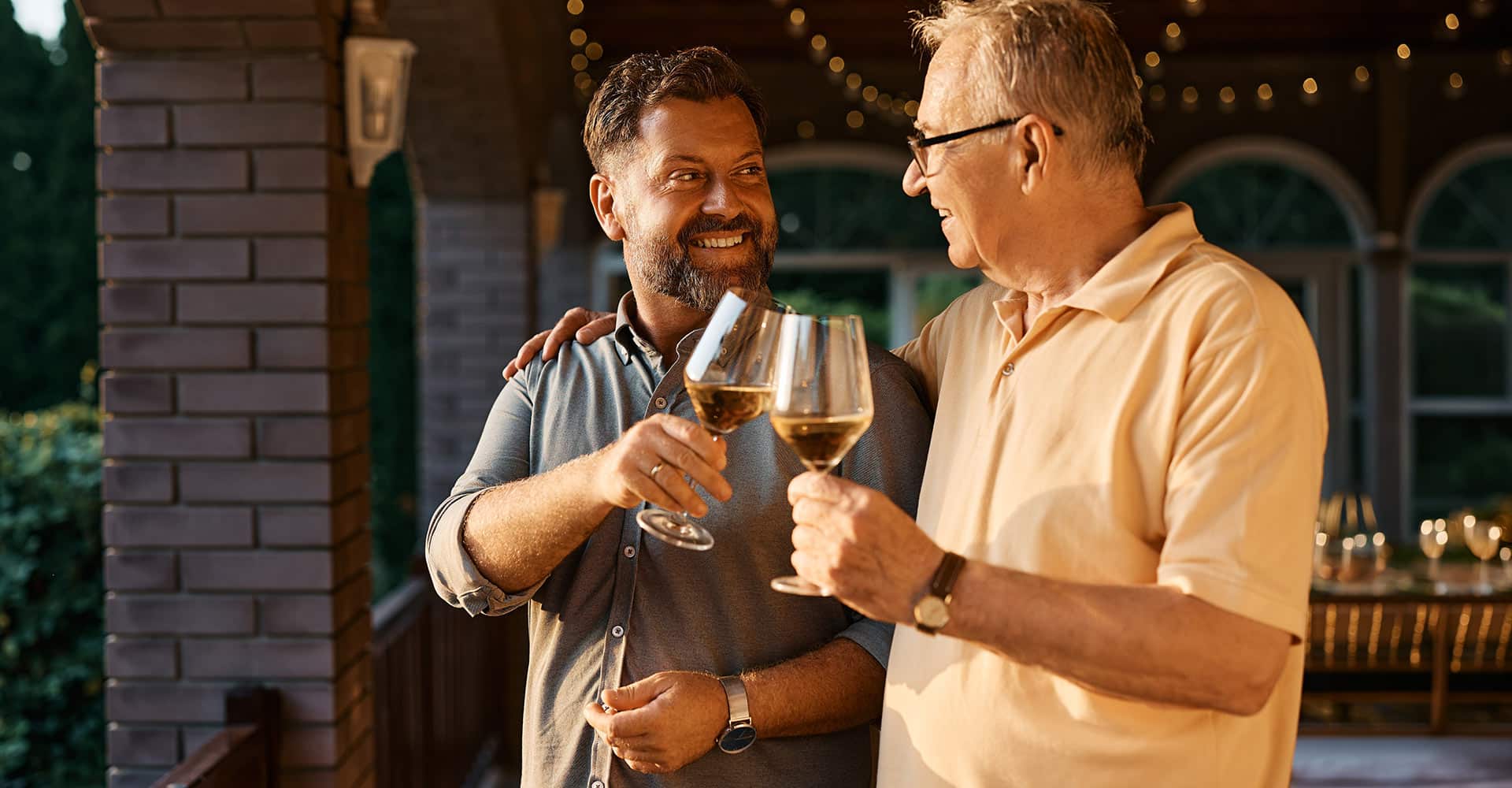
A great Father’s Day wine gift should be opened, poured and enjoyed, not placed on a kitchen counter like a small glass monument to future guilt. The best bottle is rarely the most age-worthy one. It’s the one that delivers pleasure at 6pm, with dinner on the table and nobody Googling “how long does Barolo need?”
The problem with “impressive” wine gifts
Wine gifting has a strange habit of confusing prestige with pleasure.
Father’s Day is a classic example. Someone walks into a wine shop, decides Dad deserves something “special”, and emerges with a highly structured red that needs 12 years, a stable 13°C cellar and the patience of a medieval monk.
It looks generous. It feels serious. It may even come in a wooden box, which always adds a faint air of boardroom importance. But for most people, it becomes what I’d call the guilt bottle: too expensive to open casually, too young to enjoy properly, and too fragile to keep safely without the right conditions.
A wine gift should not feel like homework.
I wrote earlier this year about smarter wine gifts for 2026, including gadgets, preservation tools, subscriptions and accessories that wine lovers will actually use. If you’re not buying a bottle, that guide is worth a look: https://wineguide101.com/wine-gift-guide-2026-smart-wine-gadgets/
But if you are buying wine itself, the better rule is simple: the 6pm test. Could this bottle be opened on Father’s Day evening and enjoyed with food, family and mild disagreement over barbecue technique? If not, it may be a great wine, but it may not be the right gift.
Why fine wine lovers are hard to buy for
Here’s the awkward truth. It’s tough buying wine for someone who already loves wine.
They usually have opinions. Sometimes shelves. Occasionally spreadsheets like me. They may already own the obvious bottle you’re thinking of, or worse, they may know exactly why they wouldn’t have bought it.
As someone who spends a lot of time tasting, reading, buying and generally overthinking wine, I’d personally rather my kids bought me something unique or interesting than simply expensive. Ice wine. A good dessert wine. An unheard-of grape. A region I don’t see every day. Something with a story.
That’s not because famous bottles aren’t wonderful. They often are. But discovery is part of the pleasure. For a fine wine lover, the best gift often isn’t “look how much I spent”. It’s “I found something you might not have tried”.
That small shift changes everything.
Why young Bordeaux and Barolo can be risky gifts
Young Bordeaux and Barolo are not bad choices because they lack quality. Quite the opposite. They’re risky gifts because they’re often built for the long game.
Left Bank Bordeaux, driven by Cabernet Sauvignon, can be dense, tannic and tightly wound in youth. Traditional Barolo, made from Nebbiolo, can be even more demanding: high acidity, formidable tannins and a structure that can feel less like a drink and more like a formal negotiation with your gums.
That grip comes from tannins, the compounds that create the drying sensation in the mouth. In young wines, these tannins can feel short, firm and reactive. Over time, they polymerise, joining into longer chains that feel softer and more integrated. Eventually, some fall out as sediment, leaving the wine smoother and more complex.
That process can take years. Sometimes decades.
So, while a young Barolo may eventually offer dried rose, tar, tobacco, liquorice and truffle, opening it too early may deliver something closer to floral sandpaper. Wine people may call that “promising”. Most normal people call it “not finished”.
Storage matters more than most gift buyers realise
Fine wine is often discussed as if every home has a temperature-controlled cellar lurking just beyond the utility room. Most don’t. Most have kitchen counters, cupboards, display racks and the occasional shelf above a radiator, which is less “cellar conditions” and more “slow-motion wine assassination”.
The ideal maturation temperature is around 55°F, or 13°C. Standard domestic rooms often sit above 70°F, or 21°C, and can fluctuate throughout the day. Heat accelerates chemical reactions in the bottle, stripping freshness and damaging aromatic compounds. At higher temperatures, wine can effectively cook, leading to dull, stewed, flat or vinegary flavours.
Temperature swings are just as troublesome. As the liquid expands and contracts, air can be pushed in and out through the cork, increasing oxidation. Low humidity can dry the cork. Light can damage wine. Vibration can disturb sediment and ageing chemistry.
This is why gifting a cellar wine only makes sense if the recipient can actually cellar it.
Bottom Line
If Dad doesn’t have proper wine storage, buy something ready, expressive and enjoyable now. The gift should create a moment, not a maintenance plan.
What makes a better Father’s Day wine gift?
The best Father’s Day wine gift is ready-to-drink, balanced and generous without being clumsy.
Look for wines with supple tannins, expressive fruit and enough structure to feel special without demanding a decade of patience. This doesn’t mean cheap, simple or obvious. It means choosing wines made, sourced or selected for immediate pleasure.
Three categories stand out: old-vine California Zinfandel, high-altitude Argentine Malbec and Grenache-led Southern Rhône blends.
They all offer flavour, personality and food-friendliness without the stern lecture that comes with opening a young classified Bordeaux before its time.
Old-vine Zinfandel: generous without the wait
California Zinfandel, especially from old vines, is one of the most gift-friendly red wine styles when chosen well.
Old vines naturally produce lower yields. Fewer grapes means greater concentration, with deeper flavour packed into the fruit. The result can be bold, ripe and full-bodied, but with enough natural integration to feel smooth rather than shouty.
The 2021 Shannon Ridge Old Vine Giannecchini Zinfandel from Mendocino County is a strong example. The vineyard was planted between 1910 and 1920, and the wine combines 90% Zinfandel with 10% Petite Sirah. It offers rich cherry, spicy plum, dark fruit and a smooth finish, with the kind of immediate appeal that makes it useful at the table rather than impressive in theory.
Wine sometimes gets oddly suspicious of pleasure, as though anything enjoyable before 2037 must be lacking seriousness. Nonsense. A wine can be generous, historic and ready to drink at the same time.
Argentine Malbec: velvet, altitude and instant appeal
Argentine Malbec has become popular for good reason. At its best, it gives dark fruit, plush texture and polished tannins without needing a long cellar nap.
The high-altitude vineyards of Mendoza and the Uco Valley bring intensity from sunlight and freshness from cool nights. Thicker skins can add colour and flavour, while the natural style of Argentine Malbec tends towards softer, rounder tannins than its French counterpart.
The Red Schooner Voyage 12 Malbec offers a more unusual example. The grapes are grown in Mendoza, chilled and transported to Napa, where the Wagner Family of Wine finishes the winemaking. The result is dark-fruited, full-bodied and polished, with fine-grained tannins and a seamless mouthfeel.
There’s also the 2021 Lagarde Guarda Malbec, from one of Mendoza’s oldest estates, with vines planted in 1906 at 850 metres in Luján de Cuyo. It brings ripe red and black fruit, soft oak, chocolate, vanilla and silky tannins.
For Father’s Day, that combination makes sense. It feels premium without being precious. It can handle grilled meat, Sunday lunch or a generous cheeseboard. It doesn’t require the recipient to own a Coravin, a cellar plan or a spreadsheet called “Drinking Windows”.
Southern Rhône blends: the civilised crowd-pleaser
Grenache-led Southern Rhône blends are another excellent route.
Grenache brings juicy red fruit and softer tannins. Syrah adds spice, colour and depth. Mourvèdre, where included, adds savoury complexity. Together, the GSM family can offer warmth, character and food versatility without the tannic scaffolding of wines built for long ageing.
The 2021 Domaine Jaume Courtois La Source Côtes du Rhône is a useful example: 85% Grenache, 15% Syrah, from a five-generation family estate in Vinsobres. The research notes boysenberry, plum, leather, wild thyme, clove and a saline finish, supported by ripe, soft tannins.
This is exactly the sort of wine that makes sense as a gift. It has provenance, character and dinner-table charm. It doesn’t sit there daring you to understand it.
Better still: buy curiosity
If the recipient really knows wine, don’t just look for famous. Look for interesting.
Ice wine, quality dessert wine, lesser-known grapes and overlooked regions can make superb gifts because they show thought. A bottle of Canadian ice wine, a great Tokaji, a sweet Loire Chenin, a Jura red, a Greek Xinomavro, a Swiss Chasselas or a serious English sparkling wine can all feel more personal than yet another “safe” prestige red.
The point isn’t obscurity for its own sake. Nobody needs a bottle that tastes like punishment just because it came from a village with three consonants and a goat on the label. The point is discovery.
For wine lovers, curiosity is part of the gift.
Bottom Line
For Father’s Day, choose wines with generosity, texture and immediate drinkability. For serious wine lovers, add a twist: something unusual, thoughtful and genuinely discoverable.
Where you buy matters
My research highlighted Big Hammer Wines as a retailer that specialises in wines chosen to be enjoyable when purchased, rather than bottles that need years of ageing. Their team tastes a large number of wines each year and selects bottles they believe offer good quality and value.
The broader lesson for buyers is simple: where you buy wine matters. A knowledgeable retailer can help you find wines that taste great now, rather than relying on expensive labels or impressive packaging alone.
That matters because wine gifting often happens under pressure. Buyers don’t always know the recipient’s exact taste, so they lean on price, famous regions and anything that looks reassuringly serious.
A good merchant reduces that risk. They should help you buy the right bottle for the right occasion, not just the grandest label in reach.
The practical Father’s Day buying rule
Here’s the protocol.
First, avoid young, heavily structured wines unless Dad actively collects wine and has the right storage. Second, choose styles known for supple tannins and expressive fruit. Third, think about the meal. Zinfandel loves barbecue and richer dishes. Malbec is brilliant with steak, lamb and grilled food. Southern Rhône blends are wonderfully flexible with roasts, Mediterranean flavours and cheese.
If Dad is a fine wine lover, add another question: what would surprise him?
That might be a dessert wine, a half bottle of something luxurious, a wine from a region he rarely buys, or a grape he’s mentioned once and forgotten you heard. That kind of gifting says you’ve paid attention, which is much better than simply outsourcing your affection to a famous label.
Finally, consider mixed cases or sampler selections if you’re unsure. One bottle can be a gamble. A small selection turns the gift into an experience.
Conclusion: buy the bottle for the evening, not the fantasy cellar
There is nothing wrong with great Bordeaux or Barolo. They are among the most serious, beautiful wines in the world when opened at the right time and stored properly. But gifting one to someone without a cellar can be like buying them a racehorse and hoping they have a paddock.
Ready-to-drink reds such as old-vine Zinfandel, Argentine Malbec and Southern Rhône blends offer a better balance of quality, generosity and immediate enjoyment.
And for the wine lover who already has the obvious bottles? Give them curiosity. Something sweet, rare, regional, unexpected or quietly brilliant.
So this Father’s Day, skip the showboating. Buy something Dad can open at 6pm, pour with dinner and remember for the right reasons.