Wine is full of rules.
Some are whispered in cellars by collectors. Some are enforced quietly in Michelin-starred dining rooms. Others are simply ignored by people drinking warm Rioja in overheated kitchens.
But behind the romance, there’s real science at work. Temperature changes volatility. Oxygen reshapes tannins. Economics shapes restaurant wine lists more than most diners realise.
So let’s translate the grand framework of enological heuristics into something more useful. A practical guide to drinking better wine without needing a lab coat.
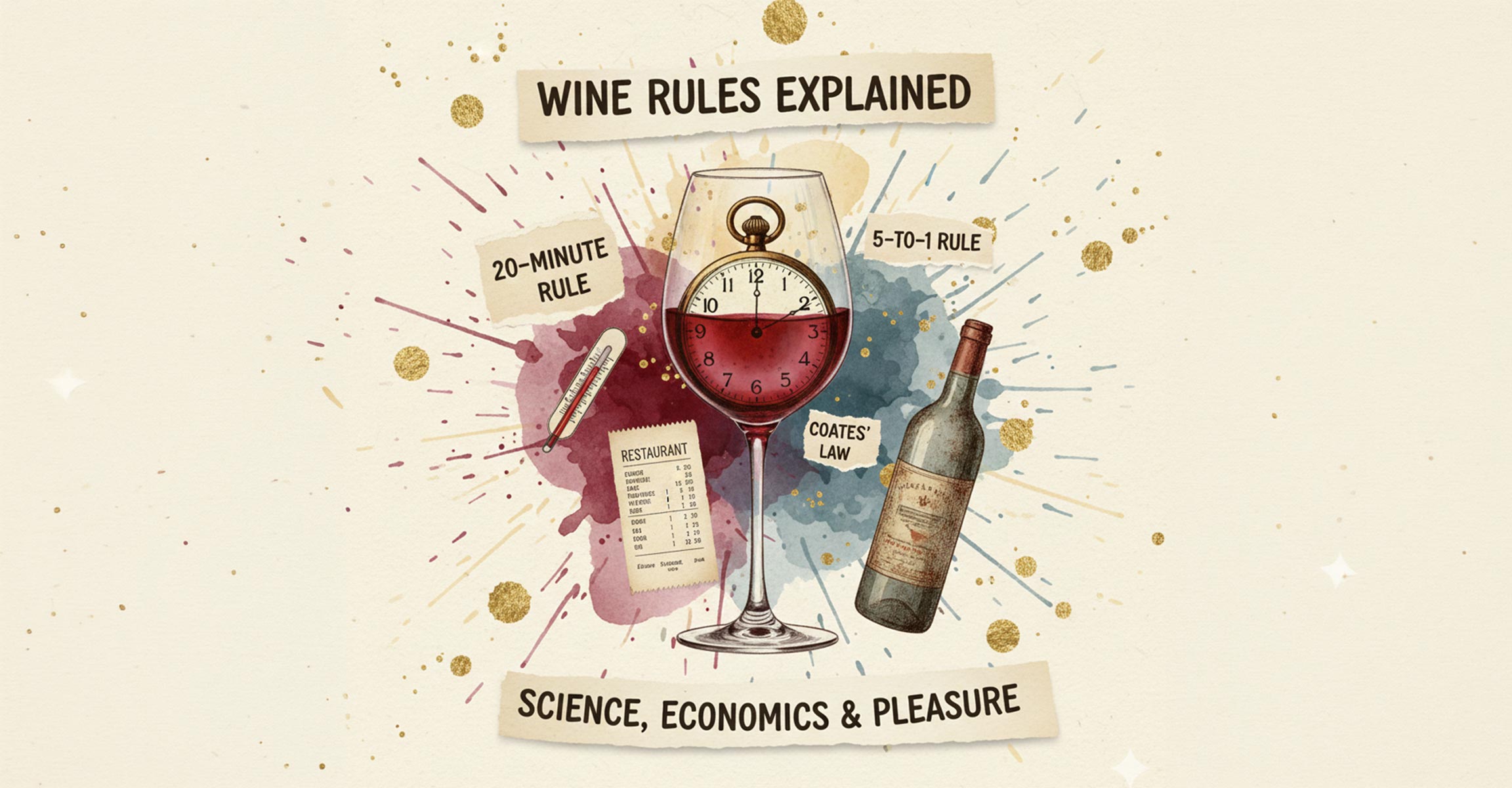
The 20-Minute Rule. The Simplest Upgrade You’ll Ever Make.
I’ve tested this more times than I can count. Pour the same Rioja at 22°C in a warm kitchen and it feels heavy, alcoholic, almost jammy. Drop it to 16°C and suddenly it tightens up. The fruit sharpens, the tannins feel cleaner, and the balance snaps into place. Same bottle. Completely different experience.
That contrast alone is why this rule matters.
Modern homes sit around 20 to 23°C. That’s far too warm for most reds and far too cold for most whites straight out of the fridge.
The fix is beautifully simple:
- Red wine: 20 minutes in the fridge before serving
- White wine: 20 minutes out of the fridge before pouring
Why it works:
When red wine is too warm, alcohol becomes overly volatile. You smell the burn before you smell the fruit. Cooling it slightly suppresses ethanol vapour and lets the fruit and structure show up properly.
When white wine is too cold, aromatics shut down. Esters and thiols don’t express themselves. Let it warm slightly and suddenly the citrus, floral and mineral notes wake up.
It’s the easiest way to improve almost any bottle. No decanter. No gadget. Just timing.
If you’re planning properly, use the 3-2-1 rule:
- 3 hours in the fridge for sparkling
- 2 hours for whites and rosé
- 1 hour for reds
Sparkling needs serious chill. Lower temperature reduces pressure and keeps the cork from trying to redecorate the ceiling.
Ageing. Or When to Stop Staring at It and Open It.
Most wine is made to be drunk within five years. Around 90 percent globally.
But for serious bottles, ageing follows patterns.
Coates’ Law of Maturity
Clive Coates MW, one of the most respected Bordeaux authorities of the modern era, proposed a useful rule: a wine stays at peak for roughly as long as it took to get there.
I’ve seen this play out firsthand with structured Bordeaux. A 2010 Left Bank tasted in 2018 was still tightly wound, all cassis and grip. Revisiting similar bottles closer to their fifteenth year, the tannins had softened, cedar and graphite had emerged, and the wine felt composed rather than forceful. That slow broadening into balance is exactly the arc Coates was describing.
If a Bordeaux peaks at 15 years, expect a plateau of similar length before decline. It’s rarely a sharp summit. It’s more of a table-top.
And here’s the key: your peak may not be mine. If you love primary fruit, open earlier. If you love tertiary leather and forest floor, wait.
The Rule of 15 for Structured Reds
Northern Rhône Syrah, Barolo, serious Cabernet. These wines often go through a dumb phase around 4 to 8 years where fruit fades but complexity hasn’t emerged.
The rule of thumb: give them 15 years.
By then tannins have polymerised, sediment forms, and the wine re-emerges with floral and savoury depth.
Patience isn’t romantic. It’s structural chemistry.
The 5 S’s. How to Taste Like You Know What You’re Doing.
There’s a reason professionals follow a sequence.
See
Look at colour and rim variation. Brick tones in red often suggest age. Deep purple usually signals youth and structure.
Swirl
This increases surface area and oxygen contact. It releases volatile aromatics.
Smell
Primary fruit. Secondary winemaking notes. Tertiary ageing character.
Sip
Assess acidity, tannin, alcohol, body. Professionals draw a little air across the wine to aerate further.
Savour
The finish is everything. Length often correlates with quality.
Decanting. Not Just for Drama.
Young, tannic reds benefit from oxygen. Thirty to sixty minutes is a safe rule. Some big vintages can take more.
Old wines are different. Decant immediately before service to remove sediment. Then drink. Extended oxygen exposure can collapse fragile aromatics.
And yes, candle decanting exists for a reason. Watching sediment approach the neck isn’t theatre. It’s precision.
Restaurant Economics. Read the List Like a Pro.
Having worked with hospitality and premium wine clients through my agency over the years, I’ve seen firsthand how wine lists are engineered. Margins, positioning and behavioural psychology are as much a part of the list as terroir and tannin. Understanding that commercial architecture doesn’t make you cynical. It makes you smarter.
This is where things get interesting.
The 5-to-1 Rule
In many restaurants, the price of one glass equals the wholesale cost of the bottle.
If the bottle cost £15 wholesale, the glass might be £15.
Five glasses per bottle means the first glass covers inventory. The next four generate gross profit.
Which means:
- Two glasses each? Buy the bottle.
- Value often improves higher up the list.
The Second-Least-Expensive Trap
Many diners avoid the cheapest bottle to avoid looking frugal.
So restaurants often load margin into the second-cheapest option.
If you want value, go slightly higher. Markups usually compress as wholesale cost rises.
The sweet spot is often mid-tier or even premium selections.
Understanding the economics doesn’t ruin the romance. It sharpens your choices.
Pairing. It’s Chemistry, Not Snobbery.
Three rules solve most pairing dilemmas.
Acid needs acid
High-acid food kills low-acid wine. Pair vinaigrette or tomato dishes with Sauvignon Blanc or Riesling.
Tannins love fat
Protein binds tannins, softening them. Steak makes Cabernet feel silkier.
Sweet balances heat
Spicy food and high alcohol amplify burn. Off-dry Riesling with lower alcohol calms things beautifully.
And remember: dessert wine must be sweeter than the dessert. Otherwise the wine tastes sour.
Storage. The 55/70 Rule.
At home, I store my better bottles in a temperature-controlled cabinet set to 12°C with humidity hovering around 65 to 70%, which mirrors the standards used by professional bonded warehouses. The key isn’t perfection. It’s stability. The fewer fluctuations, the better the long-term evolution.
For long-term storage:
- 13°C (Some argue 12º)
- 70% humidity
Stability matters more than perfection. Temperature swings cause expansion and contraction, weakening seals.
Store cork bottles horizontally. Screw caps don’t care.
And light is the enemy. UV can create sulphur compounds in white and sparkling wines. Darkness wins.
Health and Moderation
A standard serving is 150ml at around 12% ABV. Roughly 14 grams of alcohol.
Alcohol can affect blood sugar regulation, especially when consumed without food. For those managing glucose levels, the medical Rule of 15 applies: 15 grams of fast-acting carbohydrate, wait 15 minutes, retest if needed.
Wine is pleasure. It’s also chemistry. Respect both.
This article is for educational purposes only and is not medical advice. If you have specific health concerns, are managing conditions such as diabetes, or are unsure how alcohol may affect you, seek guidance from a qualified healthcare professional.
Service Etiquette. Quiet Precision.
Good service is choreography.
- Offer no more than three suggestions.
- Describe wine in three clear descriptors.
- Serve clockwise after host approval.
- Keep the label visible.
- Twist the wrist slightly at the end of the pour to prevent drips.
It’s subtle theatre with structural intent.
The Big Picture
From the 20-minute rule to Coates’ maturity curve, from tannin polymerisation to restaurant markups, wine follows patterns.
Understand the patterns and you gain control.
Chill your reds slightly.
Warm your whites slightly.
Buy the bottle if you’re having two glasses.
Give serious wines time.
Match acid with acid.
Let tannins meet protein.
Behind the romance is science. Behind the science is pleasure.
And when both align, that’s when wine stops being a drink and becomes an experience.
Cheers.